
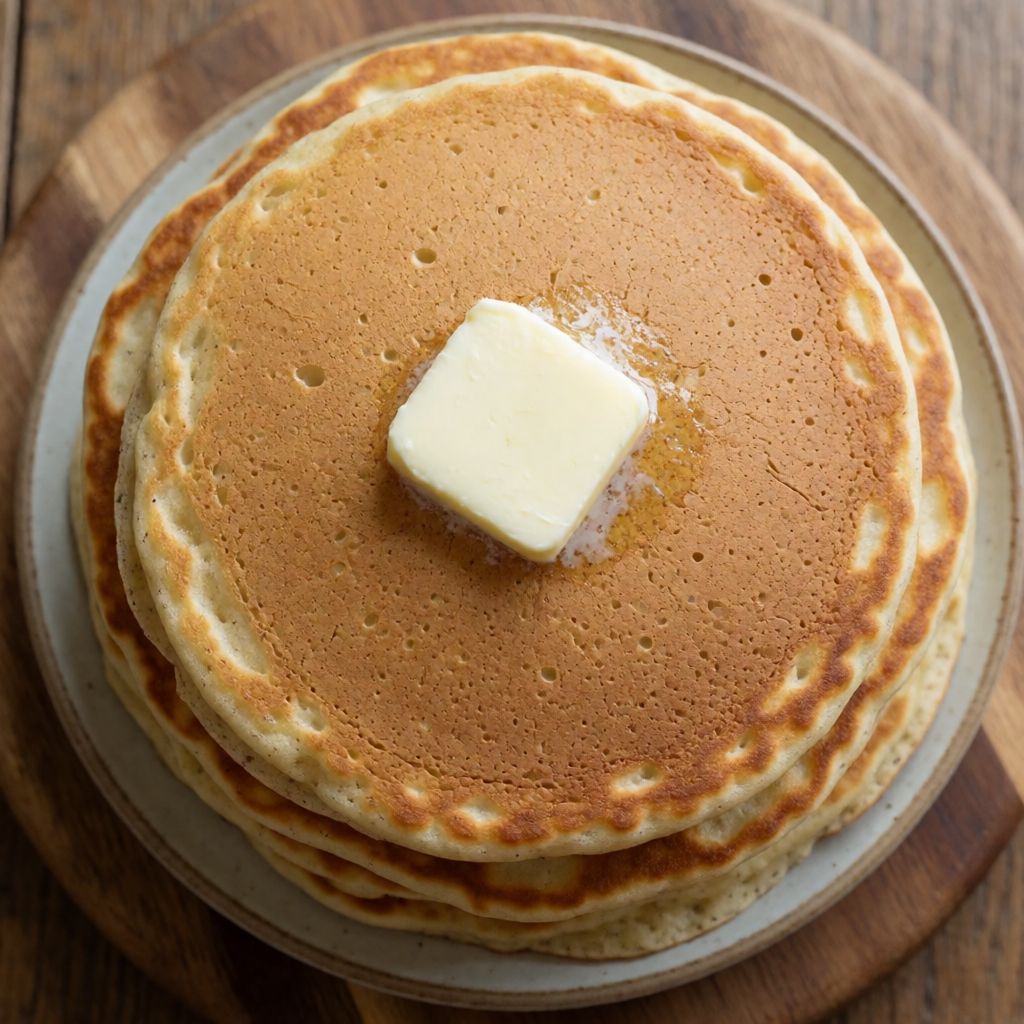
 AI photo
Gluten-Free Pancakes
Light, delicate gluten-free pancakes made with rice flour, milk and eggs — perfect with your favourite filling.
Labels are worked out automatically from the ingredients and can be wrong. Check the packaging if it matters to you.
Ingredients
- 150 g Rice Flour
- 250 ml Milk
- 3 pcs Eggs
- 40 g Butter
- 1 pinch Salt
- 1 tsp Vanilla Extract





Steps
In a large bowl, combine the rice flour, vanilla extract and salt, and mix well.
Add the milk and keep whisking so no lumps form.
Add the eggs one at a time, mixing the batter thoroughly after each one.
Cover the bowl with cling film and chill in the fridge for about 30 minutes to let the batter rest.
30 minHeat a non-stick frying pan and melt the butter in it.
Pour the batter into the pan with a ladle, tilting the pan slightly so it spreads evenly.
Flip the pancakes so they cook on both sides — about 1 minute per side.
1 minRepeat until all the batter has been used.
The gluten-free pancakes are ready — serve with your favourite filling.
What was changed
Vanillin has been replaced with Vanilla Extract, as vanilla extract is the flavouring commonly found in UK kitchens.
This is a crêpe — the thin, foldable kind British households already know from Pancake Day — made without a gram of wheat. In a normal crêpe, wheat isn't just "the flour," it's the thing that lets you spin the batter paper-thin and flip it without it tearing: gluten forms an elastic sheet when you whisk it. Take the wheat out and that sheet is gone. So this whole recipe is really an answer to one question — what holds a gluten-free crêpe together — and the answer is eggs.
Three eggs to 150 g of rice flour is a lot, more than any wheat crêpe batter would ask for. Egg protein sets firm in heat, and it's doing the gluten's old job: gluing the rice starch into a sheet instead of a scatter of grit. That changes how you work at the pan, too. Once the egg touches hot butter it starts to set almost at once, so your window for tilting the pan and spreading the batter thin is the first couple of seconds after it lands — not a leisurely swirl. Pour, tilt, done. Hesitate and you get a thick patch in the middle and a thin tear at the edge.
Some say gluten-free batter needs a gum — xanthan, guar, something from a packet — to hold itself together. Not here. The egg is already carrying that weight, as long as there's enough of it and the batter has had time to do its other job: hydrate.
Rice flour: buy the fine, baking kind, not the coarser flour sold for dusting work surfaces — coarse grains don't hydrate evenly in 30 minutes and you'll bite into sand. If you've only got a gluten-free flour blend in the cupboard, it'll work, but it carries other starches (potato, tapioca) that gelatinise differently and can leave the crêpe slightly rubbery rather than tender — not wrong, just a different crêpe.
Milk: whole milk brings fat, and fat is what keeps a thin pancake supple rather than cardboard-stiff once it cools on the plate. Semi-skimmed works, oat milk works — but with less fat in the liquid, lean on the eggs a little harder; if the rested batter looks thin and runny rather than coating the back of a spoon, beat in an extra egg white before you start frying.
Eggs: this is the load-bearing ingredient, not a seasoning. UK large eggs are the assumption here. If your batter, after the rest, still looks loose and tears when you try to lift a test corner with a spatula, the fix isn't more flour — more flour just brings back the grit problem — the fix is another egg.
Butter: it does two things at once — it stops the fragile, gluten-free sheet sticking and tearing on the way out of the pan, and it browns very slightly, which a crêpe without wheat badly needs, because wheat crêpes get some of their flavour from browning gluten proteins that aren't present here. Heat the pan, drop the butter in, and wait for the foam to rise and then go quiet — that's your cue to pour, not a clock. If the butter browns hard and smells nutty before you've even poured, the pan's too hot and the next crêpe will catch before it sets evenly; wipe it out and start the butter again rather than pour onto a too-hot surface. Any fat with no flavour of its own will do the non-stick job — sunflower oil, a flavourless oil-spray — but you lose that faint toasted-butter note, which is most of what these have instead of wheat's own flavour.
Salt and vanilla are there to correct each other — the salt stops the vanilla tasting flat and sugary, the vanilla stops the salt tasting like a savoury dish gone wrong. If you're filling these with something savoury — ham, cheese, the usual Sunday leftovers — drop the vanilla and it won't be missed.
On the pan itself: use non-stick, genuinely non-stick, because a gluten-free sheet has none of wheat's elasticity to forgive a sticking spot — it just tears. A domestic hob won't hold one steady heat the way a dedicated crêpe plate does, so expect the first one or two to be a write-off while the pan finds its temperature; that's normal, not a failure of the recipe. From this amount of batter expect around eight thin crêpes, plate-sized or a touch smaller depending on your pan — two each is a fair Sunday brunch for four. And don't shortcut the rest to save time: the patience here isn't decoration, it's the step doing the actual chemistry.