
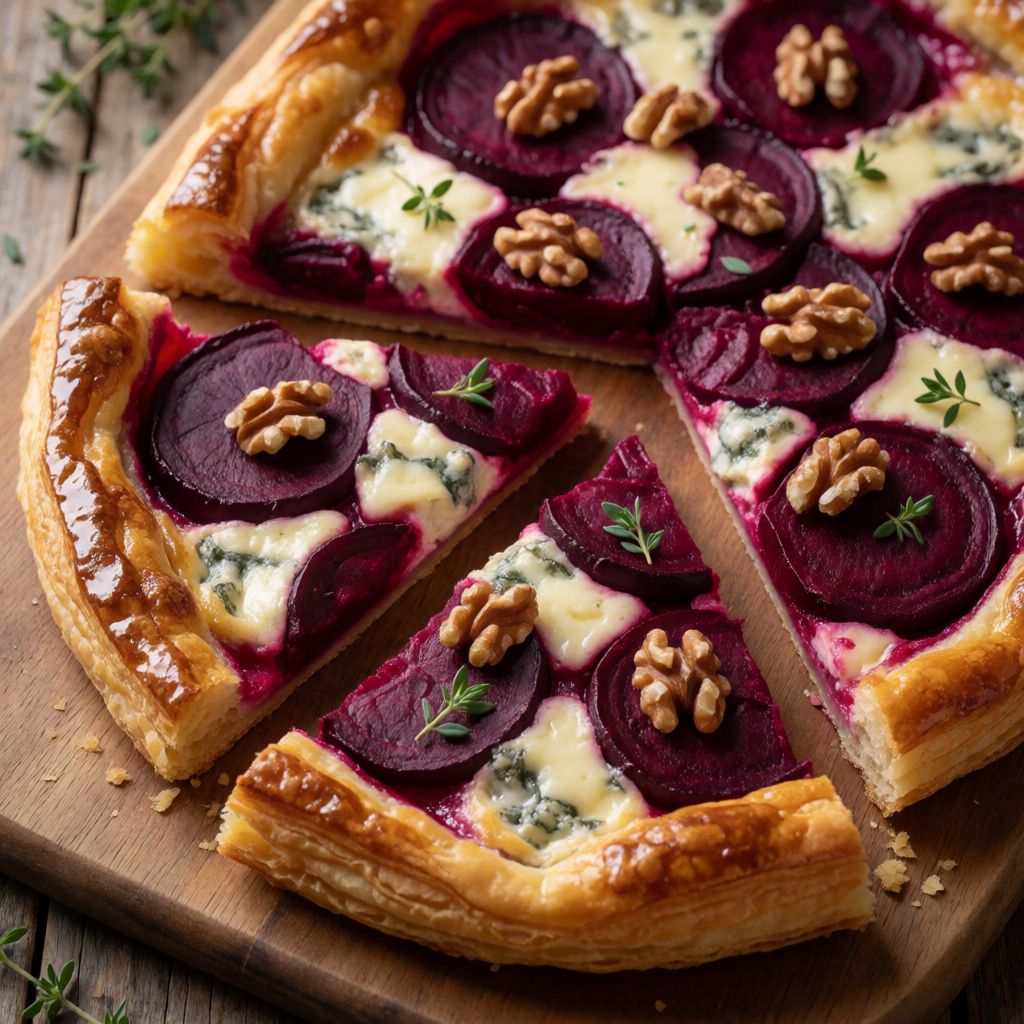
 AI photo
Beetroot and Gorgonzola Tart
A savoury puff pastry tart with beetroot, creamy gorgonzola and walnuts.
Labels are worked out automatically from the ingredients and can be wrong. Check the packaging if it matters to you.
Ingredients
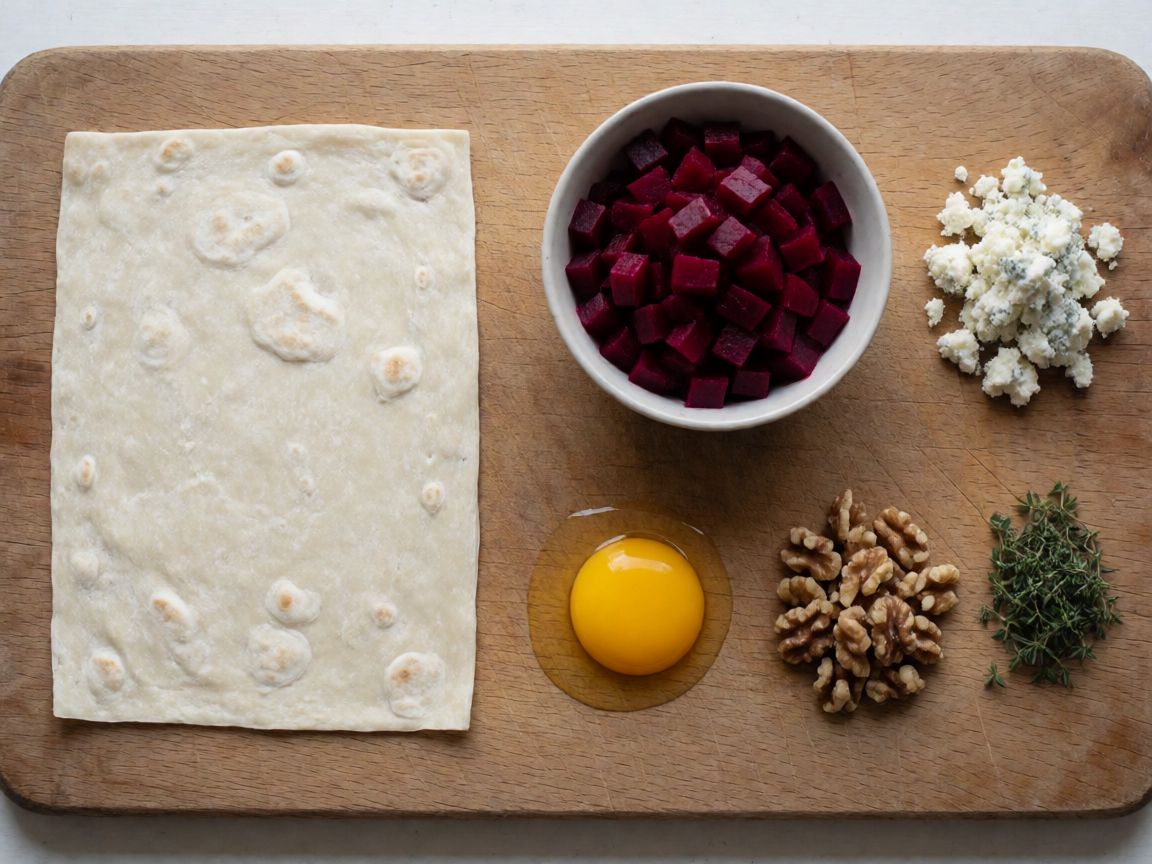
- 1 pcs Ready-rolled puff pastry
- 150 g Beetroot
- 200 g Gorgonzola dolce
- 1 pcs Egg yolk
- Walnuts to taste
- Thyme to taste
- Salt to taste
- Black pepper to taste







Steps
Unroll the ready-rolled puff pastry together with its parchment paper and place it on a baking tray.
Cut the beetroot into small pieces and spread them evenly over the pastry.
Dice the gorgonzola dolce and scatter it over the beetroot, then add the roughly chopped walnuts.
Sprinkle everything with salt, thyme leaves and black pepper to taste.
Preheat the oven to 200°C, conventional, not fan.
Fold the edges of the pastry inward and brush them lightly with beaten egg yolk.
Bake the tart for 20 minutes.
20 minLet the tart cool slightly and serve warm.
This isn't a quiche. There's no egg-and-cream custard binding it — what holds this tart together is cheese fat, gravity, and a folded rim of pastry. It's closer to a free-form galette than a pie: open-faced, rustic, meant to be a bit uneven at the edges.
What decides whether it works is how thin you cut the beetroot. Twenty minutes at a flat 200°C is enough to melt gorgonzola into cream and push the puff pastry up in its layers — but raw beetroot is dense, and only pieces cut matchstick-thin or coin-thin will go from squeak to soft in that window. Cut it thick, and you get burnt pastry wrapped around a crunchy, raw-tasting core. The dish doesn't forgive a thick dice here.
Some say beetroot must always be boiled first — no, because that rule belongs to a different job. A whole root needs an hour of simmering to push heat into its thick centre. Here you're not cooking a root, you're cooking confetti of root, surrounded by fat that conducts heat fast and keeps it moist. Different task, different clock.
The fold at the edge isn't decoration. Folding the pastry inward builds a double wall that rises taller than the flat centre, and that doubled dough becomes the dam holding the cheese in as it turns liquid in the heat. It also browns deeper, because there's twice the dough to catch colour. That's the frame you're meant to see on the plate: a dark gold rim around a softer, paler middle.
Start with the pastry. A ready-rolled puff from the chiller is fine — look for one made with butter rather than a vegetable-fat blend if you have the choice, because butter laminates hold their shape and crispness better once wet toppings sit on them. Keep the parchment it comes rolled in and slide the whole thing onto the tray on that paper. There's no tin here, no kazan, nothing to hold the shape for you — the paper is doing the job a proper vessel would, letting you move the sheet without tearing it or welding it to the tray.
Beetroot is where this recipe can quietly go wrong for a British kitchen, because the beetroot sold ready in vacuum packs in most supermarkets here is already cooked, sitting in its own faintly vinegared liquid. That's a different ingredient from raw beetroot. Raw beetroot, cut thin, releases its own moisture slowly as it heats, which is what lets it half-steam under the cheese and finish soft rather than dry. Pre-cooked vac-packed beet is wetter from the start and carries a vinegar edge — usable, even good if you like that sharpness, but cut it the same thin way, and expect a slightly different, tangier result, not a worse one.
Gorgonzola dolce is the young, soft version of the cheese — high moisture, low salt sting, and it collapses into cream rather than staying in lumps once it meets heat. Gorgonzola piccante, the firmer aged one, won't melt the same way and will read saltier against the beetroot's sweetness. The actual criterion for a substitute is simple: any blue cheese soft enough to slump under heat rather than hold its shape. Dolcelatte, sold everywhere in the UK, does the job. A young, mild Stilton loosened by its youth works too, though it will sit a touch drier.
Walnuts go in raw and roughly broken, not ground — the oven's heat is enough to warm their oil and round off the rawness, you don't need to toast them separately first. If you want a deeper, more roasted nut flavour, a dry pan for a minute before scattering them on won't hurt, but it's an addition, not a correction of a fault.
The egg yolk, brushed only on the folded rim, is there for colour, not for structure. Yolk alone — no white — carries more fat and lecithin, and that's what gives a tart its deep, glossy gold rather than a pale, patchy brown. Historically this is also the economical choice: when a cook had yolks left over from another dish needing whites, brushing pastry was where they went. If you only have a whole egg to spare, use it — the rim will still brown, just a shade lighter and less even.
On the oven: conventional, not fan, because a fan oven moves air and effectively runs hotter and drier on an open, uncovered surface like this one. If your oven only has a fan setting, don't trust the twenty minutes as written — watch instead for the pastry to puff and the rim to turn a deep gold, and for the cheese at the centre to have gone from a solid wedge to something slumped and faintly bronzed at the edges. That's the real clock. And once it's out, give it a few minutes before cutting — the cheese needs that pause to go from liquid to spoonable, and the beetroot stops bleeding colour onto the plate. Patience here isn't optional, it's the last ingredient on the list, just not written down.