
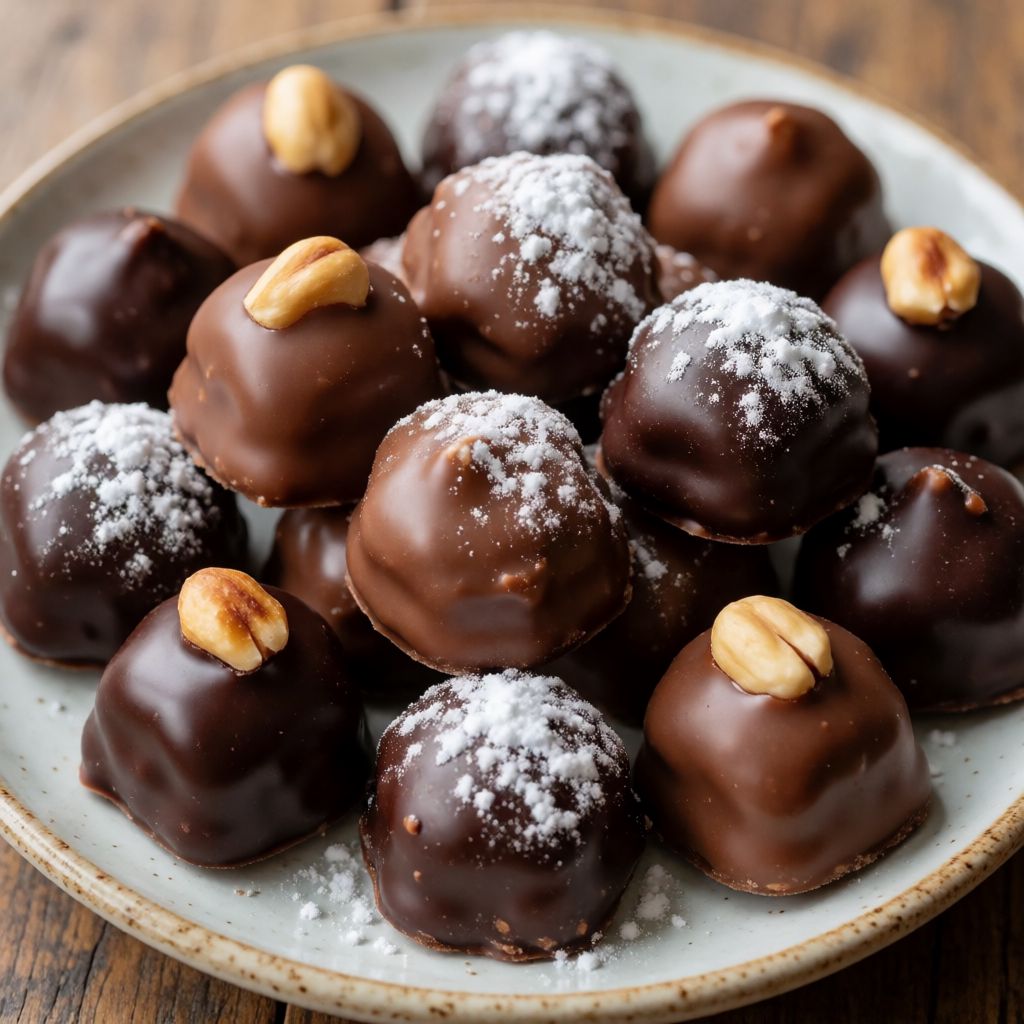
 AI photo
Chocolate Hazelnut Praline
A rich homemade chocolate and hazelnut praline, left to set overnight for a smooth, melt-in-the-mouth treat.
Labels are worked out automatically from the ingredients and can be wrong. Check the packaging if it matters to you.
Ingredients
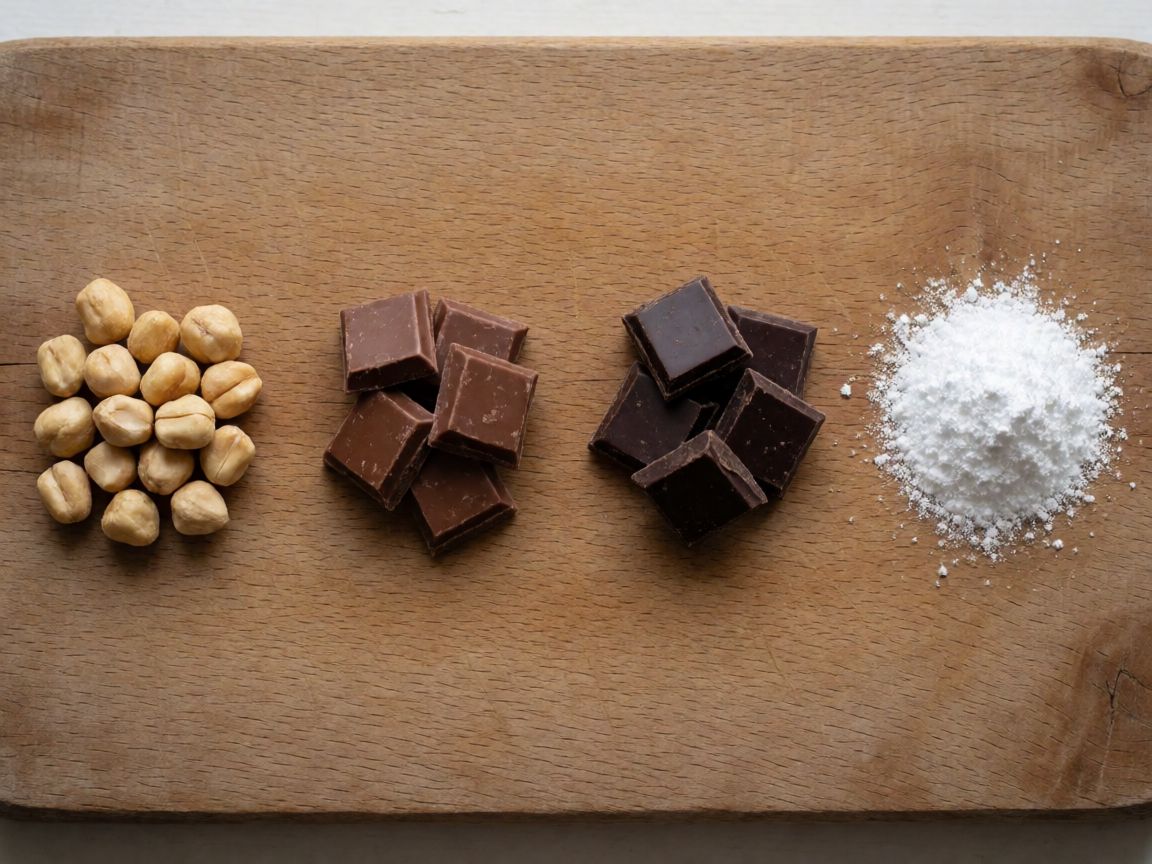
- 100 g Hazelnuts kernels
- 125 g Milk chocolate
- 50 g Dark chocolate
- 50 g Icing sugar

Steps
Toast the hazelnut kernels in the oven at 150°C fan for about 10–15 minutes, until the skins start to crack.
15 minTip the hazelnuts onto a clean tea towel and rub to remove the skins.
5 minPut the hazelnuts into a food processor and blend thoroughly until you get a smooth, delicate nut paste.
10 minMelt the chocolate in a bain‑marie over low heat.
5 minAdd the icing sugar and melted chocolate to the nut paste in the processor and blend until smooth.
5 minLine a small tin with baking parchment and pour in the mixture.
5 minLeave to set until the next day.
480 min
What you are making here is not, strictly, a praline in the old sense. A classic praline is caramelised nuts — sugar taken past melting into amber, nuts stirred through, crunch intact. This is something else: a gianduja. Hazelnuts ground until they give up their oil and turn into a soft paste, chocolate folded in to set the whole thing into a bar. Some call any chocolate-and-nut block a praline — no, because the name describes a technique, not a flavour, and the technique here is grinding, not caramelising. It matters only because it tells you what to watch for: not a crisp shell, but a paste that sets smooth and gives slightly under the thumb.
The whole thing stands or falls on two moments. First: how far you push the hazelnuts in the processor. Stop too early and you have crumbs with chocolate stuck to them. Keep going — past the grainy stage, past the point where it looks like wet sand — and the friction itself warms the nuts enough to break the cell walls and let the oil out. That oil is what carries the chocolate and lets the bar cut clean instead of crumbling. Second moment: the chocolate must melt without a single drop of water near it. Steam heat, not direct flame, not a wet spoon — because water meeting melted chocolate makes the sugar in it clump into grit almost instantly. People blame scorching for grainy chocolate. Usually it is water, not heat.
Hazelnuts are the whole point, not a filler. They carry more oil, weight for weight, than almonds or walnuts, which is exactly why Piedmontese confectioners reached for them in the first place — not out of love of hazelnuts specifically, but because cocoa was scarce and expensive under the Continental Blockade, and hazelnuts grew right there in the hills around Turin. Stretching costly chocolate with cheap local nut paste wasn't an indulgence, it was economics. That habit became gianduja, and gianduja became what you're making now. If you have no hazelnuts, any oil-rich nut will do the same job — almonds, even macadamia — but the flavour and the history both point to hazelnut, so don't swap it lightly.
Toasting at 150°C fan isn't about colour, it's about the skin. Heat dries the thin brown membrane until it goes brittle and lifts away from the kernel — that's the crack you're watching for, not a timer. Toast too far past that and the oil inside starts to turn bitter before you've even got to the processor; too little, and the skins cling on, rubbing off half-heartedly and leaving tannic, papery bits that taste bitter in the finished bar. The tea towel rub only works because the toasting has already done the work — try it on raw nuts and you'll be there all afternoon for nothing.
The chocolate is two chocolates for a reason, not a flourish. Milk chocolate alone sets soft and sweet, almost fudgy; dark alone sets firm but can taste flat and bitter against the hazelnut. Splitting it 125g to 50g gives you both: enough cocoa butter from the dark to firm the bar up, enough milk solids and sugar from the milk chocolate to keep it from tasting austere. If you only have one kind in the cupboard, lean toward dark and add a touch more icing sugar to balance it, or lean toward milk and accept a softer set — just know which trade-off you're making.
Icing sugar is specified, not caster, and that's not fussiness. Caster sugar is still a crystal; dropped into a cold, fatty paste with no heat source to dissolve it, it stays a crystal, and you'll feel it as grit between your teeth. Icing sugar is already ground fine enough to disappear into fat without ever needing to be heated or stirred into a syrup. If you only have caster, you'd need to dissolve it into the melted chocolate while it's still properly hot and liquid, then let it cool slightly before mixing with the nut paste — more fuss, same result if you're careful.
The parchment-lined tin is just there to let you get the set block out in one piece — nothing clever, just common sense for a domestic kitchen with no proper mould. And the overnight wait is the one ingredient with no substitute. You can't speed-chill this in a freezer and expect the same texture; fast-cooled fat sets unevenly, sometimes streaky, sometimes soft in the middle no matter how firm it looks on top. Patience here isn't virtue for its own sake — it's literally what turns a bowl of melted paste into something you can slice. A tin this size, cut into small squares, will do a dozen or more people a modest sweet with their tea after Sunday lunch — this is not a single serving, whatever the recipe card says.