
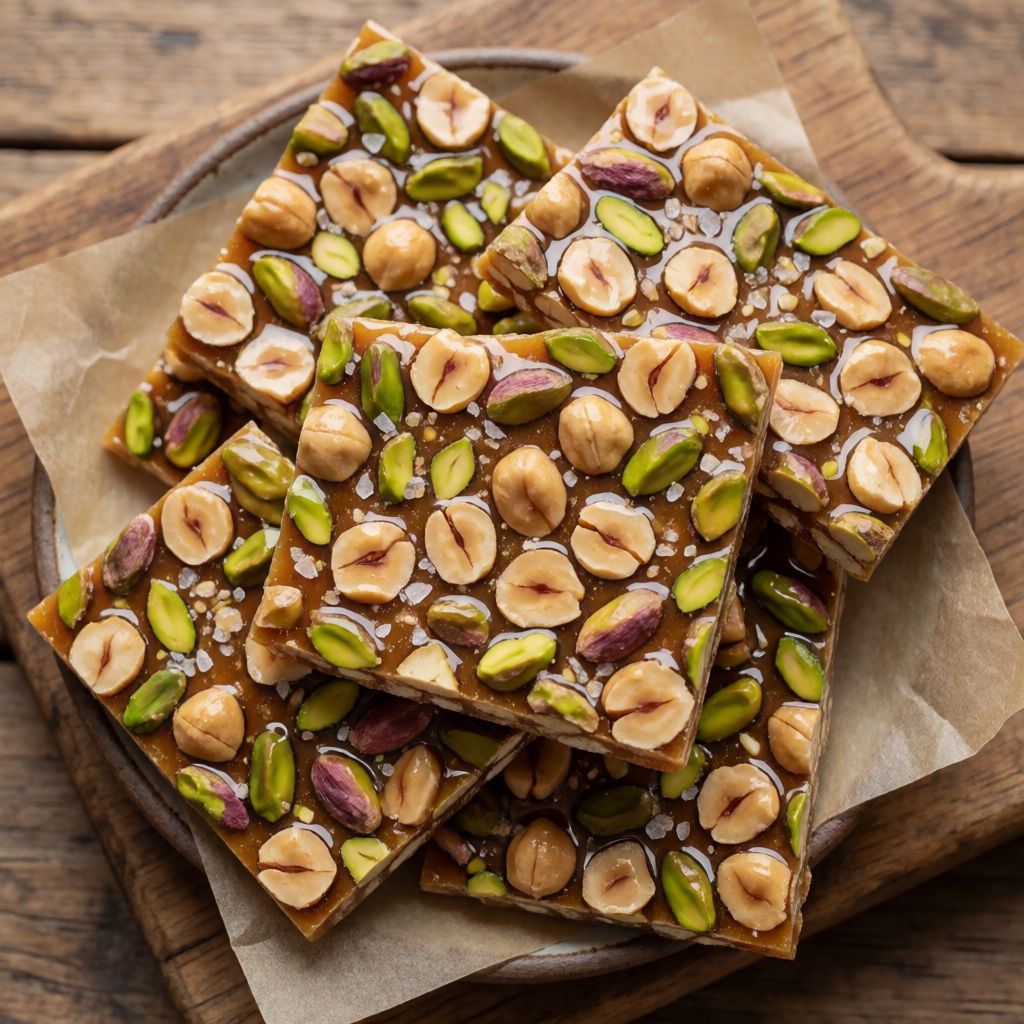
 AI photo
Salted Hazelnut & Pistachio Brittle
A crunchy homemade caramel brittle studded with chopped hazelnuts and pistachios.
Labels are worked out automatically from the ingredients and can be wrong. Check the packaging if it matters to you.
Ingredients
- 75 g Hazelnuts finely chopped
- 50 g Pistachios finely chopped
- 150 g Sugar
- 25 g Butter
- 100 ml Water boiling
- 30 g Glucose Syrup
- 1 tsp Salt flaky, for sprinkling





Steps
Place the hazelnuts in a frying pan and warm over medium heat, stirring, until the skins start to crack.
5 minWrap the nuts in a clean cloth and rub to remove the skins. Finely chop the hazelnut kernels and pistachios.
5 minWipe the pan dry and let it cool.
2 minPut the sugar in the pan and heat over medium heat until it slowly melts.
5 minAdd the butter and stir until the mixture sizzles.
2 minReduce the heat and, stirring, pour in the boiling water and glucose syrup; keep stirring until you get a thick caramel at about 130°C.
10 minSpread the caramel onto baking parchment, smooth into a thin layer, then sprinkle with flaky salt and the chopped nuts.
5 minLet the caramel cool, then break into rustic shards.
5 min
What you're making here is sugar glass with nuts set inside it — not a sauce, not a fudge, a genuine amorphous solid. You boil a sugar solution until almost all the water is driven off, and when it cools fast enough the sucrose molecules have no time to line up into a crystal lattice. They freeze into disorder instead — that disorder is why it shatters clean rather than bending or smearing. Fudge is the same sugar gone wrong on purpose: crystallized, soft, grainy. Brittle is sugar gone right: no crystals, no give.
The one moment that decides everything is the colour of the caramel in step 6, not the ten minutes the recipe gives you as a floor. Pull it too pale and there's still water trapped in there — it cools soft and chewy, sticks to your teeth, disappoints. Push it past a warm amber into dark brown and the sugar itself starts breaking down into bitter compounds that fight the nuts instead of framing them. You're aiming for the colour of good whisky, in a pan you watch, not one you walk away from. 130°C is the number on paper; in a flat with no sugar thermometer, drop a bead of it into a cup of cold water — if it sets hard and snaps, you're there; if it's soft and pulls like toffee, give it another minute.
Hazelnuts first, because they take the longest and need the most attention. The point of warming them in the pan isn't flavour alone — heat makes the skin expand faster than the kernel underneath, so it cracks and lifts away. That's why you're listening and watching for the skins splitting, not counting to five minutes blind; nuts vary, pans vary. Rubbing them in a cloth afterwards isn't fuss for its own sake — hazelnut skin carries real bitterness (it's where most of the tannins sit), and leaving it on is the quiet reason a brittle tastes "off" without anyone being able to say why. Pistachios you leave as they are; their skin is thin and doesn't carry the same bitterness, which is also why they go in raw and chopped while the hazelnuts are still being peeled. If hazelnuts aren't to hand, almonds or cashews work on the same logic — any dense, oily nut that holds a crunch and doesn't go soft with moisture. Walnuts and pecans are too soft and too bitter-skinned for this; they'll sulk.
Sugar is the whole architecture, and plain white granulated is correct here precisely because it's pure sucrose with nothing else competing for space in the crystal lattice — no molasses, no moisture, no stray minerals to seed crystallization early. This is also where the old warning comes from, that you must never stir caramelizing sugar. Half true. Before the sugar has fully melted, dragging grains through liquid syrup can scrape dry crystals back into it and start a chain reaction of recrystallization — that's the real mechanism, not some superstition about caramel being temperamental. Once it's a smooth melt, stirring is not just safe, it's necessary, so the heat doesn't scorch one patch while the rest sits pale.
Glucose syrup is the thing standing between you and fudge. Sucrose molecules are uniform and happy to stack into crystals the moment they get a chance to cool slowly; glucose syrup is a mixed bag of different sugar molecules of different shapes, and they physically get in the way of that stacking. No glucose syrup in the cupboard — golden syrup does the same job, or light corn syrup if that's what's on the shelf; even a few drops of lemon juice work by a different route, breaking some sucrose down into the same kind of mixed, disorderly sugars before it ever gets the chance to crystallize.
The boiling water in step 6 matters for a reason that has nothing to do with taste: pour cold water into sugar sitting near 160°C and you get a violent, spitting reaction as it flashes to steam, and often a seized, lumpy mass instead of a smooth caramel. Boiling water meets the hot sugar closer to its own temperature, so the shock is gentler and the syrup stays liquid and workable. The butter before it does something similar at a smaller scale — it's mostly fat with a little water in it, and that water sizzling off is what tells you it's incorporated rather than sitting on top as an oily film. Any butter works; if you're using a spread instead, expect more water and less structure, because spreads are built to stay soft in the fridge, not to behave like fat under heat.
Salt on top isn't seasoning in the usual sense — sugar in large quantities mutes its own sweetness to the tongue unless something sharp interrupts it, and flaky salt sitting on the surface (not stirred in) gives you that interruption in bursts rather than evenly, which is why flaky salt and not fine table salt. Fine salt would dissolve into the warm caramel and vanish; flaky salt sits there and crunches.
On equipment: forget a sugar thermometer if you don't own one, the cold-water test above will tell you the truth just as well. Use the widest, flattest pan in the cupboard rather than a tall saucepan — sugar caramelizes more evenly spread thin than pooled deep, and a wide pan lets steam escape instead of condensing back in. No marble slab for cooling, obviously; a sheet of baking parchment on a cold worktop does the same job in a British kitchen, it just cools a little slower, so work quickly once you pour.
The ingredient the recipe doesn't list is patience, and it's the one that actually fails most often. Rushing the sugar melt scorches it in patches before the middle catches up; rushing the water-and-glucose stage means you pull it off before it's thick enough and get a toffee that never properly sets. Let it tell you when it's ready, by colour and by the way a drop behaves in cold water, not by a clock. The quantities here make one full tray — plenty to break into a dozen shards for an afternoon of tea, despite what the serving count says.