
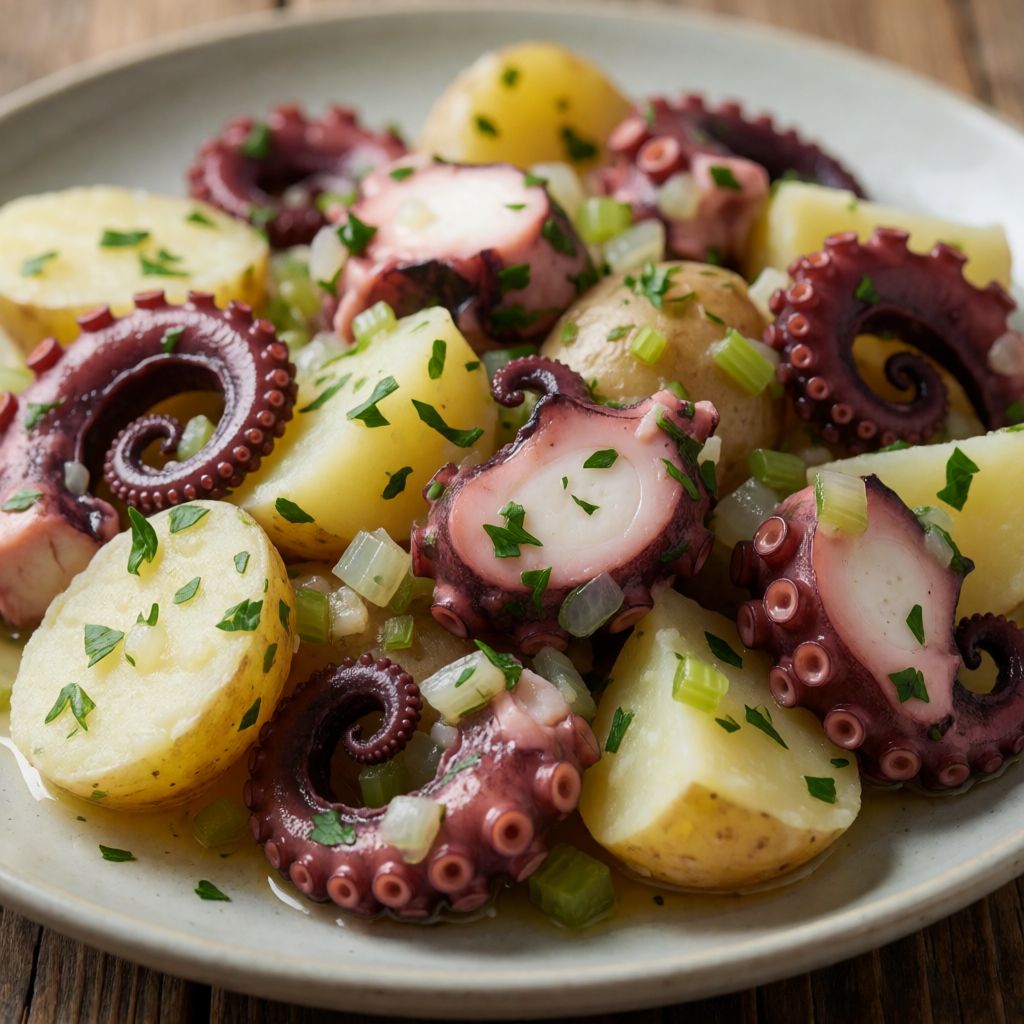
 AI photo
Octopus with Potatoes
A classic octopus and potato salad, dressed with olives, chilli, garlic and lemon.
Labels are worked out automatically from the ingredients and can be wrong. Check the packaging if it matters to you.
Ingredients
- 1 pcs Octopus 1-1.2 kg
- 2 pcs Lemons, juiced
- 1 pcs Celery stick
- 1/2 pcs Onion
- 1 bunch Parsley
- 1 pinch Salt
- 100 g Green olives, pitted
- 1 tbsp White vinegar
- 1 pcs Fresh chilli pepper
- 2 clove Garlic
- 6 pcs Potatoes
- 2 tbsp Olive oil










Steps
Clean the octopus thoroughly. Bring a large pot of water to the boil, add the celery, onion and garlic. When it boils, dip the octopus in three times, holding it by the head.
Fully submerge the octopus in the water and simmer gently.
45 minCover and continue simmering gently for even cooking. It is ready when the thickest part reaches 63°C.
Leave the octopus in the cooking liquid to cool.
Boil the potatoes in their skins in salted boiling water.
20 minIn a bowl, coarsely chop the fresh chilli, then add the garlic, olives, parsley, white vinegar, lemon juice, salt and olive oil.
Peel the potatoes, cut into cubes and add to the bowl.
Rinse the octopus and remove any excess skin.
Cut the octopus into small pieces, add to the olives and potatoes, and mix well.
Slice the octopus head very thinly and add to the rest of the ingredients, mixing well.
Serve, shaping portions with a cooking ring, sprinkling with parsley and a drizzle of olive oil.
What was changed
Chilli flakes were swapped for Fresh chilli pepper, since the recipe chops it rather than sprinkling flakes.
Octopus with potatoes is a cold salad wearing a warm dish's reputation. The octopus is cooked once, gently, then left to sit in its own broth, and everything after that — the olives, the chilli, the lemon — is just dressing a thing that's already finished. What decides whether it works isn't skill, it's nerve: can you leave the pot alone for the better part of an hour and not touch the lid.
The first myth to break: "dip it in boiling water three times to make it tender." That trick doesn't tenderise anything — what it does is shock the skin so it doesn't split and shed its purple colour into the water the moment the flesh starts to cook. Tenderness comes later, from slow heat breaking down collagen, the same chemistry that turns a tough shin of beef into something you can cut with a spoon. Three dips just keep the octopus looking like an octopus instead of a grey rag.
The second myth, the stubborn one: "put a wine cork in the water." People have sworn by this for generations. It does nothing — cork has no enzyme that softens anything, and if it worked, every fishmonger in the Mediterranean would be rich on corks alone. What actually tenderises an octopus is time at a gentle simmer, full stop. If yours is small and young, it was always going to be tender. If it's a big old one, no cork on earth saves it — only patience does.
The octopus itself is the one ingredient you can't substitute your way out of — no squid or cuttlefish gives you that same dense bite once cooked properly, they're thinner-walled and turn to nothing in 45 minutes of simmering. Buy one that's already been frozen once if you can; freezing ruptures the muscle fibres and does a chunk of the tenderising job for you before it ever sees the pot, which is why Mediterranean cooks who can't be bothered with long cooking times often buy frozen on purpose. Fresh, never-frozen octopus from a British fishmonger is fine too, it just asks slightly more of your patience.
The aromatics in the poaching water — celery, onion, garlic — aren't there to flavour the octopus, which barely absorbs anything through that rubbery skin in an hour. They flavour the water, and the water flavours the dish back a little when you cool the octopus in it rather than draining it straight into the sink. Skip them if you're out, and you've lost very little; what you can't skip is the gentle heat, because a hard boil tears the skin off in strips and leaves you fishing purple shreds out of a rolling pot.
Potatoes boiled in their skins, not peeled first — that's not tradition for tradition's sake, it's physics. A peeled potato in boiling water is mostly surface area exposed to water, and it waterlogs, turning soapy and falling apart before the centre is cooked. The skin acts as a barrier, keeping starch and potato flavour in and excess water out, so you get a potato you can actually cube cleanly afterwards instead of mash. Any waxy or all-rounder potato works — King Edward, Maris Piper, whatever's in the Sunday-roast bag, since this isn't a dish precious about variety.
The dressing is built from things that want no cooking and no mellowing: raw garlic, raw chilli, vinegar, lemon, olive oil. Use an olive oil that actually tastes of something here — it's not a frying medium to be heated away, it's eaten raw in the final mix, so a bland bottle gives you a bland salad. If you've only got a flavourless vegetable or sunflower oil in the cupboard, that's the one place a substitution genuinely costs you something; there's no clever workaround for olive oil's bitterness and fruit in a dish built around it.
The olives and the vinegar are doing the same job from two directions: cutting through the richness of the oil and the slight fattiness of octopus skin with sharpness, so the dish doesn't sit heavy. Green olives specifically, because black ones bring a sweeter, oilier note that fights the lemon instead of backing it up — if you only have black, use fewer and add a touch more vinegar to compensate.
Cutting the tentacles into pieces but slicing the head thin and separate isn't fussiness — the head has a different texture, softer and less fibrous, and left in thick chunks it goes slippery rather than firm. Thin slices give you that texture in a bite-sized way without it dominating. And the cooking ring at the end — a biscuit cutter does the job just as well in a British kitchen — isn't restaurant showing-off, it's the only way a loose, oiled salad holds a tidy shape on a plate instead of looking like something that fell off a fork.