
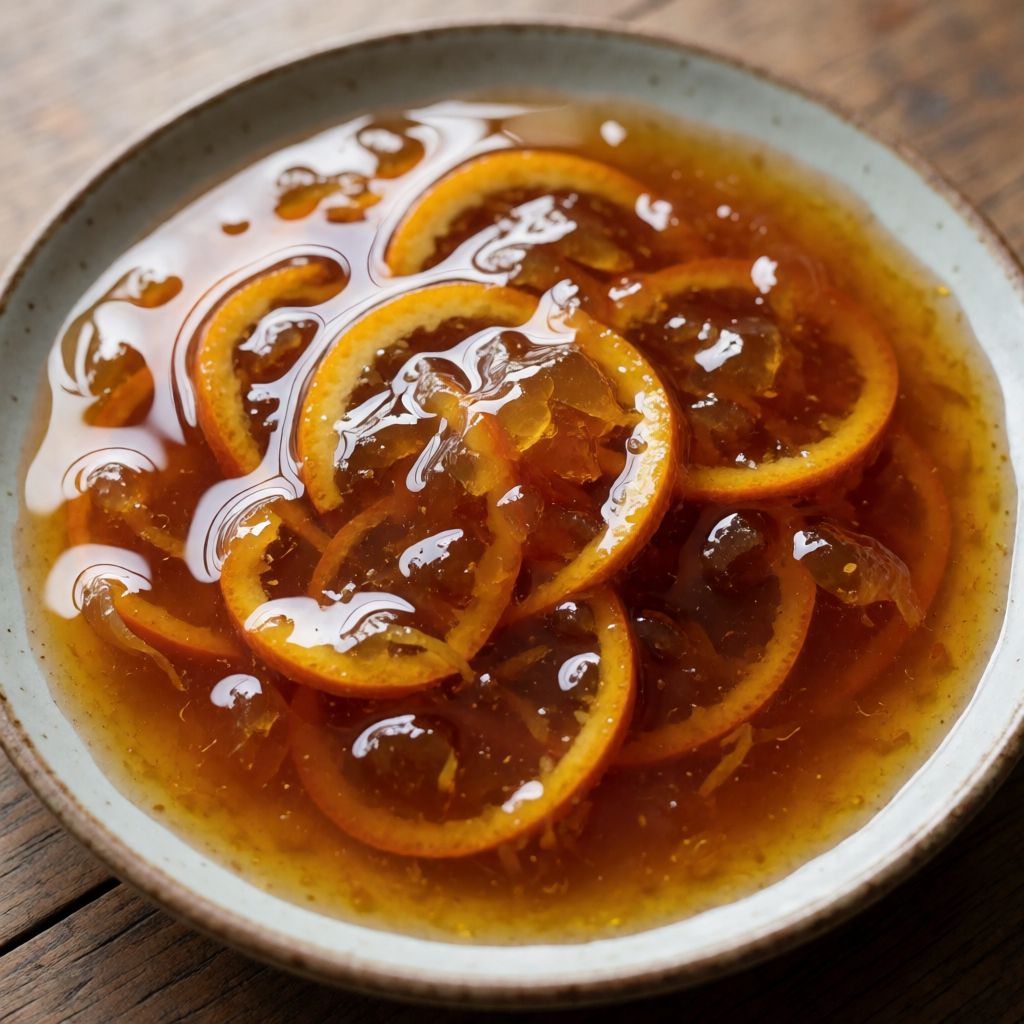
 AI photo
Bitter Orange Marmalade
A classic Seville orange marmalade with vanilla, simmered slowly until thick and spreadable.
Labels are worked out automatically from the ingredients and can be wrong. Check the packaging if it matters to you.
Ingredients
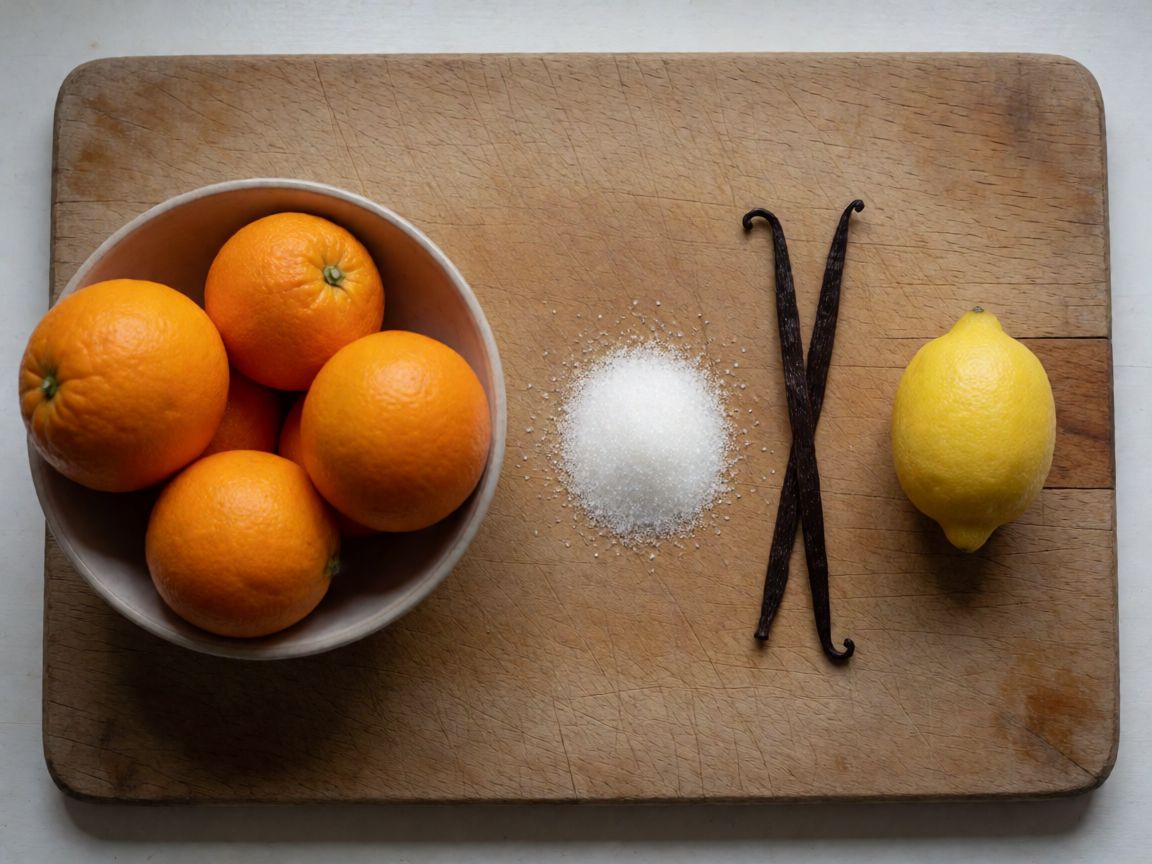
- 1 kg Bitter (Seville) oranges
- 800 g Sugar
- 2 pcs Vanilla pods
- 1 pcs Lemon
- 2 l Water





Steps
Wash the oranges and slice them thinly, then place them in a pot with the sugar and vanilla pods.
Set the pot over a low heat and let the sugar dissolve.
Add the water and lemon juice, then bring to a boil.
Cover with a lid, reduce the heat to low, and simmer for about 1 hour, stirring occasionally.
60 minIf you like, cook for a further 15–20 minutes for a thicker set, taking care it does not catch.
Spoon the hot marmalade into sterilised glass jars.
Check the seal by pressing the centre of each lid.
Marmalade is not jam with a posh name. Jam is sweetness that happens to have fruit in it; marmalade is bitterness that sugar is trying, and failing, to fully tame. That failure is the whole point. If your jar turns out merely sweet and orangey, you have made a jam and lost the dish.
What decides whether it works has nothing to do with the clock. It is whether the peel has actually softened — whether that tough white pith has gone from rubbery to something you could cut with a spoon — and whether the syrup has reached the point where it will hold a shape, not run, once it's cold. You test that the old way: a cold saucer from the freezer, a drop of hot marmalade on it, a finger pushed through after half a minute. If it wrinkles like skin on cooling milk, it's set. If it stays liquid, it needs more time on the heat, not more sugar.
The low heat at the start is not caution for its own sake — it's there because sugar poured over raw sliced fruit and then rushed to a boil will seize and crystallise on the bottom before it's had the chance to dissolve into the fruit's own juice. Give it the low, slow start and the sugar melts into syrup gently; skip that and you get grit at the bottom of the jar and a burnt note in the smell.
The bitter orange itself (Seville orange, if you're buying by name) is doing two jobs nothing else quite does. First, pectin — concentrated in the white pith and the pips, which is why thin slicing and long, patient simmering matter: you need time for that pith to break down and release what it's holding, not a shortcut. Second, bitterness, from compounds in the peel's oil glands, which is the backbone flavour here, not a flaw to cook out. This is also why the fruit only shows up in markets for a few weeks around January — it was traded fruit, historically shipped in from Spain and Portugal in winter, too sharp to eat raw, so households turned it into something that kept for months. That's the whole economic reason marmalade exists: a fruit nobody wanted to bite into, rescued by sugar and time.
If you genuinely can't get them, don't try to force sweet oranges to behave — add extra lemon and a little grapefruit pith instead to borrow back some acid and bitterness. It will be decent. It will not be marmalade in the strict sense, and there's no trick that changes that; name the limit and move on.
Sugar at 800g to a kilo of fruit is doing more than sweetening — it's the preservative, the thing that lets this sit in a cupboard for months without spoiling, and later it's the thing that lets the syrup hold a set once enough water has boiled away. Ordinary granulated white sugar is the right choice because it's neutral; a very dark sugar would fight the citrus for attention. If that's all you have, use less of it and taste as you go.
Lemon juice is there for acid, full stop — pectin needs an acidic environment to set properly, and citrus fruit on its own can be borderline depending on ripeness. Any fresh lemon juice does the job; bottled will work in a pinch, it's just a flatter acid with less of the oil that lemon peel would otherwise contribute if you were ever tempted to add a sliver of that too.
Vanilla pods here are not traditional, and nobody needs to pretend they are — they're doing a simple thing, rounding off the bitterness with warmth so the whole jar doesn't read as one-note sharp. Split the pods so the seeds get into the syrup during that hour of simmering; a good vanilla paste does the same job if pods are dear, which they usually are.
On a domestic hob, use the widest pan you have rather than a tall, narrow pot — width means the liquid reduces evenly across the surface rather than cooking fiercely in one spot where the ring sits hottest, which is exactly how you end up with scorched sugar at the bottom while the top is still watery. Stir when the recipe says to, more as the mixture thickens near the end, because once the water's mostly gone the sugar has nowhere to hide and will catch fast.
Sterilising the jars and pressing the lid afterwards aren't rituals, they're both doing real work: heat on the empty jars kills what's living on the glass, and the hot marmalade going in creates the vacuum that pulls the lid down tight as it cools — press the centre and if it doesn't flick back up, you've got your seal and the jar is good until you open it. If it does flex, that jar goes in the fridge and gets eaten soon, not stored on a shelf.