
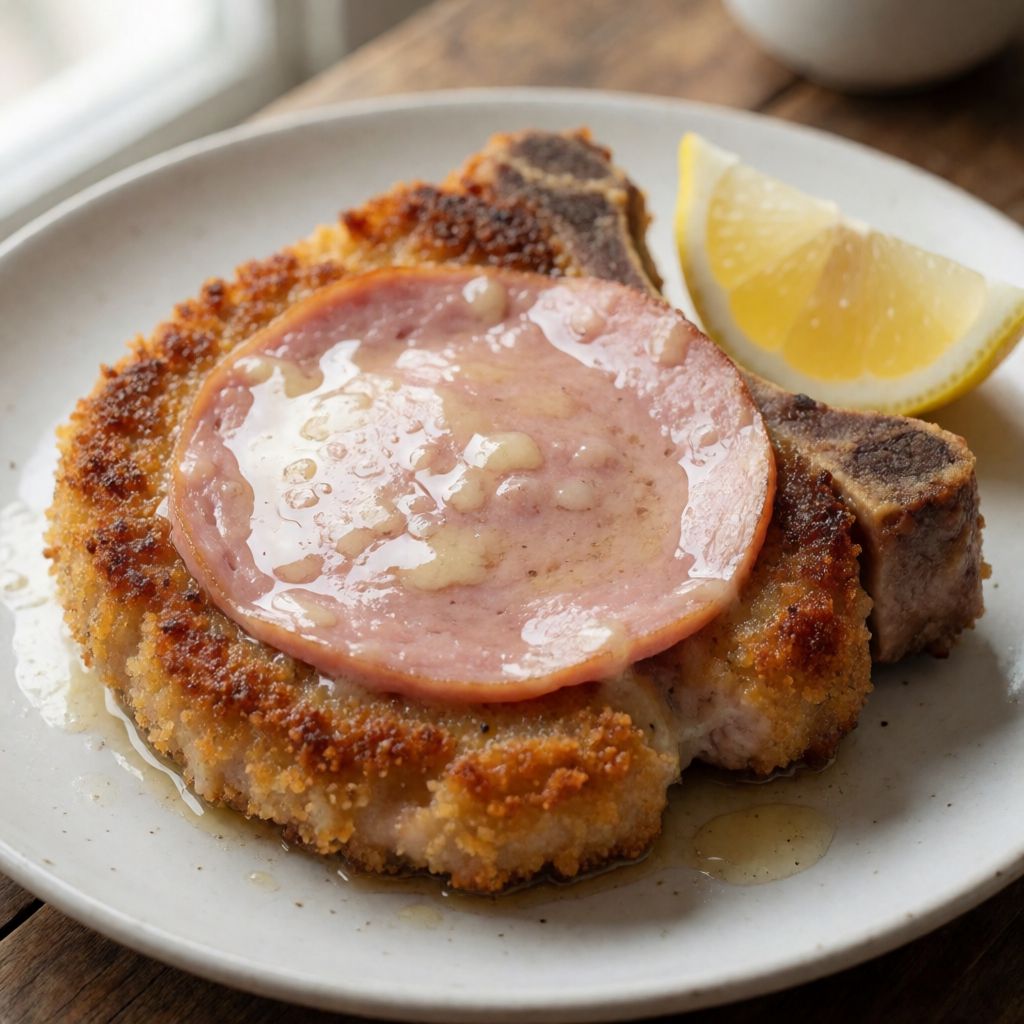
 AI photo
Papal-Style Pork Chops
A hearty pan-cooked dish of pork chops layered with mortadella and parmesan, finished under a lid until tender.
Labels are worked out automatically from the ingredients and can be wrong. Check the packaging if it matters to you.
Ingredients





Steps
Lay the pork chop slices in a frying pan, drizzle with lemon juice, season with salt to taste, and leave to marinate.
60 minLay the parmesan slices and thickly sliced mortadella on top of the meat.
Add a few knobs of butter, cover with a lid, and cook over low heat until cooked through, reaching an internal temperature of 70°C.
20 min
What was changed
Pork Chop updated to match the name of the dish.
This is pork cut thin, seasoned with lemon and salt, then roofed over with mortadella and parmesan and finished under butter and a lid until the inside reaches 70°C. Nothing fancy about the method — it's a covered fry that behaves like a small steam oven. The lid is the whole trick: trap the steam that comes off the butter and the melting cheese, and that vapour does two jobs at once — it melts the parmesan into the mortadella above, and it keeps the meat from drying out below, without you ever having to flip it and knock the toppings off.
The lemon is not there to tenderise the meat for an hour, whatever anyone tells you. Some say an acid marinade works its way deep into flesh and breaks it down — no, it doesn't, not in 60 minutes and not through a centimetre of muscle. What lemon juice does is sit on the surface, season it, and start a very shallow softening of the outer fibres. Its real job is flavour: a sharp edge to cut through butter, mortadella fat and melted cheese, which otherwise sit heavy on the tongue with nothing to answer them.
Doneness here is not a clock question, it's a thermometer question, and that's rare — usually I tell you to watch colour or feel for give, but pork chops this thin, under a cap of cheese you can't see through, give you almost nothing to look at. So 70°C at the centre is your real marker; the 20 minutes on the card is just how long that tends to take on a low flame, not a countdown you trust blindly.
Start with the meat. Eight pieces listed, one serving on the card — ignore the card, eight thin chops feed four people properly, six if they've had bread first. "Thin" matters more than the word "chop" suggests: these need to be cut or beaten flat, because a cutlet that thick in the middle won't hit 70°C before the parmesan on top has gone from melted to leathery and dry. A thick, proud chop is a different dish entirely and wants a different method — searing, resting, maybe a finish in the oven. Here the thinness is what lets a low, gentle heat cook meat and topping in the same stretch of time.
Mortadella is already cooked — it's an emulsion of pork, fat and spice set by gentle heat in its own casing, not a raw sausage waiting for your pan to finish the job. That's why low heat is enough for it: you're warming it through and letting its fat loosen into the butter, not cooking it. If you can't get it, don't reach for raw bacon or a dry salami — they behave nothing like it. A good cooked ham with a little extra fat rubbed on top gets you closer, though you lose mortadella's soft, almost spreadable texture and its pepper note.
Parmesan is chosen for being hard, aged and low in moisture, which is exactly what lets it melt into strings instead of collapsing into a puddle of oil the way a young, wet cheese does under heat. Any firm, well-aged cheese with a dry rind can stand in — grana padano obviously, but a mature cheddar from your own fridge will melt with a similar texture, even if the taste leans sharper and less nutty. What won't work is the pre-grated bag stuff: it's dusted with starch to stop it clumping in the bag, and that same starch stops it melting smoothly on your chop — you get grit instead of a cap.
Butter is doing more than lubricating the pan. Its milk solids brown faintly and add a note that a neutral oil simply doesn't have, and that note is part of the dish, not decoration — which is why I won't give you a flavourless-oil substitute here the way I normally would. The trade-off is that those same milk solids scorch fast, so the heat under the pan has to stay low enough that the butter stays golden and foaming, never brown and smelling faintly burnt. If it starts to colour before the meat's near done, you've got the flame too high, not the timing wrong.
Most home kitchens don't have a kazan-style lid that actually seals, and that's fine — a wide pan and an upturned plate sitting over it will hold enough steam to do the job, even if it hisses a little at the edges. What you're protecting against by covering at all is a dry top: without a lid, the butter just fries the underside while the cheese on top sits half-melted and the mortadella barely warms, so you'd end up with a chop cooked on one face and raw-tasting on the other. Letting the chops sit in their lemon and salt for the full hour beforehand is not something to rush past either — that's patience working as an ingredient, not a formality, because a shorter sit just means thinner seasoning and a sharper, less settled lemon taste once it hits the heat.