
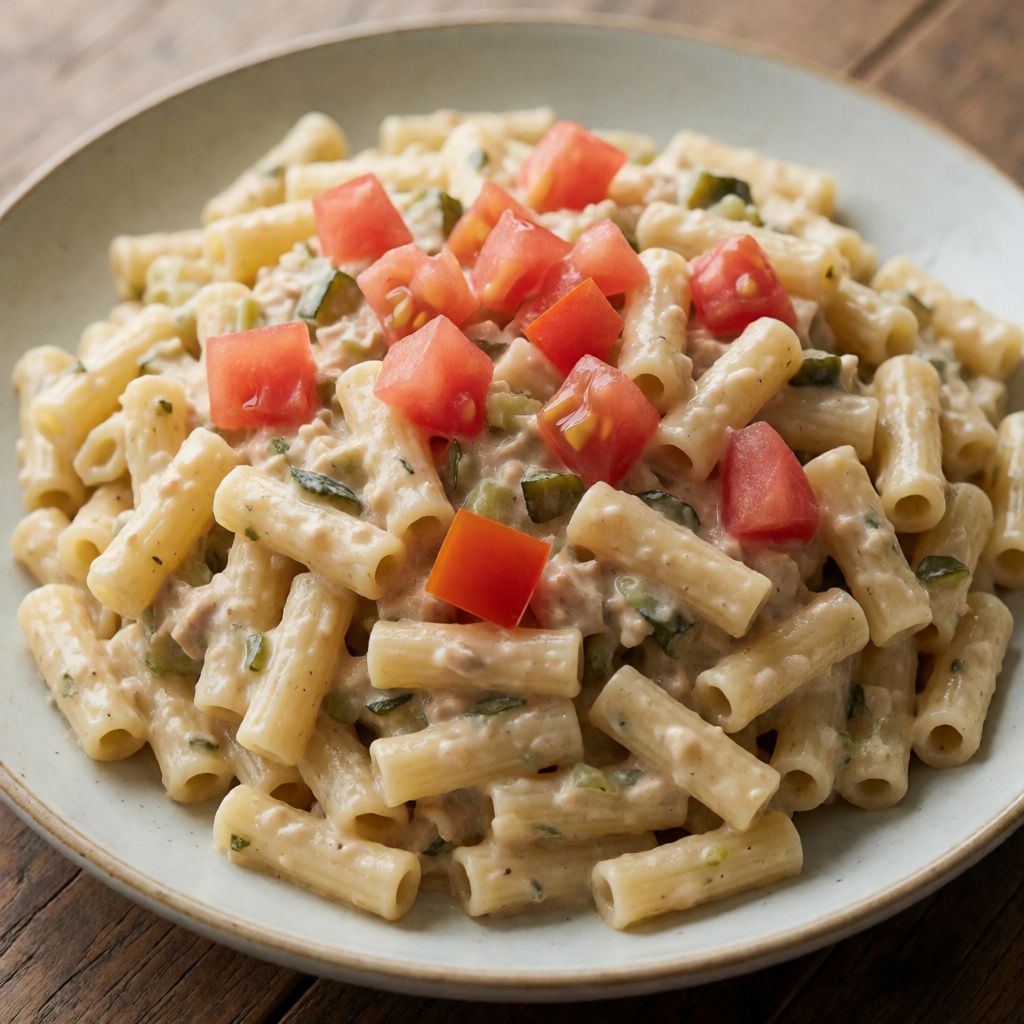
 AI photo
Pasta with Tonnato Sauce
Pasta tossed with a tuna and mayonnaise tonnato sauce, pickled cucumbers and tomatoes.
Labels are worked out automatically from the ingredients and can be wrong. Check the packaging if it matters to you.
Ingredients
- 320 g Pasta
- 160 g Tuna
- 50 g Mayonnaise
- 2 pcs Gherkins sweet pickled gherkins
- 2 pcs Tomato
- Lemon Juice to taste
- Salt to taste
- Black Pepper to taste
- Olive Oil to taste








Steps
Bring a large pot of salted water to the boil and cook the pasta according to the pack instructions.
Wash the tomatoes and dice them finely, season with salt, black pepper and olive oil, stir and set aside to marinate.
Finely chop the sweet pickled gherkins into small pieces.
Drain the oil from the tuna and transfer it to a blender.
Add the mayonnaise and lemon juice, and blend until smooth and creamy — this is your tonnato sauce.
Once the pasta is al dente, drain it, tip it into a bowl, drizzle with a little olive oil and leave to cool to room temperature.
When the pasta has cooled, toss it with the tonnato sauce, mix well, then add the gherkins and tomatoes.
Mix everything together — the pasta with tonnato sauce is ready to serve.
What was changed
We swapped Gherkins because the dish uses sweet-and-sour pickled cucumbers, which correspond to jarred gherkins here rather than fresh cucumber.
This is pasta dressed in a cold, savoury cream built on tuna - not a sauce you cook, one you build in a blender. It's the same logic as Piedmont's vitello tonnato, where cold sliced veal gets coated in a tuna-and-caper mayonnaise - swap the veal for pasta and you've got a dish for a hot evening, nothing on the hob after the water's drained.
What decides whether it works isn't a cooking temperature but a waiting one. Mayonnaise is already an emulsion - egg, oil, acid, held together by a thread. Heat snaps that thread: the oil weeps out, and what should be a cream turns greasy and thin. That's why the pasta cools to room temperature before it meets the sauce. Not fussiness - physics. Give it the ten minutes it needs. Patience is the one difficult ingredient in this whole dish.
Myth worth naming and killing here: "sauce your pasta the second it's drained, while it's hot, so it drinks everything in." True enough for oil, garlic, a tomato sugo - heat helps those bind, and the pasta's own starch grabs them. False for this. This sauce isn't built to survive heat. It's built to survive the fridge.
The gherkins and the salted tomato aren't garnish. The sauce is tuna fat plus mayonnaise fat plus a little more fat for luck - something raw, sour and with a bit of snap has to argue with it, or by the third forkful the dish just sits there, heavy.
Start with the tuna. Buy it packed in oil, not water - you want that oil folded into the sauce as flavour, not something to be drained away and lost. Draining it is about getting the right balance of fish to fat for blending, not disposing of anything bad; keep a spoonful of the drained oil back if the sauce comes out stiffer than you'd like and needs loosening.
Mayonnaise - shop-bought is perfectly fine, this isn't the dish to prove you can hold an emulsion by hand. What matters is the balance already in the jar: more fat and acid than sugar. Some are sweetened past the point of use here, and that fights the lemon juice you add next. If the finished sauce tastes flat and heavy rather than wrong, it's short of acid, not salt - reach for the lemon again before the salt.
Lemon juice does two jobs. It cuts the fat - tuna oil plus mayonnaise is a lot of richness with nothing to answer it - and it's the difference between tuna-mayonnaise-on-pasta and something that actually tastes like a tonnato sauce. Add it gradually while the blender runs and taste as you go; "to taste" really means that here, because lemons vary and mayonnaises vary, and no fixed spoonful suits all of them.
Gherkins, sweet and pickled, chopped small - the same instinct behind serving piccalilli next to a slab of cheese at the end of a Sunday roast: fat needs something sour and with a bit of crunch to push back on it. No sweet gherkins in the cupboard - any small sharp pickle in vinegar will do the same job; chopped capers lean closer to the original Piedmontese sauce, if you want to drift that direction.
Tomato gets diced and salted early and left to sit while everything else happens - ten minutes with salt, pepper and oil draws a little juice out and lets the tomato take oil and seasoning back in. That's seasoning by osmosis, not decoration, and it's why it goes in before anything else, not at the end as an afterthought. Any ripe tomato does the job; out of season, a firmer cherry tomato holds its shape better than a big watery one that collapses to pulp in the bowl.
On kit: no kazan, no stand blender required. A stick blender, or a food processor cup, or even a fork and some elbow work will mash tuna, mayonnaise and lemon into something smooth enough - nobody is inspecting it for lumps under a lamp. Pasta shape doesn't much matter either; this sauce isn't trying to bind into the dough the way a ragù does, it just has to coat, so short or long, whatever's in the cupboard works. Count on roughly 80g dry pasta a head, which is where the 320g for four comes from.