
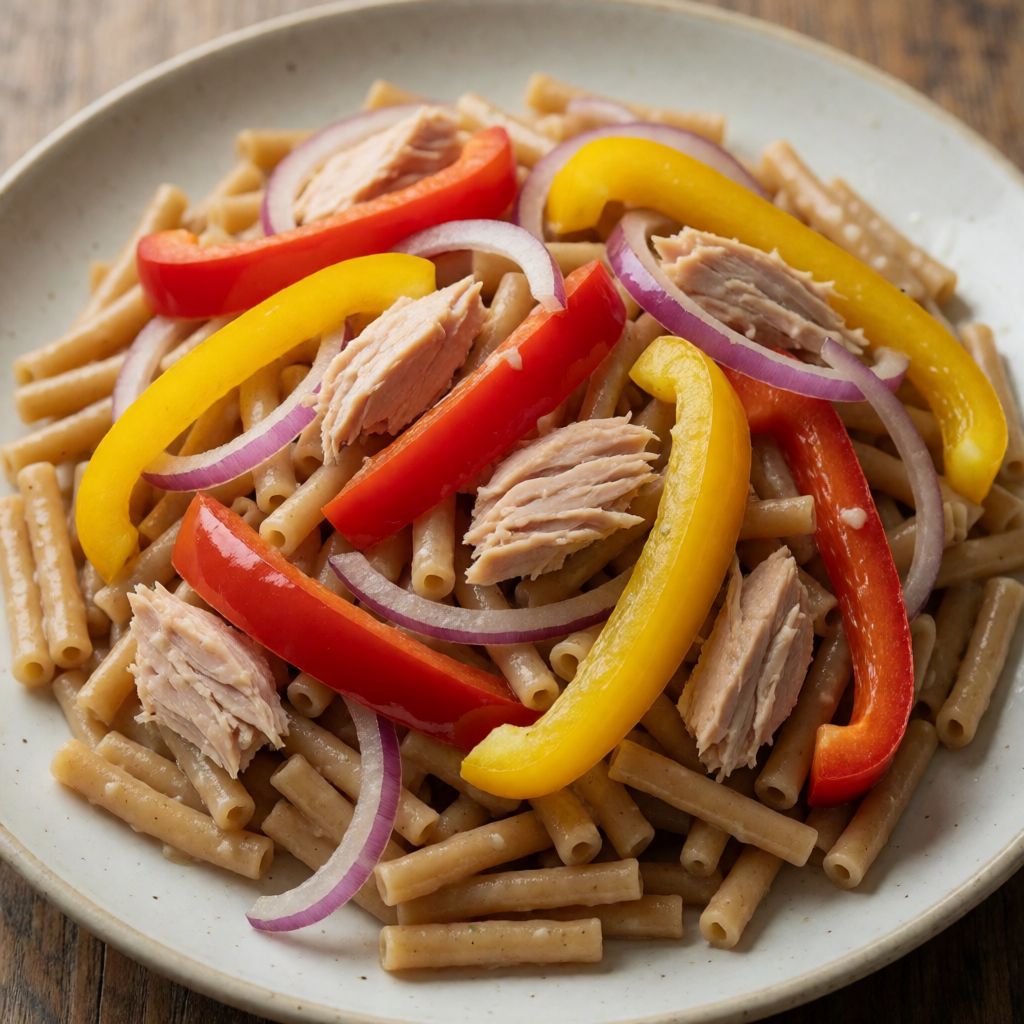
 AI photo
Kamut Pasta with Bell Peppers and Tuna
A fresh, no-cook sauce of bell peppers, tuna and capers tossed with kamut pasta.
Labels are worked out automatically from the ingredients and can be wrong. Check the packaging if it matters to you.
Ingredients
- 360 g kamut pasta
- 1/2 pcs yellow bell pepper
- 1/2 pcs bell pepper
- 1/2 pcs green bell pepper
- 120 g tuna
- 1/2 pcs red onion
- 2 tbsp capers
- oregano to taste
- 2 tbsp olive oil
- salt to taste






Steps
Wash and dry the bell peppers, remove the seeds and inner membranes.
Cut the bell peppers into strips about 1 cm thick, then into small cubes.
Peel the red onion and cut it into thin half-rings.
Take the tuna in oil, drain the oil and mash it with a fork into small pieces.
In a bowl mix the bell peppers, mashed tuna, onion and chopped capers.
Season everything with olive oil, a pinch of salt and oregano, and mix.
Cover with cling film and leave for 1 hour so the flavours blend.
60 minBring a pot of water to the boil, salt it and cook the pasta according to the time on the packet.
When the pasta is cooked al dente, drain it and rinse under running water.
Transfer the pasta to the bowl with the dressing, mix well and serve.
This is a cold pasta salad wearing an Italian name, and it works precisely because nothing in it gets cooked except the pasta. Three colours of pepper, raw red onion, tinned tuna, capers — all of it sits together in a bowl under oil and salt and waits. The dish is decided not at the stove but in that hour of waiting, which is why kamut pasta, with its nubbly, slightly nutty bite, suits it better than a soft durum shape: it holds structure against a dressing that's really a quick marinade, not a sauce.
The one moment that matters at the hob is rinsing the pasta under cold running water the instant it's drained. Skip that and you get a warm, steaming mass that goes straight into raw onion and oil — the onion wilts, the peppers soften, the oil slicks and pools instead of coating. Cold pasta meets cold dressing and nothing melts into anything else; every cube of pepper stays a cube.
Some say pasta salad is just pasta with stuff on it, thrown together minutes before eating. No — because the whole point here is that the vegetables, tuna and capers sit together first, dry, so the onion's sharpness mellows, the capers' brine spreads out, and the tuna stops tasting like tin and starts tasting like itself with company. Thirty minutes is survivable; an hour is where it actually happens. Patience is doing the cooking that heat isn't.
Kamut is just a brand name for an old wheat variety, khorasan, grown mostly for people who want "ancient grain" on the box rather than any real difference in the pot — it cooks like a slightly chewier durum pasta. If you can't find it, any good durum wheat pasta with some bite left in it does the job; what you're after is a pasta that still has backbone after it's cold, not one that goes slack. Short shapes — fusilli, penne, farfalle — work better here than long ones, because they trap the little cubes of pepper and caper in their folds instead of letting the dressing slide off.
The three peppers aren't decoration. Red, yellow and green are the same vegetable at different points of ripeness — green is unripe and sharper, red is fully ripe and sweeter, yellow sits between — and using half of each gives you a spread of sweetness and bite rather than one flat pepper flavour. If you only have one colour, use it; the dish survives, it just speaks in one note instead of three. Cut them to a genuine small cube, not a sliver, because a raw pepper that's too big stays crunchy in a way that fights the soft tuna rather than complementing it.
Tinned tuna in oil, not in water, is the right choice, and not for tradition's sake — it's economics. Oil-packed tuna holds its structure when you mash it with a fork; water-packed tuna turns to mush and waterlogs the dressing. You still drain the oil off, because the dish gets its own dose of olive oil measured separately, and tinned oil is usually a flavourless vegetable oil, not something you want carrying the dish.
Capers are there for salt and sourness in small, sharp bursts — think of them as seasoning, not vegetable. If you've none, a few chopped green olives or a spoon of chopped gherkin gets you a similar hit of brine, though it won't taste identical. Red onion, cut into thin half-rings, gives bite without the raw aggression of white or yellow onion; if red onion isn't to hand, a milder shallot works, but double the resting time to let it calm down.
The oil itself should be one with no smell of its own that fights the vegetables — a light, fruity olive oil is traditional because it's what's grown where this dish comes from, but any neutral vegetable oil will carry the dressing, just without olive oil's faint bitterness that balances the sweetness of the peppers. Oregano, dried or fresh, is doing aromatic work that a British kitchen might reach for instead with a pinch of mixed herbs — not the same, but it won't ruin anything.
Finally: don't skip the rest in the fridge, and don't rush it under time pressure because dinner's in forty minutes. If you're short on time, make the dressing in the morning before work and let it sit in the fridge all day — it only improves. This is a dish built to be made ahead, eaten cold or just-cool, which makes it genuinely useful on a day when the oven's busy with something else — a Sunday roast, for instance — and you need a starter or a side that asks nothing of the hob beyond one pot of boiling water.