
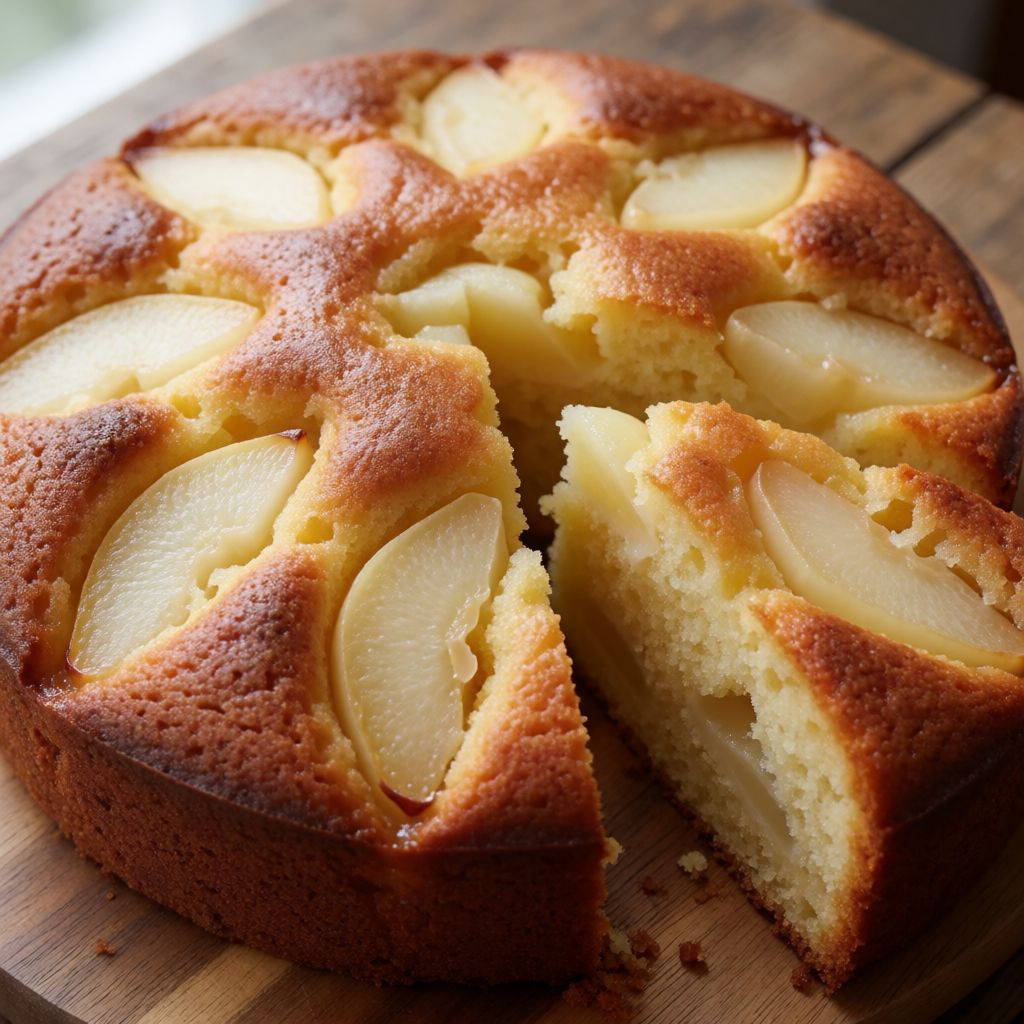
 AI photo
Pear Cake
A moist pear cake flavoured with cinnamon, simple to bake any day of the week.
Labels are worked out automatically from the ingredients and can be wrong. Check the packaging if it matters to you.
Ingredients
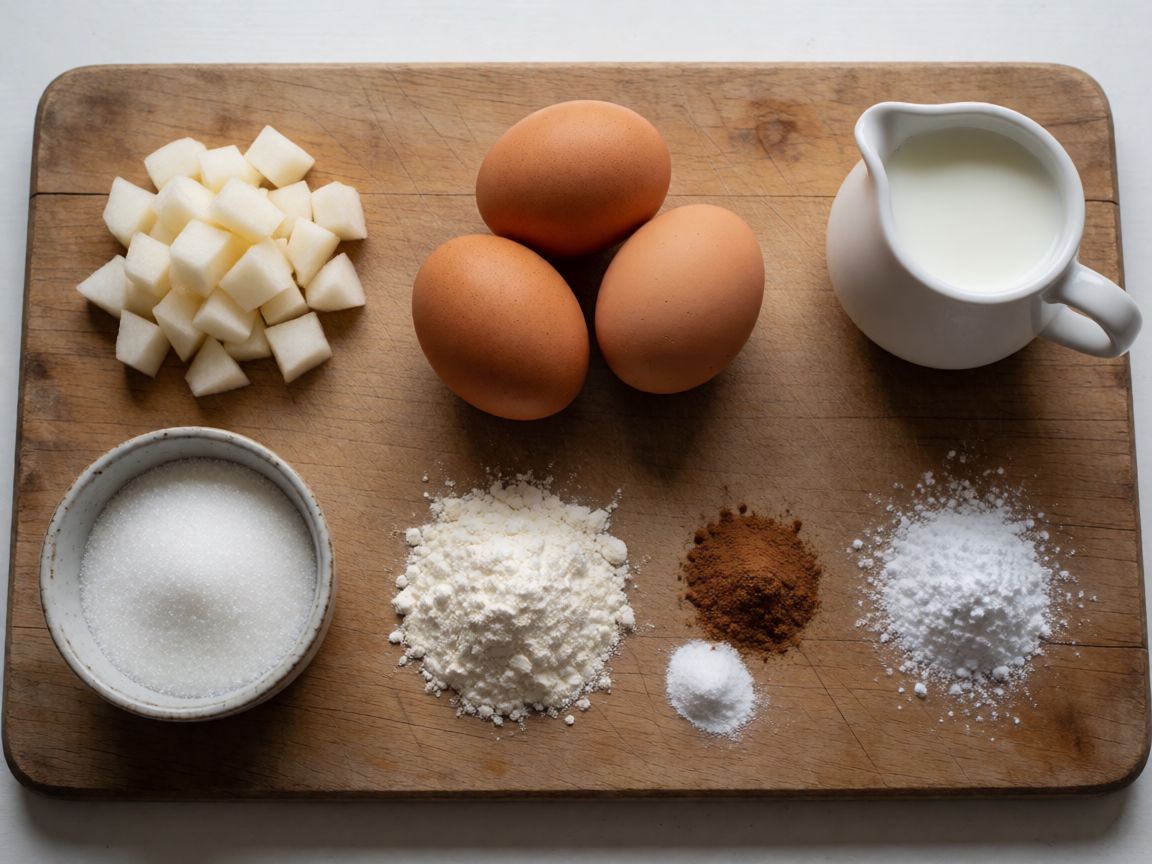
- 200 g Pear
- 3 pcs Eggs
- 150 g Vegetable oil
- 200 g Caster sugar
- 75 ml Milk
- 300 g Plain flour
- 15 g Baking powder
- 1 tsp Cinnamon
- 1 tbsp Icing sugar for dusting









Steps
Peel the pears, cut into pieces and place in a blender with the eggs and vegetable oil; start blending.
Add the sugar, milk and cinnamon, and mix until smooth.
Sift in the flour and baking powder, and whisk until you have a smooth batter.
Grease a 22 cm baking tin, dust with flour and pour in the batter.
Bake in a fan oven preheated to 180°C for 58 minutes.
58 minCheck it's done with a wooden skewer — it should come out clean and dry.
Let the cake cool, remove it from the tin and dust with icing sugar if you like.
This is not really a 'pear cake' in the sense of pear slices sitting on top of a sponge — the pear disappears into the batter. You blend it with the eggs and oil until it's a smooth, pale, slightly fragrant liquid, and that liquid becomes the main wet base of the whole thing, doing the job that butter-and-sugar creaming does in an English Victoria sponge. That's the mechanism worth understanding before you touch the oven: this cake has no butter, no creaming, no air beaten in by hand — it rises purely because flour and baking powder meet a wet, heavy batter and have to lift it chemically.
What decides whether it works is the state of the batter before it goes in the tin, not the oven. It has to be smooth — no flecks of unblended pear, no streaks of flour — because any lump is a pocket that won't set the same way as the rest, and that's where a sunken, gummy patch comes from after baking, not from 'opening the oven too early' as people like to blame. Sift the flour and baking powder together and whisk them in properly; that's not fussiness, that's insurance against a dense streak running through an otherwise good cake.
Some say a cake this wet, with fruit blended right into the batter, can't rise properly and will always end up heavy — no, because the 15g of baking powder here is doing more lifting than you'd normally expect for 300g of flour, precisely because it has to push through puréed fruit and oil instead of a light, creamed mixture. The generous baking powder is the compensation, not a mistake in the recipe.
Pear: you want one that's ripe enough to be sweet and give a proper purée, but still firm enough to hold its shape when you cut it — not the soft, bruised, nearly-brown one you were about to throw in the bin. An overripe, watery pear adds too much free liquid to the batter, and that's the real cause of a cake that looks baked on the outside and sits wet and dense in the middle: too much water for the flour to absorb, so the centre never fully sets even though the skewer test on the edges says it's fine. If your pears are rock-hard and under-ripe, give them more time on the counter before you cook with them — cinnamon later will forgive a lot, but it can't fix raw starch.
Eggs and oil go in with the pear and get blended together first, before sugar or flour. This is the whole trick of the recipe: blending creates an emulsion, binding fat, water and protein into one stable liquid, the way a vinaigrette held together by mustard is one liquid instead of oil floating on vinegar. That emulsion is what carries air and structure into the final bake even though nobody's whisking egg whites separately. Vegetable oil is specified because it has no smell or taste of its own — any neutral oil does the same job: sunflower, rapeseed, a flavourless groundnut oil. Olive oil would fight the cinnamon and the pear with its own character, so leave it for savoury things.
Caster sugar dissolves faster into a wet batter than granulated would, which matters here because you're not creaming it with fat for minutes on end — it's going straight into a blender with liquid, so it needs to be fine enough to disappear quickly rather than leave a slight grittiness in the finished crumb.
Milk at 75ml is a small adjustment, not a major liquid — it loosens the batter slightly so the flour hydrates evenly rather than sitting as a stiff dough around the pear purée. If you're out of milk, a splash of water or any neutral plant milk does the same loosening job; it's not there for flavour, there's too little of it for that.
Flour and baking powder, sifted together: sifting isn't ceremony, it breaks up the little clumps baking powder forms in storage, so you don't bite into one dense, slightly bitter dot in an otherwise even cake. The 15g baking powder is higher than you'd use in a drier, lighter sponge, and that's deliberate — it's working against a batter made heavy by purée and oil rather than light with whipped egg and butter.
Cinnamon does double duty: flavour, obviously, but it also rounds off any thin, slightly sharp edge an under-ripe pear brings, the way a pinch of spice covers for fruit that isn't at its absolute best. A pear cake with no cinnamon isn't wrong, it's just more honestly a pear-and-egg cake with nowhere to hide if the fruit was mediocre.
On the tin and oven: 22cm and 180°C fan assume you know your own oven's quirks — fan ovens circulate heat so the stated temperature tends to run true across the whole tin, but a domestic fan oven's thermostat can still drift by ten degrees either way, which is why the skewer, not the clock, has the final word. Let the cake sit in its tin and cool before you turn it out — this isn't patience for its own sake, the crumb is still finishing its set in the first warm minutes out of the oven, and turning it out too soon is how you get a cake that looks perfect and then collapses slightly on the plate. With tea, as it should be, this one takes its time twice: once in the oven, once on the side before you dust it and cut in.