
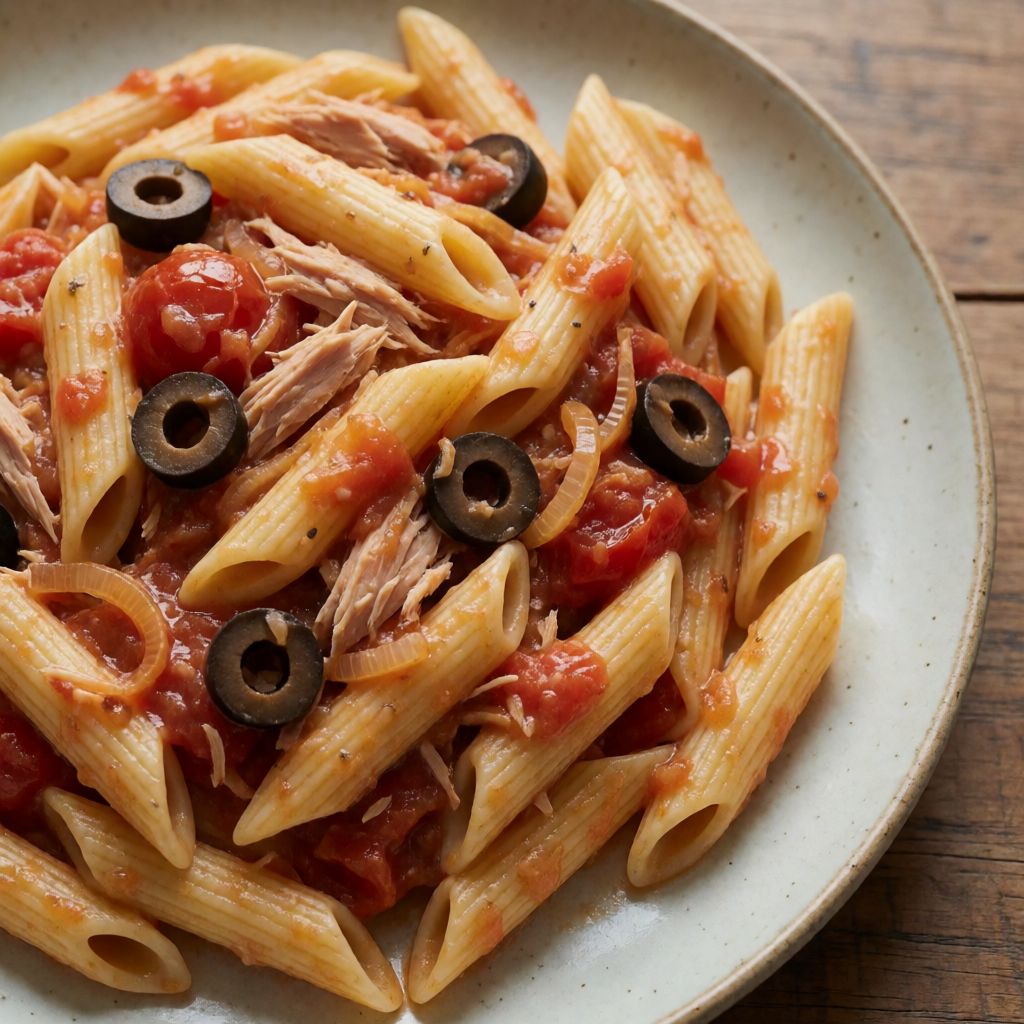
 AI photo
Penne with Tuna and Cherry Tomato Sauce
A quick Italian-style pasta dish with tuna, olives and cherry tomatoes, perfect for a simple midweek dinner.
Labels are worked out automatically from the ingredients and can be wrong. Check the packaging if it matters to you.
Ingredients
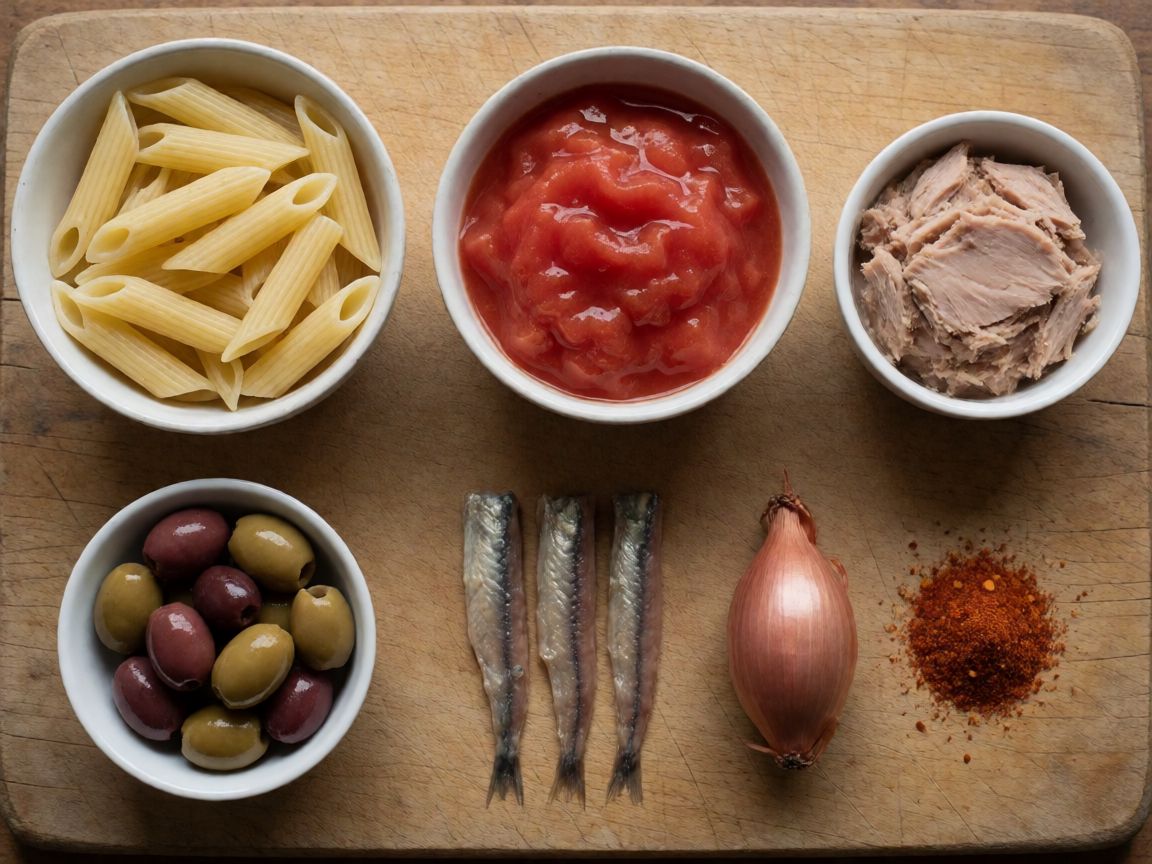
- 400 g Penne
- 300 g Cherry tomatoes
- 280 g Canned tuna drained weight
- 80 g Taggiasca olives
- 3 pcs Anchovies
- 1 pcs Shallot
- 2 tbsp Olive oil
- 1 pinch Ground chilli pepper
- 1 pinch Salt to taste





Steps
Bring a large pot of water to the boil for the pasta, season with salt and cook the penne according to the time stated on the packet.
In a large frying pan, heat the olive oil and fry the finely chopped shallot until golden.
Add the anchovies and let them dissolve into the pan, stirring.
Add the cherry tomatoes, washed and cut into quarters, season with ground chilli pepper and cook.
5 minAdd the well-drained and flaked tuna, and season with a little salt.
Add the Taggiasca olives, stir and cook for a few more minutes.
Cook the penne until al dente, then drain and transfer to the pan with the sauce, mixing well.
Serve the dish immediately, garnished with chopped parsley if desired.
This is a store-cupboard pasta, not a market one. Think of a fisherman's wife making supper from what sits in the larder for months: a tin of tuna, a jar of anchovies curled in oil, a handful of small olives. Nothing here needs to be fresh except the tomatoes and the shallot — everything else was built to keep. That's the real reason the dish exists: not elegance, but a freezer-less kitchen before freezers, and a need to eat well on a boat or a budget.
What decides whether it works is order and heat, not quantity. The shallot has to go from raw to soft to gold before the anchovies go in — rush it and the shallot stays raw and sharp under everything else, because nothing after this point cooks it further. The anchovies need just enough heat to break down into the oil, not fry and turn bitter. The tomatoes get a short, hot cook so the quarters soften and give up some juice but don't collapse into jam — you want sauce with pieces in it, not purée. And the tuna, which is already cooked in the tin, only needs warming through at the end; push it any longer in the heat and it turns from soft flakes to dry threads, because you're now cooking it a second time with no liquid left to protect it.
Some say anchovies will make the dish taste "fishy" and put people off for that reason — no. Their whole job is to dissolve and disappear, leaving behind savouriness and salt, not their own flavour. If you can taste anchovy as anchovy, something went wrong: either too much, or added too late to melt properly.
Penne earns its place through its ridges, not tradition for tradition's sake — this is a coarse, chunky sauce with no cream to cling to, and ridged pasta grips loose bits of tomato and tuna that a smooth tube would let slide off. Any short ridged shape does the same job; what you want to avoid is a shape built for stuffing or trapping thin sauces, because this one isn't thin.
Cherry tomatoes are chosen for their skin-to-flesh ratio, not for looks. A big tomato, cut the same way, gives you more water and less sugar relative to its mass, and in a five-minute cook that water has nowhere to go but into a thin, slack sauce. Cherry tomatoes concentrate faster because there's less of them to reduce. Pick ones that give slightly under your thumb — too firm and they won't break down in the time you've got; too soft and they'll turn to mush before the tuna even goes in. Out of season, drained canned cherry tomatoes will do, but drain them harder than you think you need to.
Tuna: the drained weight on the label matters because the oil or water it sits in is doing nothing for your sauce — it's dead weight you're paying for and then pouring away. Buy tuna in olive oil if you want a slightly richer, more forgiving flake; water-packed is leaner but dries out faster under heat, which is exactly the failure this dish is built to avoid. Flake it with a fork, don't mash it with a spoon — you want pieces that survive being tossed with hot pasta, not paste.
Anchovies are the backbone, not a garnish, which is why they go in early, into fat, not at the table. If you have none, the honest substitute is anything salty and savoury that melts into oil the same way — a dash of fish sauce, or a spoon of the brine from the olive jar — but understand it changes the dish's edge, it won't vanish the same way cured anchovy does. Capers chopped fine can also stand in, though they bring sourness as well as salt, which anchovies don't.
Taggiasca olives are small and mild because they come from Liguria, where the olive itself is a mild variety grown more for oil than for eating whole — that's an economic fact, not a mystical one. A big, assertive olive like Kalamata will fight the anchovies for attention and usually win, leaving you with a bitter edge where you wanted a gentle one. If that's what's in your cupboard, use fewer of them, and pit them — whole with the stone left in is only authentic in the sense that someone, somewhere, once bit down on one by accident.
Shallot rather than onion is a speed decision as much as a flavour one: shallot has less water, so it moves from raw to gold faster and with less risk of stewing in its own liquid before it browns. On an ordinary UK hob — gas ring or electric coil, not a professional burner that drops heat the instant you turn the dial down — that matters, because electric coils especially hold their heat and keep cooking after you think you've backed off. Watch colour, not the clock: white to translucent to the first gold edges is your cue, and once you see gold, move on.
Salt is the one place people get this dish wrong twice over: they salt the pasta water generously, which is right, and then salt the sauce again out of habit, forgetting that anchovies and olives are already doing most of that work. Taste before you add the pinch the recipe calls for — it's there to round things off, not to start the salting from zero. For four people, 400g of dry pasta is the usual measure — 100g a head — which gives you enough surface and ridge to carry the sauce without drowning in it.