
 AI photo
Pizza Croissants
Puff pastry croissants filled with tomato, mozzarella and ham, baked until golden.
Labels are worked out automatically from the ingredients and can be wrong. Check the packaging if it matters to you.
Ingredients
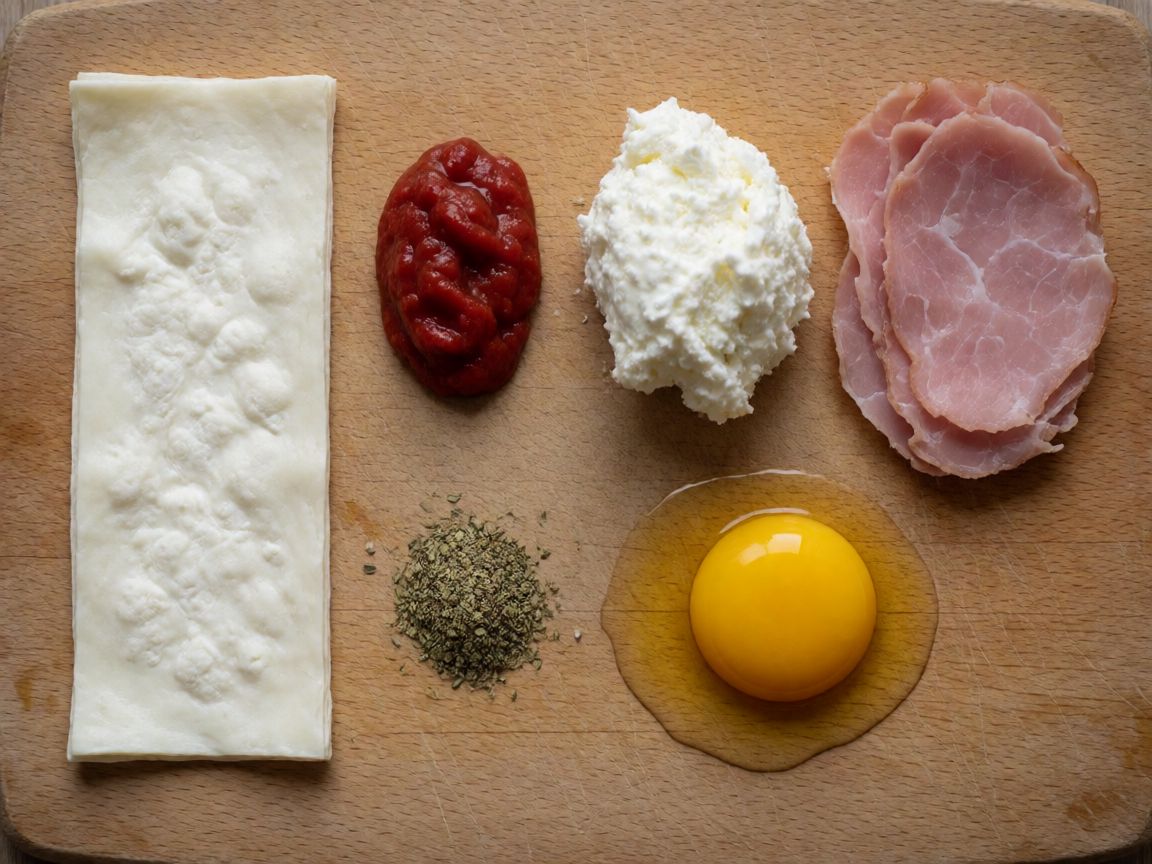
- 1 pcs Ready-rolled puff pastry (not yeasted)
- Tomato paste to taste
- Mozzarella to taste
- Ham to taste
- Oregano to taste
- 1 pcs Egg yolk






Steps
Unroll the puff pastry and cut it into 4 triangles with a knife or a pastry wheel.
On each triangle, spread tomato paste and scatter mozzarella and ham to taste, dividing evenly.
Sprinkle with oregano and roll the pastry into a croissant from the wider edge, pinching the ends well.
Place the croissants on a baking tray lined with parchment paper.
Brush each croissant with egg yolk and add a little more tomato paste on top.
Sprinkle with oregano and bake in a fan oven preheated to 180°C.
20 minServe the pizza croissants hot.
This isn't a croissant pretending to be a pizza — it's puff pastry borrowing a croissant's fold because that fold happens to be the best shape for holding a filling that wants to leak. A croissant, the real yeasted kind, rises because yeast breathes and the dough stretches around that breath over hours. Puff pastry rises for a completely different reason: thin sheets of dough with fat between them, and when heat hits, the fat melts and the water in it turns to steam, and that steam has nowhere to go but up, shoving the layers apart. That's why the recipe is emphatic — not yeasted. Ready-rolled puff pastry already has that lamination done for you, folded by a machine dozens of times. You are not building structure here. You are only shaping and filling something that's already built.
What decides whether this works is restraint with the filling and discipline with the seal. Tomato paste and mozzarella and ham "to taste" sounds generous, and it is a trap — too much, and the melting cheese finds the weakest point in the pastry and pushes through before the layers have had a chance to puff. Pinch the ends well isn't a throwaway instruction, it's the whole defence against a flat, greasy bottom: unsealed pastry lets steam escape sideways instead of lifting the layers, and the croissant collapses into itself, dense in the middle, raw-tasting of flour where it never got the chance to flake.
The pastry itself is the one ingredient you can't really substitute with a criterion, because the whole dish depends on lamination you didn't do yourself. If you only have shortcrust, don't use it here — it has no layers to separate, it will just bake into a biscuit around melted cheese. If you can get all-butter puff rather than one made with vegetable fat, take it; butter has a sharper melting point and a flavour of its own, so the lift is cleaner and the croissant tastes of something beyond "pastry-shaped." Most UK supermarket ready-rolled puff is vegetable-fat based and perfectly fine — just don't expect the same depth of flavour, that's the trade you're making for convenience.
Tomato paste rather than a looser pizza sauce is deliberate, whether the recipe says so or not. Paste is concentrated and low in water. A wetter sauce would sit against the raw pastry and start softening it from the inside before the heat ever gets a chance to crisp it, and you'd end up with a soggy seam running down the middle of each croissant. If all you have is passata, you can use it, but reduce it on the hob first until it's thick enough to hold its shape on a spoon — otherwise you're pouring water straight onto your lift mechanism.
Mozzarella: the criterion is low moisture, not prestige. Fresh buffalo mozzarella, the kind sitting in its own whey, is wonderful on a real pizza baked hot and fast, but here it will flood the pastry with water as it melts over twenty minutes at a gentler heat. Go for the block mozzarella sold for grating or for pizza — it melts stretchy without drowning anything. Any firm, mild, meltable cheese does the same job if mozzarella isn't to hand; the point is meltability without a puddle.
Ham just needs to be already cooked and sliced thin — it's there to warm through and season, not to cook from raw, and thin slices won't get in the way of pinching the pastry shut. Oregano is doing what dried herbs do best when baked rather than eaten raw: dried oregano actually holds up better to oven heat than fresh, which tends to scorch and turn bitter in a dry oven environment, so don't feel you're using the lesser version here.
The egg yolk wash, rather than a whole beaten egg, is the detail that gets the colour right. Yolk is mostly fat and protein with very little water, so it browns deep and even through Maillard reaction without the pale, sometimes blotchy sheen that whole egg can leave, since the egg white's extra moisture has to evaporate first before any browning can start. If you've only got a whole egg, use it, but expect a slightly lighter, less uniform gold.
On the oven: 180°C assumes fan, and that's not a small detail. A fan circulates the hot air, so heat reaches the pastry faster and more evenly from every side — that's why the number sits lower than you'd expect for puff pastry, which usually likes a hotter blast. If your oven has no fan, you're better off nudging up towards 200°C, because without that air movement the heat is lazier and slower to reach the centre of the tray, and a cooler oven will stall the steam-lift before the layers have separated properly — you'll get pale, slightly leathery croissants instead of ones that shatter. Judge it by sight in the end: deep gold-brown all over, with the layered edge visibly flaking apart where it's cut or pinched, not just a clock running out. Four triangles from one sheet feeds four as a light bite — a Sunday-tea sort of thing alongside the roast leftovers, or a stopgap before the main event, not quite a meal on its own.