
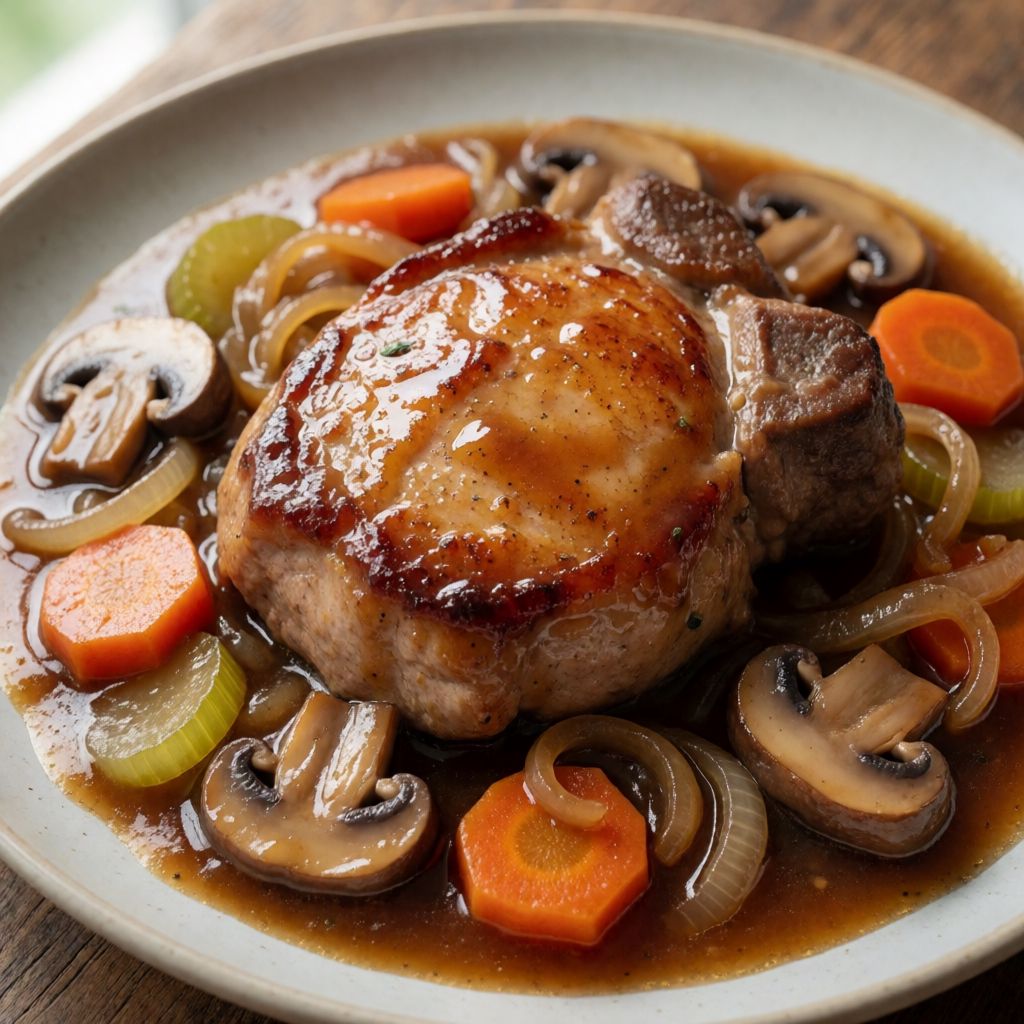
 AI photo
Pork Loin Joint with Lager and Mushrooms
A pork loin joint roasted with lager and served with oven-baked mushrooms.
Labels are worked out automatically from the ingredients and can be wrong. Check the packaging if it matters to you.
Ingredients
- 1 kg Pork Loin Joint boneless, tied for roasting
- 800 g Mushrooms cleaned and sliced
- 1 pcs Celery Stick
- 1 pcs Onion
- 1 pcs Carrot
- 700 ml Lager
- Olive Oil to taste
- Salt to taste
- Black Pepper to taste, ground
- 1 tbsp Parsley






Steps
Tie the pork loin joint with kitchen string, rub it with salt, and sprinkle with the chopped carrot, onion and celery mixture and the pepper.
Place the joint in a roasting tin with olive oil and put it in the oven at 180°C, turning it at least once.
Pour over the lager and continue cooking in the oven. It is ready when the internal temperature reaches 70°C.
Meanwhile, put a baking dish with the sliced mushrooms into the oven.
10 minAdd olive oil, parsley and lager to the mushrooms and keep cooking.
10 minTake everything out of the oven, let the roast rest, remove the string and slice it.
Serve with the roasting juices, placing the mushrooms on top.
What was changed
The cut has been corrected to Pork Loin Joint, and the mushrooms are now Mushrooms, widely available in UK shops.
This is a Sunday roast that swaps wine for lager and gravy-making for something more direct — the joint sits straight in its own bed of vegetables, the beer goes in halfway through, and what comes out is a joint with a dark, bitter-sweet crust and a tray of mushrooms cooked separately so they roast instead of stew. It reads like a simple roast dinner and it is, but two things decide whether it's a good one or a dry one.
First, that scatter of carrot, onion and celery under the meat isn't garnish, it's a trivet. Pork loin has very little fat running through it compared with shoulder or belly — most of what it has sits as a cap on top. Lay the joint straight on metal and the underside fries in its own rendered fat instead of roasting; the vegetables lift it just enough that hot air and, later, lager can get underneath. They also happen to flavour the fat as it melts, which is why you chop them, not leave them whole.
Second — and this is the whole dish, really — doneness here is a number, not a clock. You're told 70°C at the core, and that number is doing real work: it's hot enough to be safe, cool enough that the protein hasn't seized up and pushed all its moisture out. Sixty minutes is what it usually takes in an 800g–1kg joint at 180°C, but ovens lie to you — mine runs hot by about 10 degrees, yours might run cold — so the oven setting gets you in the right country, the thermometer tells you when you've arrived.
Start with the joint itself. You want boneless loin, rolled and tied — ask the butcher to do it if you're not confident with string, because a loose tie means the meat unrolls as it shrinks and cooks unevenly, tight end to loose middle. The string isn't decoration, it's what keeps the roast a cylinder instead of a flat slab, which matters for even cooking: a flat piece of meat has more surface exposed to heat and dries faster at the edges before the centre catches up. Look for a fat cap with some thickness left on — if your butcher has trimmed it down to nothing, the meat will roast drier, because that fat is basting it from above as it renders.
The carrot, onion and celery trio is the classic French mirepoix base, but here it's doing a British Sunday-roast job: trivet first, flavour second. If you've no celery, don't go hunting for it — a stick of celery contributes a background bitterness and little else, and a roast without it is still a roast. Leave it out, or use a pinch of celery seed if you have it in the cupboard already. Chop the three roughly the same size so they cook at the same rate and none of them burns to carbon while another is still raw.
The lager is the one ingredient people ask about, and it earns its place through simple chemistry, not folklore. Poured over partway through cooking, it does two things: it releases the browned bits stuck to the tin (what the French call deglazing, though nobody in this kitchen needs the French for it), and as it reduces in the heat its sugars concentrate and caramelise while its bitterness cuts through the fat of the pork. This is really the same logic as Belgian carbonade or German pork-in-beer dishes — in places where grapes don't ripen reliably, beer was always the cheaper, more available cooking liquid, so it became the braising wine by default. Any lager works here — a plain pale lager, nothing craft or heavily hopped, because you want carbonation and a light bitterness, not a flavour that argues with the meat. A stout or porter will bring roasted, almost coffee-ish notes that fight the pork rather than lift it; cider is sweeter and will push the dish toward something else entirely.
The mushrooms get their own tray and their own timing, and that's deliberate, not a space-saving habit. Mushrooms are mostly water held in a cell structure that collapses the second real heat hits it — put them under the meat with the mirepoix and they'd flood the tray, drown the vegetable trivet, and steam everything into greyness instead of letting it roast. Cooked separately in their own shallow dish, that same water released, with the lager and parsley alongside, becomes a short, intense sauce instead of a swamp. Use any firm mushroom — chestnut, portobello, even flat field mushrooms sliced thick; the delicate button ones will simply disappear into the liquid, which isn't wrong, just a different result.
For the oil, the only real rule is: no smell of its own. Olive oil is named here and works well, but if yours is a strong, peppery extra virgin, you'll taste it faintly against the beer and pork — a milder olive oil, or a neutral sunflower or rapeseed oil, lets the lager and the meat's own fat do the talking instead. Salt goes on before the oven, because it needs time sitting on the surface to draw a little moisture out and start the crust; pepper, same logic, coarse-ground so it doesn't burn to bitterness in the time the joint takes to brown. And once it's out of the oven, give the joint ten minutes under foil or an upturned bowl before you cut it — that rest is not optional dead time, it's the muscle fibres relaxing and pulling the juices back in from wherever the heat pushed them. Cut too early and all that juice ends up on the board, not on the plate.