
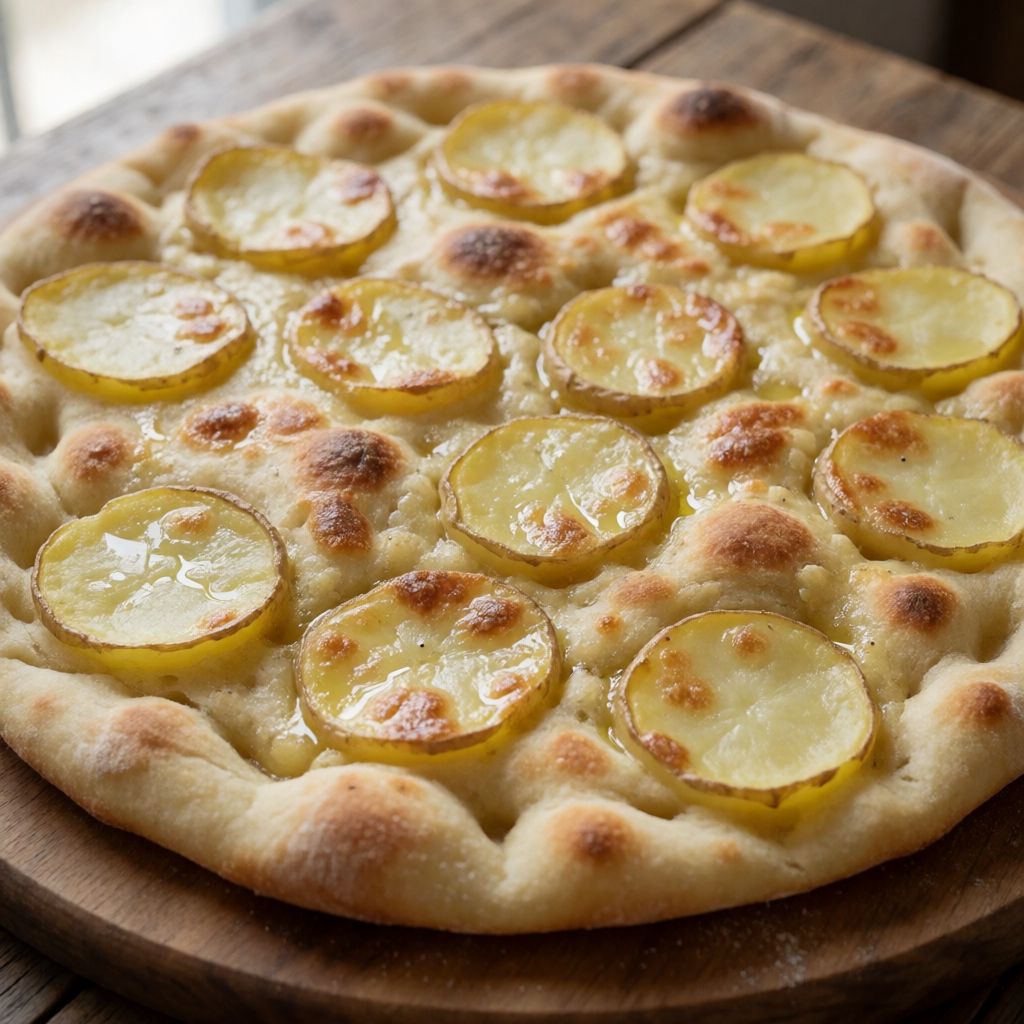
 AI photo
Gluten-Free Potato Schiacciata
A gluten-free Italian-style potato schiacciata, thin and crisp, flavoured with Parmesan and rosemary.
Labels are worked out automatically from the ingredients and can be wrong. Check the packaging if it matters to you.
Ingredients






Steps
Wash and peel the potatoes, and weigh out 450 g of peeled potato. Slice it thinly using a mandoline and set aside.
In a large bowl, mix the rice flour with room-temperature water until you get a smooth, thick batter.
Add the salt, olive oil and Parmesan, and mix well.
Add the potato slices and mix everything together thoroughly.
Line a baking tray with parchment paper and pour in the batter, spreading it evenly into a thin layer.
Sprinkle the top with Parmesan and rosemary, then drizzle with olive oil.
Bake in a preheated oven at 180°C for 45 minutes.
45 minServe warm.
Forget what the name promises. "Schiacciata" usually means a Tuscan flatbread — yeasted dough, pressed thin, baked until it blisters. This isn't that. No yeast, no kneading, no rise. What you're making is a savoury batter, closer kin to a Yorkshire pudding than to focaccia. Rice flour has no gluten, so there's no elastic web to trap air or hold a crumb together — the whole structure comes from starch grains swelling and setting when they meet heat. That single fact explains every instruction below it.
What decides whether it works is the batter before it ever sees the oven. "Smooth, thick batter" in step 2 isn't cosmetic — it's load-bearing. A lump of unmixed rice flour is a pocket of raw starch that never gelatinises properly; it stays gritty and pale while everything around it sets firm. Thick enough also keeps the potato slices suspended through the batter instead of sinking to the tray — too thin a mix and you end up with a crisp, oily potato floor and a wet flour layer that never joins it as one piece.
One myth worth dropping: you don't need the gum-laden gluten-free flour blends to get something cohesive here. Those gums exist to fake bread's stretch — the stretch this dish never asked for. Plain rice flour, mixed wet enough, sets on its own.
A tray this size feeds four as a side alongside something else, or two as a thin main with a salad pulled in. It's not a loaf you slice for the week — eat it warm, close to when it comes out.
The water-to-flour ratio looks odd on paper — 600ml against 400g, nearly a third more water than you'd give wheat flour — but rice starch needs that much more water to hydrate, since there's no gluten to hold moisture elastically. If all you've got is a gummed gluten-free blend, add the water slowly rather than all at once; those blends absorb on their own schedule, not rice flour's. Chickpea flour follows similar logic and turns up in flatbreads across the Mediterranean for the same reason — it gelatinises with heat too — but it brings its own smell and a denser bite, so it's a substitute, not a stand-in.
Potato choice matters less than potato thickness. A floury potato — Maris Piper, King Edward, the sort that goes into a Sunday roast's mash — releases a little starch as it bakes and helps the binding along. A waxy new potato holds its shape more cleanly and leans on the rice starch around it to do all the gluing. Either is fine. What can't vary is the mandoline-thin slice, because the whole bake has one time window, and the potato has to cook through inside it — not sit raw-centred under a browned top, which is the defect thick slices always produce here.
The parmesan is split for a reason: what goes into the batter works from the inside — salt, fat, savour, folded through everything; what goes on top is there for colour and crust, because only the top surface meets direct dry heat. Any hard, aged, salty cheese substitutes on the same logic — pecorino, grana padano, even an old cheddar, though that last one pulls the whole dish toward a different country. Nutritional yeast gives savour without dairy, but no browning — it won't fake the crust.
The olive oil inside the batter isn't there for richness so much as to carry the rosemary. Rosemary's aroma is fat-soluble; without enough fat around it, the herb just sits there smelling of dust rather than perfuming the crumb. For the batter, any oil with no smell of its own would do the same binding job — but keep true olive oil for the drizzle on top, because that's the part you'll taste raw and uncooked, straight off the spoon.
Ten grams of salt for 400g of flour is more than you'd put in a bread dough, and that's deliberate — bread earns flavour over hours of fermentation, this batter gets none of that time, so the seasoning has to do its job immediately, once, in the mix.
As for doneness: 45 minutes at 180°C is a lower bound, not a verdict — ovens and trays disagree with each other more than recipes admit. Watch the top go from wet shine to a dry, faintly blistered gold, and watch the edges start to pull from the parchment. I haven't put this exact tray in my own oven, so weigh what you see over the number on the page. Let it rest a few minutes once it's out, too — rice starch keeps firming as it cools, and a slice cut too hot will slump sideways instead of holding its own edge.