
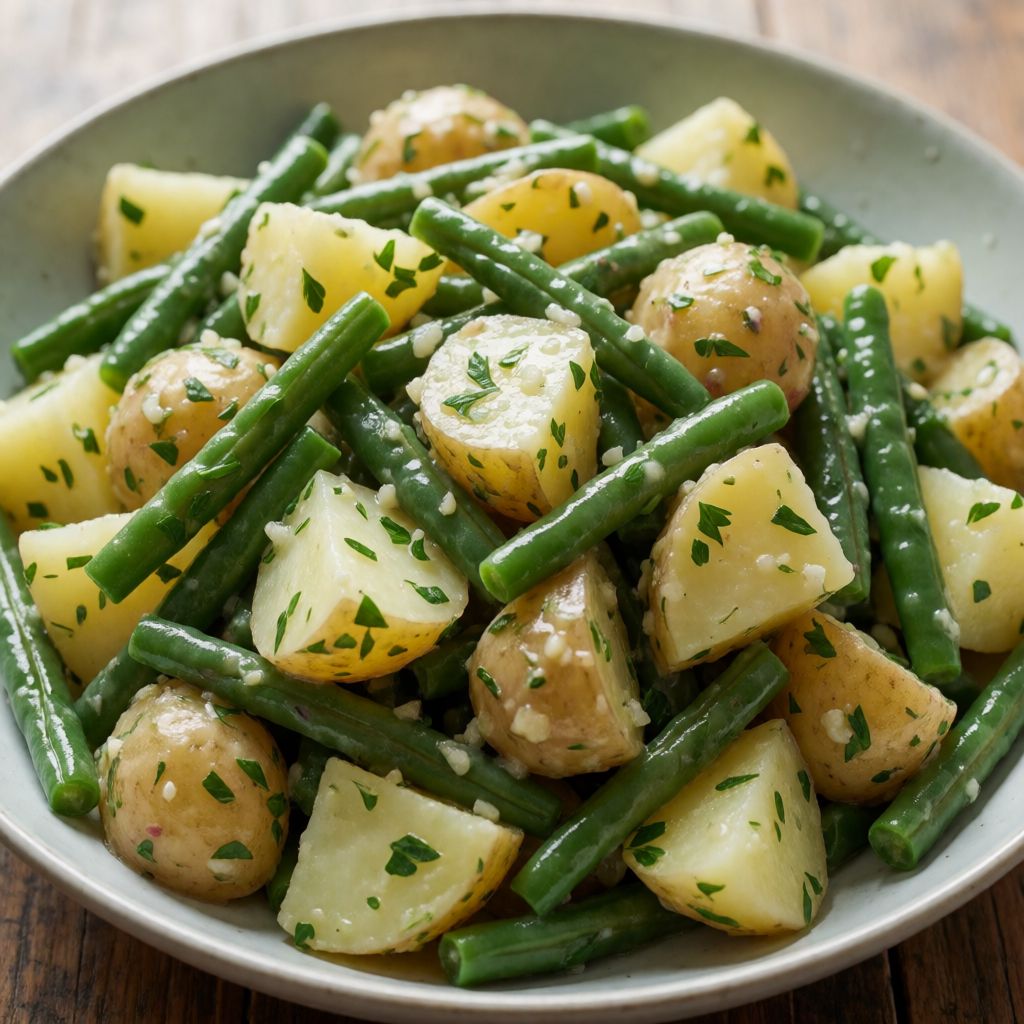
 AI photo
Potato and Green Bean Salad
A simple, fresh salad of boiled potatoes and green beans tossed in an olive oil, lemon and garlic dressing.
Labels are worked out automatically from the ingredients and can be wrong. Check the packaging if it matters to you.
Ingredients
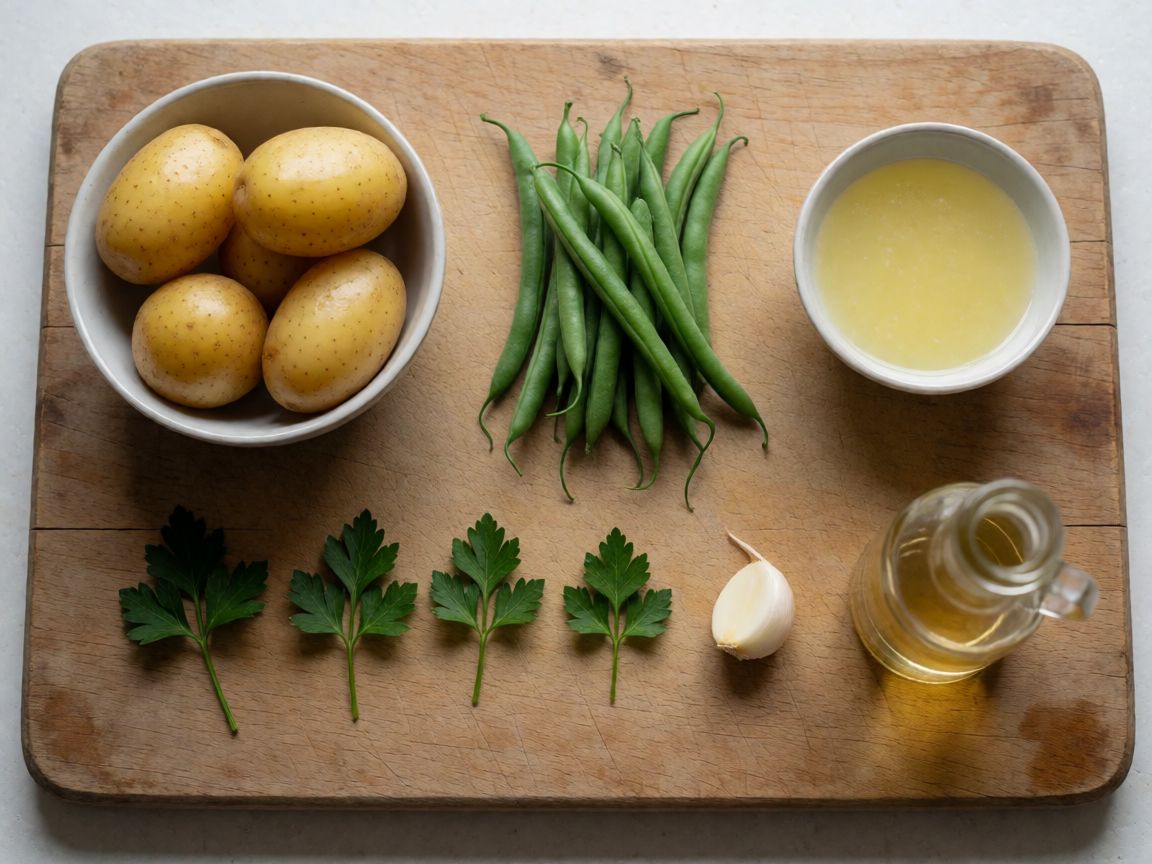
- 400 g Potato
- 400 g Green beans
- 40 ml Olive oil
- 4 pcs Parsley sprigs
- 1/2 pcs Lemon juice juice of half a lemon
- 1/2 clove Garlic
- 20 ml White wine vinegar
- Salt to taste
- Black pepper to taste









Steps
Wash the potatoes thoroughly to remove any soil, then place them in a pot of water. Bring to the boil.
Cook the potatoes for about 40 minutes, until tender.
40 minRinse the green beans under water, trim the ends and remove any tough strings.
Bring a pot of salted water to the boil and add the green beans.
Cook the beans for 4 minutes, then drain and rinse under cold water.
4 minOnce the potatoes are cooked, drain them, peel and cut into large chunks. Transfer to a bowl.
Cut the beans and add them to the potatoes.
Mix the olive oil, white wine vinegar, lemon juice, parsley, garlic, salt and black pepper. Pour the dressing over the salad.
Chill the salad in the refrigerator for a few hours to let it rest and develop flavour.
This isn't really a cooked dish, it's two vegetables managed separately and then introduced to each other under a sharp dressing, after which you leave them alone in the cold to sort themselves out. A boiled potato salad with beans — nothing clever in that sentence — but the whole thing stands or falls on the gap between "done" and "gone too far," and that gap is wide for a potato and about ninety seconds for a bean.
What decides whether it works: whether the potato is tender right through to the middle without the skin splitting and sloughing starch into the water around it, and whether the bean still looks and tastes like a bean — green, with a squeak of bite — rather than the khaki, give-no-resistance thing you get from a tin. Potato and bean want almost opposite handling. The potato wants slow, steady heat it can't escape, boiled whole in its jacket so the inside cooks evenly before the outside gives up. The bean wants a short hard cook and then a cold stop, pulled out the moment it turns, the way you'd grab a child back from the pool edge before they go all the way in.
Some say you should salt the potato water hard, same as you would for pasta. No — a whole potato in its skin barely lets salt through anyway, it's cooking in its own jacket, mostly sealed. It's the bean that needs the salted water, because it goes in naked, no skin to argue with, and the salt gets straight to it.
Potato: go for a waxy or all-purpose type, not a floury one bred for mash and roasting. A floury potato (the kind that makes a brilliant Sunday roast potato) will often break down at the edges in the long simmer and turn the water starchy and cloudy, giving you ragged, half-dissolved chunks instead of a clean cube that holds its corners. Waxy holds its shape under a long boil precisely because it has less starch to swell and burst. If you only have floury potatoes in the cupboard, that's fine — just watch them more carefully near the end, because their forgiving window is shorter.
Green beans: fresh, firm, snapping rather than bending when you flex them — that snap is the test for freshness, a bean that bends like rubber has already lost moisture and will cook limp no matter what you do. Trim the tough stem end and any string along the seam; that string is fibrous and doesn't soften, it just sits there reminding you it's there. Frozen beans work as a substitute and need even less time, since they're already partly cooked in the blanching before freezing — go by colour and bite, not the clock.
Olive oil, 40 ml for four people, is doing two jobs: carrying the garlic and lemon flavour, and coating the vegetables so the dressing clings instead of running off into a puddle at the bottom of the bowl. Use one you'd be happy to taste off a spoon — this isn't a cooking oil here, it's eaten raw, so any harshness or bitterness in it goes straight into the salad with nowhere to burn off. If all you have is a neutral vegetable oil with no character of its own, it'll still bind the dressing, you'll just lose the particular flavour olive oil brings — fine for texture, a loss for taste.
White wine vinegar and lemon juice are both acid, but they're not interchangeable without a thought: vinegar is sharper and flatter, lemon brings sharpness plus a top note of its own fruit. Together they do a job neither does alone — the vinegar cuts through the oil and potato's starchiness, the lemon lifts it so it doesn't just taste sour, it tastes bright. If you're out of one, lean harder on the other and taste as you go; the point is acid sharp enough to wake the potato up, not any specific bottle.
Garlic, half a clove, raw and crushed into the dressing rather than cooked — crushed releases the sulphur compounds that give garlic its bite, and because it never meets heat here, that bite stays sharp rather than mellowing into the sweetness you'd get from roasting. Half a clove sounds stingy until you remember it's raw: a whole clove raw in a dressing this size would dominate the plate rather than season it.
Parsley is here for green freshness and a bit of bitterness to balance the oil — flat-leaf if you can get it, it has more flavour than curly, which is mostly there to look nice at the edge of a plate. No real substitute that behaves the same way, though a little dill would take the dish somewhere else entirely and not necessarily somewhere worse, just somewhere different.