
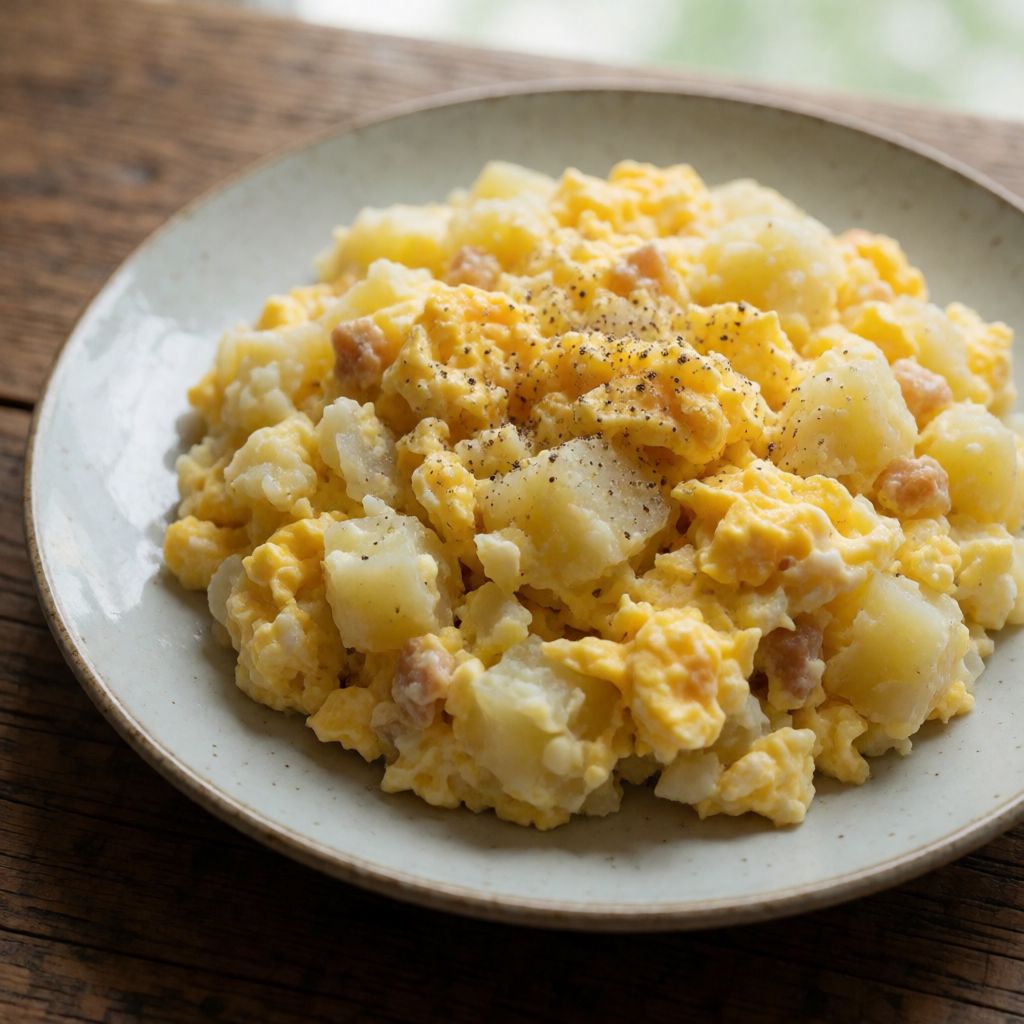
 AI photo
Potato Deruny, Fried in an Ebleskiver Pan
Traditional Ukrainian grated potato pancakes, pan-fried until golden and crisp.
Labels are worked out automatically from the ingredients and can be wrong. Check the packaging if it matters to you.
Ingredients





Steps
Mix the grated potato and beaten eggs in a bowl together with the crushed garlic, salt and pepper.
10 minFry the mixture in butter in a cast-iron ebleskiver pan (a pan with round indentations), until golden on both sides.
5 min
This is grated potato held together by nothing more clever than itself, fried in a mould meant for Danish pancakes - the one with round hollows, sold here as an æbleskiver or poffertjes pan. Forget Danish pancakes for a moment. All that pan is, structurally, is cast iron with small wells, and a well holds heat on every side of whatever you put in it, not just underneath. That's the whole trick: instead of a flat disc with two sides browning, you get a little dome browning almost all the way round, which gives you more crust for the same amount of middle.
What decides whether this works is starch, not egg. Some say you need flour or breadcrumbs to bind a potato fritter - no, because raw grated potato is already carrying its own glue: free starch granules, knocked loose by the grater, sitting in the cell walls. Hit them with hot butter and they gelatinise - swell, go sticky, set. That's the bond. The egg helps, because its protein firms up too and traps the shreds in a net, but it's the second signature on the contract, not the first. Flour is insurance for a watery potato, not a rule.
Which is why you don't squeeze the liquid out here, and some recipes insist you must. In a flat pan, yes - that liquid pools, steams the underside, and you get something closer to a boiled pancake than a fried one. In the ebleskiver pan the wells are narrow and deep, so the liquid has nowhere to pool; it reduces into the starch instead of fighting it, and the butter underneath still gets direct contact with the metal. The pan shape solves a problem the method would otherwise create.
On the potato: grate it coarse, as the recipe says, not fine. Fine grating turns the flesh to a near-purée - it loses its structure, holds less air, and the starch you need is diluted into watery mush that won't set so much as congeal. Coarse shreds keep a lattice, like the warp of a small basket, and the starch gelatinises around that lattice rather than instead of it. In Britain, reach for a floury potato - Maris Piper or King Edward - over a waxy salad potato like Charlotte. Floury varieties have looser cell structure and shed more free starch when grated, which is exactly the glue you're relying on; waxy ones hold their shape better raw but give you less binding power, which here works against you.
Peel it, because potato skin carries a faint bitterness and a different texture, and in a mixture this plain - no flour, no onion, no herb beyond garlic - there's nothing to hide it behind. And work fast once it's grated: raw potato oxidises in air within minutes, the cut surfaces turning grey-brown, which is enzyme meeting oxygen, not spoilage. Mixing it straight into egg coats the shreds and slows that down, which is the real reason to combine everything promptly rather than leave grated potato sitting on a board admiring itself.
The egg does two jobs: it's a second binder, its protein setting with heat alongside the potato starch, and it loosens the mixture enough to spoon into the wells rather than pack it in like a snowball. Two eggs to three potatoes is a ratio, not a law - if your potatoes run large and wet, you might want to lean on a third egg; if small and dry, two will do fine. Garlic goes in raw and crushed, not fried first, because it's protected inside the mixture - it never touches bare metal, so it cooks gently through the surrounding moisture instead of catching and turning bitter the way raw garlic does in dry heat.
Butter is the fat here for taste, not for any technical reason you couldn't replace. Watch it as it melts in the wells: first it foams, then the foam settles and the milk solids start to turn gold-brown and smell faintly of toasted nuts - that's your cue the pan's ready, not a dial setting. If that worries you, or you want a cleaner fry with less chance of the solids catching black before the potato's done, use a fat with no flavour of its own and let butter be a flourish stirred in at the end instead - sunflower or groundnut oil, or clarified butter if you want the taste without the solids that burn.
No ebleskiver pan? You can still make this in an ordinary flat pan - plenty of households here don't own one, and there's no shame in that. You lose the all-round crust and the dome shape; press the mixture into flatter patties with a spatula, since without the well's wall holding the shape for you, gravity is the only thing keeping them together, and flip once the underside is a solid, even gold rather than spotted. It becomes a latke by another name, and a reasonable one.
A small domestic note: this sits well next to a Sunday roast as a change from roast potatoes - same starchy potato, same oven-free convenience on a day when the oven's already busy with the joint. Seven servings as written means small - two or three little domes each, a side, not the main event. And give the batter its ten minutes before frying; it's not wasted time, it's the egg settling into the starch evenly instead of sitting on top of it.