
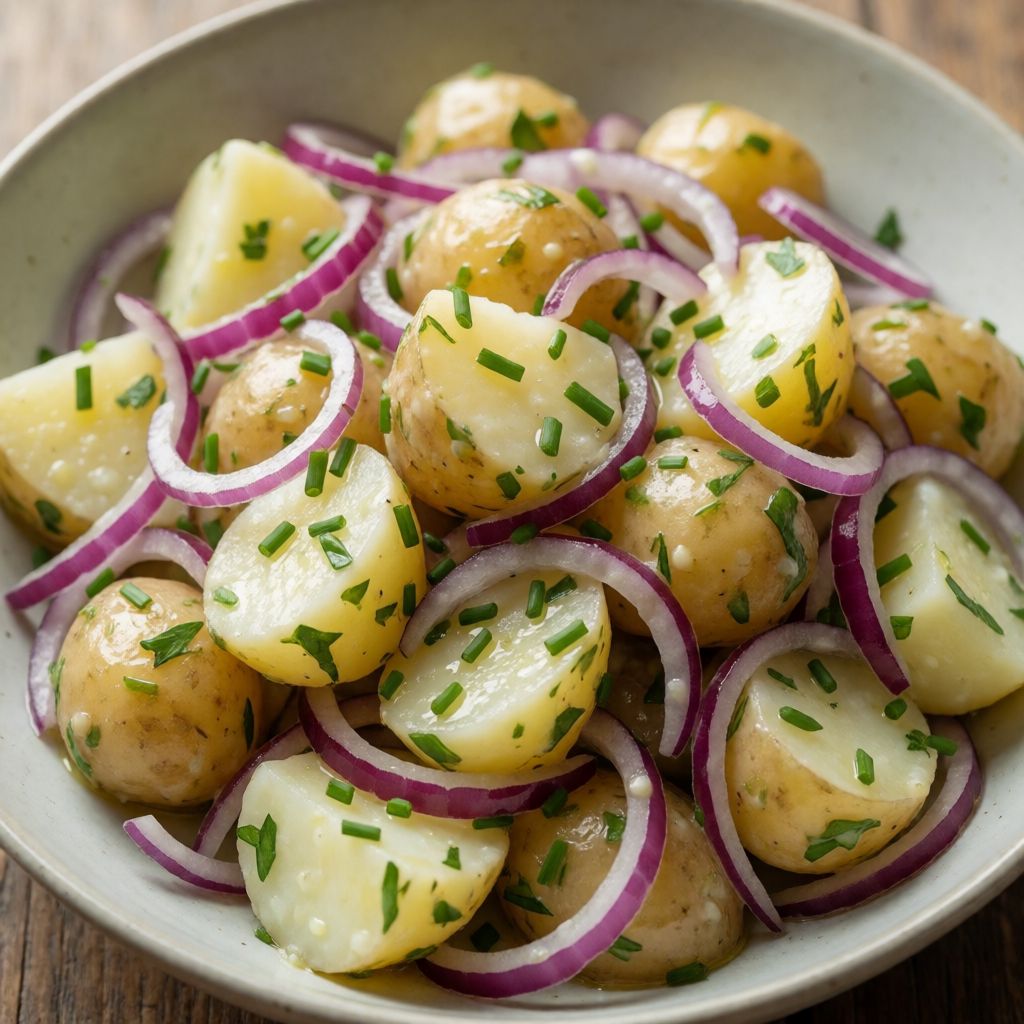
 AI photo
Potato and Red Onion Salad
A simple steamed potato and red onion salad dressed with olive oil and cider vinegar.
Labels are worked out automatically from the ingredients and can be wrong. Check the packaging if it matters to you.
Ingredients
- 2 pcs Potato
- 1 pcs Red Onion
- Chives to taste
- Parsley to taste
- 1 tbsp Olive Oil
- Flavoured Salt to taste
- Black Pepper to taste
- 1 tbsp Apple Cider Vinegar








Steps
Place the potatoes in their skins and the peeled red onion in the steamer basket, adding a few chive sprigs or parsley stalks for aroma.
Steam in an electric steamer.
10 minLet the vegetables cool, peel the potatoes and cut into chunks, and slice the onion.
Dress the vegetables with a vinaigrette of olive oil, apple cider vinegar, flavoured salt and black pepper.
Sprinkle with freshly chopped parsley or chives.
Serve the warm salad as a starter with Gaeta olives.
What was changed
The original pepper blend Black Pepper was replaced with black pepper, a seasoning more familiar in British kitchens.
This is not a potato salad that happens to use steam instead of a pot of boiling water — the steam is the whole point. Boil potato and onion together and you dilute two things at once: the potato's own starch bleeds into the water, and the red onion's pigment, anthocyanin, is water-soluble too — it will dye your cooking water pink and leave the onion itself grey, half-sweet and half-boiled-sock. Steam, and neither of them touches standing water. The potato keeps its starch inside its own skin; the onion keeps most of its colour and bite, just softened at the edges, the way frost softens a leaf without rotting it.
What decides whether this works: the potato has to be a waxy one, and it has to go in whole, skin on, because that skin is the only wall between the flesh and the water vapour — peel it first and the steam carries flavour and texture off with equal enthusiasm. And the vinaigrette has to meet the vegetables while they're still warm, not reheated-warm but just-off-the-steamer warm — the surface starch has opened up at that point, and the potato drinks the oil and vinegar in rather than wearing them as a coat. Dress it cold and you've made a potato wearing a salad costume.
Start with the potato, because it decides more than anything else. You want a waxy variety, something that holds its shape under heat instead of collapsing into crumbs — Charlotte, Jersey Royal in spring, or Maris Peer. Save the floury Maris Piper or King Edward for your Sunday roast, where fluffy and falling apart at the edges is exactly what you're after and exactly what would ruin this. Two medium potatoes in their skins is roughly 300–350g, enough for four as a starter, not as the whole meal.
The red onion does two jobs: colour, and a rounder, milder onion flavour than white or yellow would give you raw. If that's all you have, use yellow, but slice it thinner and expect more bite even after steaming — yellow onion carries more of the sulphur compound that makes your eyes water, and heat alone won't tame that as completely as it does in red.
Chives and parsley appear twice and do two different jobs. The stalks go into the steamer not for a flavour you'll taste directly, but for aroma carried on the vapour itself — the same cheap trick as a bouquet garni. The chopped leaves at the end are for freshness and colour, a job the cooked stalks can no longer do once their aromatic oils have already gone into the steam.
Oil and vinegar are a vinaigrette, and the criteria matter more than the brand names. For the oil: anything that stays liquid and tastes mostly of itself without shouting — a mild olive oil, or a cold-pressed rapeseed oil, which is both local in Britain and genuinely suited to this. For the vinegar: something with a little fruit sweetness behind the acid rather than a flat sharpness — cider vinegar, a light wine vinegar, lemon juice at a pinch, though lemon won't give quite the same roundness.
"Flavoured salt" just means salt that's already carrying something — herb salt, garlic salt, whatever's sitting in the cupboard. Without one, plain salt and a pinch of dried thyme or oregano does the same job; the dressing shouldn't need six bottles to taste finished. Gaeta olives are small, wrinkled, oil-cured, soft rather than glossy — if you can't find them, any oil-cured black olive with that same wrinkled skin will do. The shiny brine-cured kind from a jar of mixed olives is a sharper, different animal and will fight the dressing instead of sitting beside it.
You don't need an electric steamer for any of this. A metal colander set over a few centimetres of simmering water in a wide pan, lid on — or, when the lid has wandered off as lids do, an upturned plate — does the same job. What tells you it's done isn't a clock but a skewer: it should slide into the potato with no resistance at the centre, and the onion should have gone from stiff and squeaky to pliable, bending rather than snapping. Then give it the patience it needs without being told to: let the potato cool just enough to handle without scalding your fingers, no further. That short window, too hot to hold but too cool to still be properly hot, is exactly when the knife should be in your hand — it's the only moment the potato will actually take the dressing in, rather than merely tolerate it on the surface.