
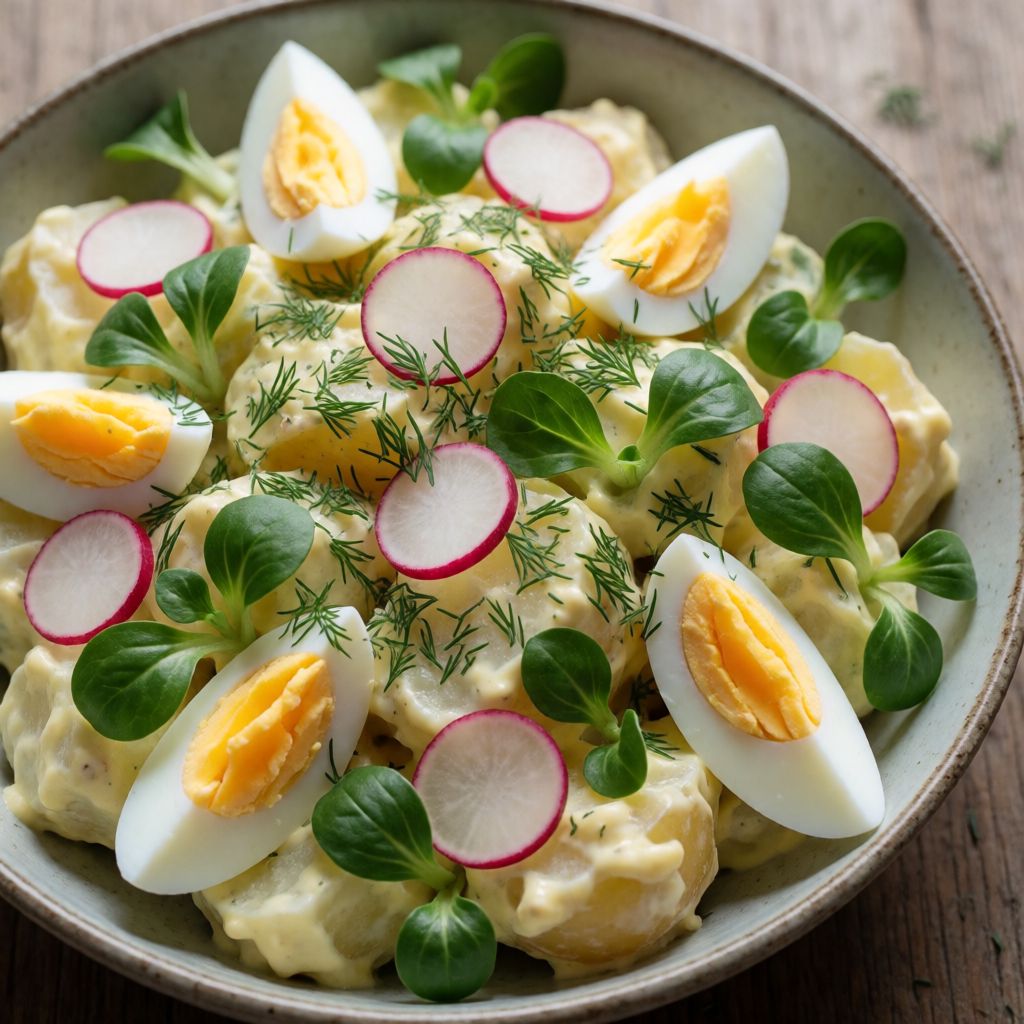
 AI photo
Potato Salad with Eggs, Mustard Dressing and Dill
A fresh potato salad with eggs, mustard dressing and dill, finished with radish and lamb's lettuce.
Labels are worked out automatically from the ingredients and can be wrong. Check the packaging if it matters to you.
Ingredients










Steps
Whisk together the mustard dressing and season to taste. Set aside to let the flavours develop.
Wash the potatoes and boil them in a pan of lightly salted water until tender.
20 minDrain and leave the potatoes to cool to room temperature, then cut them in half.
10 minPut the eggs into a pan of boiling water and cook for 7.5 minutes.
8 minDrain and cover with cold water until the eggs have cooled. Peel and halve the eggs.
5 minToss the potatoes with the mustard dressing and arrange in a bowl with the lamb's lettuce and radishes.
Top with the eggs and sprinkle with dill, salt and freshly ground pepper.
This is a warm-potato salad, and that's the whole trick of it. Potatoes that go into dressing hot — or at least no colder than your hand — drink the mustard and oil instead of just wearing it. Cold boiled potato has a skin that's gone tight and closed; warm potato is still a bit porous, still breathing out steam, and it pulls the dressing in through that open structure. Toss the same potato once it's sat on the counter for an hour and gone fridge-cold, and the dressing just sits on top like rain on a waxed jacket. So "leave the potatoes to cool to room temperature" is not really about temperature for its own sake — it's about catching the window where they're cool enough to handle without burning your fingers, warm enough to still take the dressing.
Some say you should dress a potato salad once it's fully cold, "so it doesn't go soggy." No — soggy comes from waterlogged potato, not warm potato. If your potatoes taste wet and bland, the water got in during boiling, not during dressing.
On the potatoes themselves: you want a variety that holds its shape when boiled — a waxy potato, not a floury one. Floury potatoes (good for mash, for roasting) collapse at the edges in water and give you a salad of mush and grit. In a UK shop, ask for "salad potatoes" or anything sold as waxy — Charlotte, Jersey Royals in season, or a new potato. If all you've got is a floury main-crop potato, boil it in the skin and handle it gently; the skin holds it together where the flesh alone would fall apart.
The mustard in the dressing wants to be a proper table or Dijon-style mustard — something with real bite, not a mustard powder paste or a sweet American mustard that's mostly sugar and vinegar already. If honey is also sugar, and your mustard is sweet too, the dressing loses its edge; that's the one substitution worth being careful with. Any smooth mustard with heat will do the job mustard is there for: to make the oil and lemon juice hold together as an emulsion instead of separating into oily puddles and sour puddles.
Olive oil here just needs to be an oil with no strong flavour of its own fighting the lemon and dill — a light olive oil, a sunflower oil, a rapeseed oil (and rapeseed is the one actually grown and pressed in Britain, worth knowing if you want a local bottle). Save anything heavily peppery and green for drizzling at the table, not for whisking into a dressing with mustard and honey, where its flavour just gets lost and wasted anyway.
Honey is there to round off the sharpness of mustard and lemon, not to make the thing taste of honey. A teaspoon less or more won't hurt you; taste as you go rather than trusting the spoon measure blindly, because mustards vary a lot in how hot they are.
Lamb's lettuce (sometimes sold as corn salad) is a soft, mild leaf that wilts the moment it meets warm, dressed potato — which is exactly its job here, to go slightly limp and pick up dressing rather than sit crisp and separate like a side salad. If you can't find it, use a soft baby spinach or a mild butterhead lettuce; avoid anything tough and bitter like rocket or a hard romaine, which will fight the dressing instead of taking it on.
Radishes are the one raw, crunching, peppery thing in the bowl against all that soft warm potato and egg — slice them thin enough that you get the bite without a mouthful of radish. And the two bunches of dill: one goes in early with the leaves, the other is for sprinkling at the very end, because dill loses its sharp, almost aniseed smell fast once it's cut and sitting in warmth — add it last so it still smells of something when it reaches the table.
This feeds four as a proper side, or two as a light lunch with bread. It's not a dish that minds waiting a little once assembled — but don't make it hours ahead and expect the lettuce to still look like lettuce. Patience belongs to the dressing and the eggs, not to the finished bowl sitting around.