
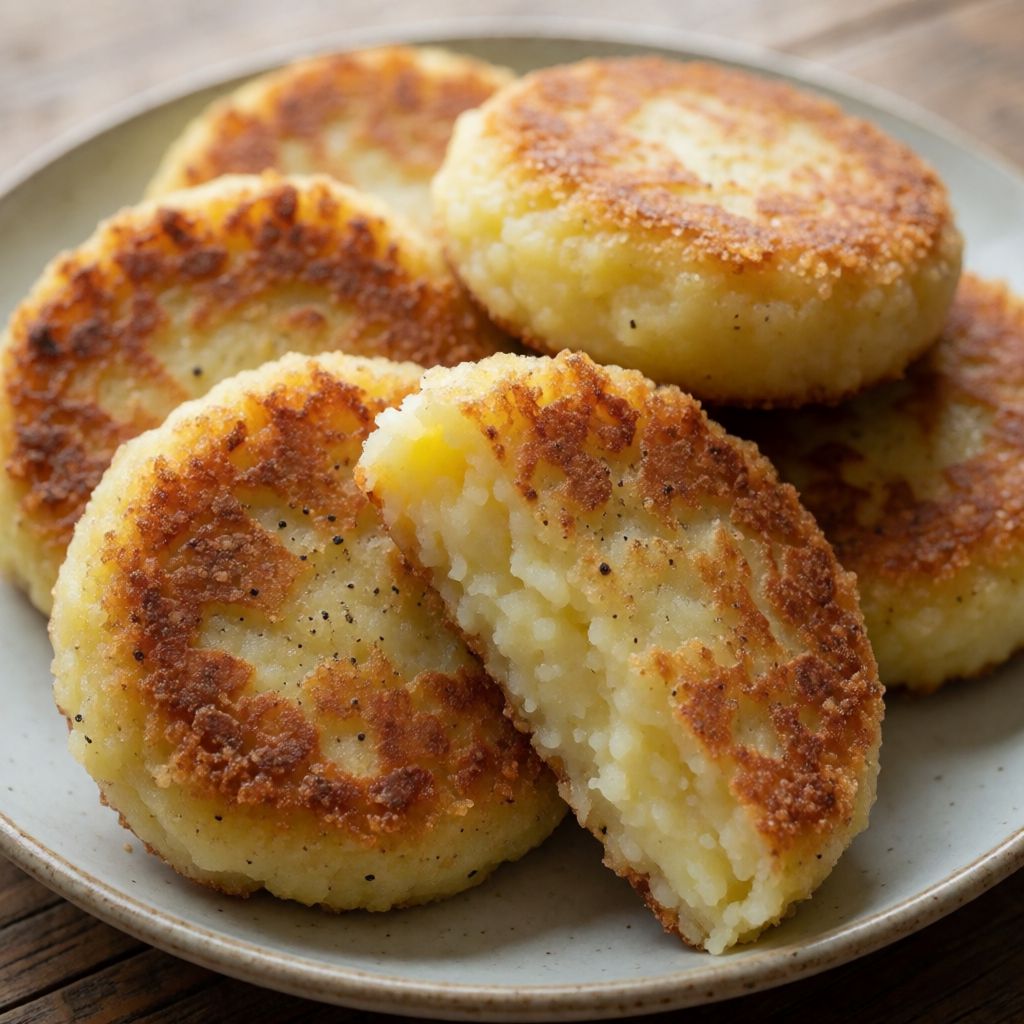
 AI photo
Potato Toasties: A Tasty Dinner Fix
A quick, comforting potato dough filled with ham and melting cheese, cooked on a griddle.
Labels are worked out automatically from the ingredients and can be wrong. Check the packaging if it matters to you.
Ingredients
- 500 g Potatoes
- 1 pcs Egg
- 200 g Plain flour
- Salt to taste
- Black pepper to taste
- Olive oil to taste
- 100 g Ham
- 100 g Smoked scamorza or provolone





Steps
Boil the potatoes in their skins in plenty of water. Leave to cool, then peel.
Push the potatoes through a potato ricer, add salt and pepper, and beat in the egg.
Mix well and gradually work in the flour, kneading the dough by hand.
On a lightly floured surface, roll out the dough to a thickness of 4-5 mm.
Cut an even number of rectangles, each about 10x12 cm.
Fill half the rectangles with thin slices of scamorza or provolone and ham.
Top with a second layer of potato dough to form the toasties, and brush with olive oil.
Heat a griddle pan and cook the toasties in small batches.
Fry for about 5 minutes on each side, brushing the second side with oil too.
5 minServe hot, while the cheese is still lovely and stretchy.
What was changed
We swapped the rice flour for Plain flour, the flour most British cooks keep in the cupboard.
This is a potato dough sandwich — essentially gnocchi dough rolled flat, stuffed with ham and melting cheese, then fried on a dry griddle instead of boiled. Think of it as what happens when toastie logic meets gnocchi logic: the bread is replaced by potato, and the "toasting" comes from a hot ridged pan rather than two slices of white bread and a sandwich press.
What decides whether this works is the dough, and the dough is decided by the potato. Push boiled, cooled, peeled potato through a ricer and you get a dry, even crumb with no lumps — that's what lets you add flour sparingly. Mash it with a fork instead and you get pockets of wet potato that force you to add far more flour to get a workable dough, and more flour means tougher, more "bready" toasties instead of soft ones. Some say any potato will do — no, because a waxy, wet variety holds water that never properly escapes in boiling, and you end up compensating with flour at the dough stage, which is the wrong place to fix a water problem.
Cooling before peeling and ricing isn't fussiness, it's starch physics: hot potato is wet and gluey, and working it warm makes a sticky, overworked dough that toughens when fried. Let it sit, let the steam leave, then work it — the dough stays short and tender.
Potatoes: 500 g, boiled whole in their skins. Skin-on boiling keeps water from flooding into the flesh through cut surfaces — peeled, cut potato boiled in water acts like a sponge and you'd be ricing something waterlogged. If you're starting from a British supermarket bag, reach for a floury type — Maris Piper, King Edward — the kind sold for mash and roasties, not for salads. A waxy potato gives you a sticky, wet mash that drinks more flour than it should, and the extra flour is what turns a tender toastie into a chewy one.
Egg: one, there to bind the ricer-fine potato and the flour into a dough that holds together on the rolling surface and doesn't crumble when you stuff it. Without it you lean harder on flour again to get the dough to cohere — same problem, same fix in the wrong direction. If you need egg-free, a spoon of plain yoghurt or a touch more potato starch gets you some of the binding, though the dough will be slightly less elastic.
Plain flour: 200 g is a target, not a law — the real amount is whatever your ricer potato needs to stop sticking to your hands. Work it in gradually for exactly this reason: too little and the dough tears when you fold it over the filling; too much and it fries up dense instead of light. Any plain, low-protein flour works; strong bread flour will fight you by developing gluten and turning the dough elastic and tough, which is the opposite of what potato dough is for.
Ham and scamorza (or provolone): the filling is deliberately simple because the dough is already rich. Thin slices matter — thick ham or thick cheese either won't melt through in the frying time or will split the seal between the two potato layers as steam pushes it open. Provolone is the easy substitute because it's the same family of stretchy, low-leak cheese — if you're hunting in a UK supermarket and find neither, a drier mozzarella (the block type, not the ball in brine) will behave similarly; the wet, fresh ball mozzarella will weep water into your dough and is worth avoiding here.
Olive oil: brushed on, not poured. This isn't about flavour so much as conduction and browning — a dry potato dough on a dry hot surface will stick and tear before it colours; a thin film of oil gives even contact and a crust. Choose any oil with no strong smell of its own — a light olive oil, a neutral vegetable oil, even clarified butter if you want richness — because a heavily flavoured extra virgin will mostly burn off on a hot griddle and leave bitterness instead of aroma.
On the pan: a griddle pan in a British kitchen is a fair stand-in for what this dish really wants — strong, dry, direct heat without a kazan or open flame. You're not looking for a number on the dial; you're looking for a pan hot enough that a brushed surface sizzles gently on contact rather than sitting inert. Go in batches, not because tradition says so, but because crowding a shallow domestic pan drops its heat fast, and a cooled pan steams the toasties soft instead of crisping them — which is the one thing that ruins the texture here.
Doneness isn't a clock. Five minutes a side is your floor, not your answer — what you're actually waiting for is a dough gone from pale and raw-looking to golden with visible blistering, firm enough to lift cleanly on a spatula without the filling spilling. The cheese tells you the rest: cut in while it still pulls into strings, and you know you got the timing right. Let it sit too long off the heat and that stretch is gone — so this is a dish to eat standing at the counter if need be, not one to plate up and leave for tea to brew.