
 AI photo
Potatoes with Roe
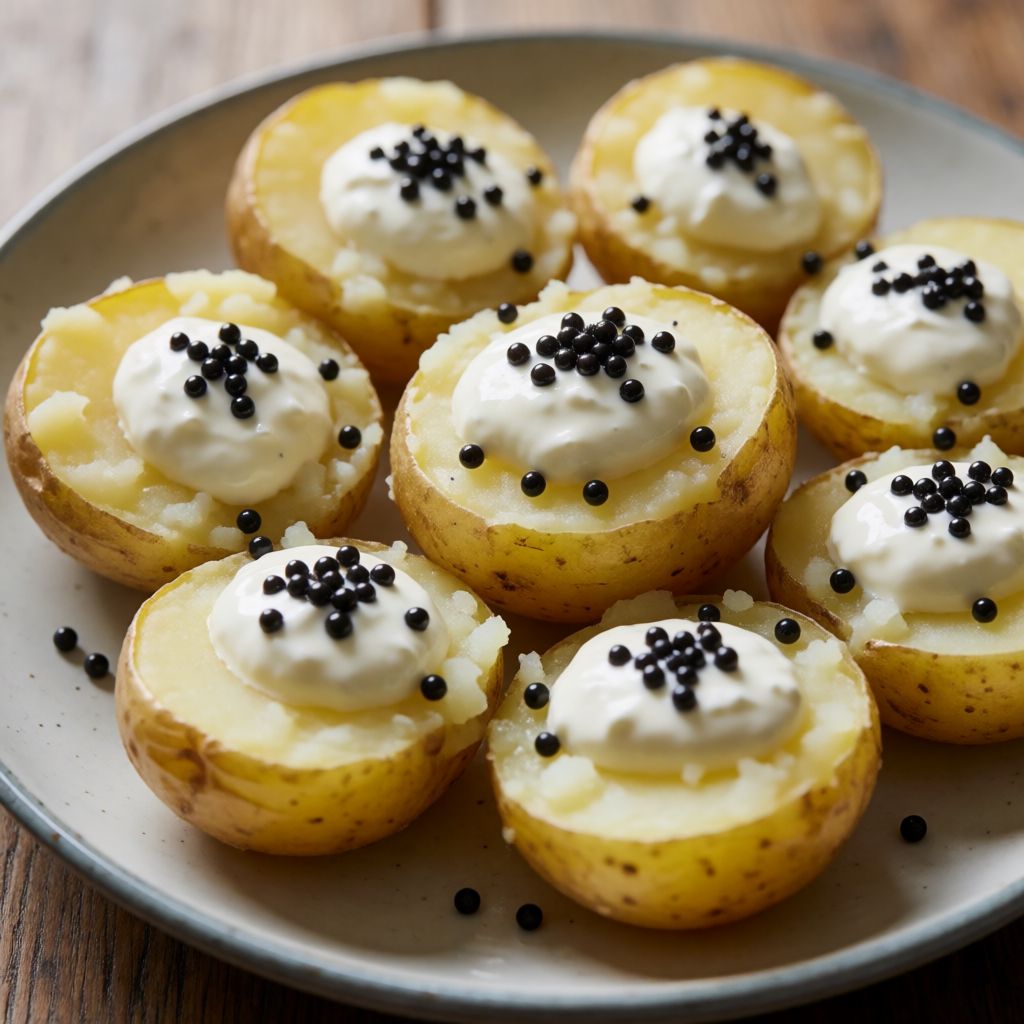
Crispy baked potato slices topped with crème fraîche, roe and fresh herbs — an elegant appetiser or side.
Labels are worked out automatically from the ingredients and can be wrong. Check the packaging if it matters to you.
Ingredients






Steps
Thoroughly dry the potatoes with a clean towel.
3 minPlace the potatoes on a baking tray lined with parchment, tossing first in the olive oil, then in the salt.
2 minBake in a preheated oven at 200°C (fan/convection) for 25–30 minutes, or until cooked through.
28 minLet the potatoes cool completely.
12 minCut the potatoes into thick slices and arrange on a plate or platter.
2 minPlace a small spoonful of crème fraîche on each potato slice, then a little lumpfish roe on half the slices and a little trout roe on the other half.
2 minFinish with dill and parsley, and serve immediately.
1 min
This is a cold, composed dish — not a cooked potato with a garnish thrown on, but a plate where the potato has one job: be a pedestal. Baked skin-on, cooled hard, sliced into disks, it carries cold crème fraîche and two kinds of fish roe. Nothing here gets heated again after it leaves the oven, and that's the whole point. It's the Nordic-Russian zakuska logic transplanted to a Sunday-roast kitchen: cheap starch doing the heavy lifting so a small, expensive thing — the roe — goes further and looks generous.
What decides whether it works is patience with the cooling, not skill with the knife. Cut a hot potato and it crumbles or weeps starch; the crème fraîche won't sit, it'll slide off or half-melt into the warmth and go thin and sour-smelling instead of cool and rounding. You need the potato fully cold — properly room-temperature cold, right through — so the flesh has firmed up enough to hold a clean cut and support weight on top without bowing.
Some will tell you a dish this delicate needs the potato peeled. No — leave the skin on. Baking it skin-on seals the moisture inside while the outside, coated first in oil then salt, dries and concentrates into a thin savoury crust. Peel it first and that moisture just escapes as steam; you'd get a dry, flat-tasting potato with nothing for the salt to grip onto.
Potato first, because it's the one choice that can quietly ruin this without you knowing why. You want a waxy variety — Jersey Royal, Charlotte, Anya, any new potato sold as 'salad' type — because low starch means the structure holds when you slice it into disks after baking. The floury kind you'd reach for on a Sunday, Maris Piper or King Edward, is bred to go fluffy and fall apart under fat and heat, which is exactly wrong here: it'll crumble at the knife instead of giving you a clean round to build on.
The oil and the salt aren't seasoning in the usual sense — they're how you get a crust at all on a potato that's otherwise just going to steam inside its own skin. Oil first so the salt has something to cling to and so heat transfers evenly across the surface instead of scorching bare patches. Any oil with no strong smell of its own will do this job; olive oil earns its place here because its flavour doesn't fight the brine of the roe later, but if you'd rather the roe speak alone, a flavourless oil like sunflower does the structural work just as well.
Crème fraîche at 38% fat isn't there for richness alone — it's a buffer. Fish roe is salt-cured, and eaten on its own in any quantity it's a wall of salt and brine. The fat coats and mutes that, and the acidity in crème fraîche does what a squeeze of lemon would otherwise be asked to do, so don't feel you're missing a step by not reaching for a lemon — the dish already has its acid built in. If you've only got soured cream, use the full-fat kind; thin or low-fat versions will just run off the potato instead of sitting on it. Mascarpone is too rich and has no acid of its own, so it won't cut the salt the same way — fine in a pinch, but it's not doing the same job.
Lumpfish roe is the frugal cousin in this pairing — small, black- or red-dyed eggs, firm, with a dry little pop. It became a pantry staple precisely because real sturgeon caviar got scarce and expensive, and someone worked out that herring and lumpfish roe, salted and dyed, gave a similar bite and a similar look for a fraction of the cost. Trout roe sits next to it for contrast rather than necessity: bigger beads, a softer, almost buttery burst, and a warmer colour. Put both on the plate and you get two different mouthfuls instead of one — that's the only reason there are two.
Dill and chives go on last, and only at the very end, because once you chop herbs they start to wilt and darken the moment they sit around, especially near anything salted or damp. Chop them close to serving, not ahead of time, and you keep the colour and the sharp smell that's the point of adding them at all.
None of this is quick, and it shouldn't be rushed to look quick. The oven time is fixed by what the potato needs; the cooling time is fixed by what the crème fraîche and the roe need. Try to shortcut the cooling and you're not saving ten minutes, you're swapping a clean plate of potato rounds for a mess of warm mash with caviar sinking into it.