
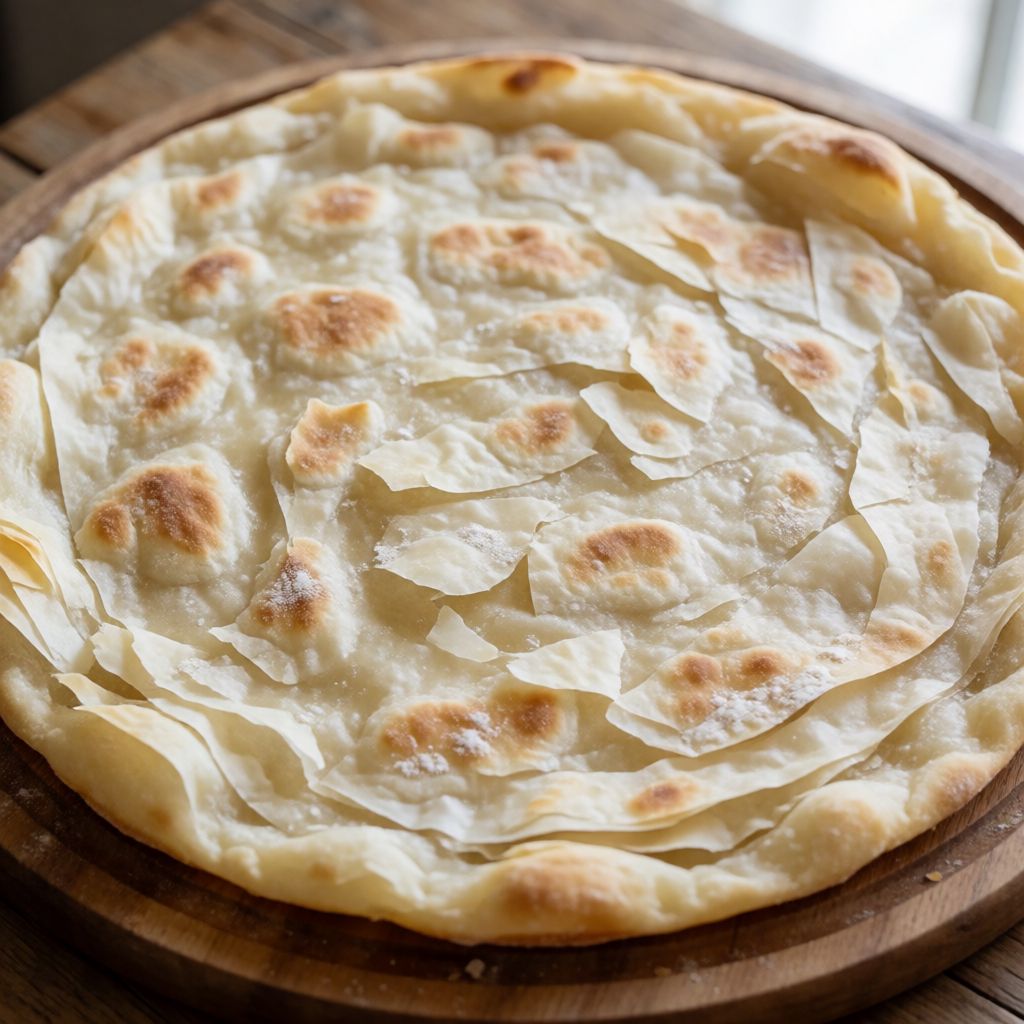
 AI photo
Crescia Sfogliata
A traditional Italian layered flatbread, rolled thin and pan-fried until flaky and golden.
Labels are worked out automatically from the ingredients and can be wrong. Check the packaging if it matters to you.
Ingredients
- 500 g Plain Flour
- 125 ml Water
- 75 ml Milk
- 50 g Lard
- 1 pcs Egg
- 6 g Salt
- Oil or Lard to taste, for brushing the dough






Steps
In a large bowl, tip in the flour, add the egg and mix with a fork. Pour in the water and milk, add the lard and salt. Knead everything into a smooth, even dough.
Divide the dough into 10 equal pieces, roll into smooth balls, cover with cling film and leave to rest.
60 minRoll each ball out thinly with a rolling pin on a lightly floured surface. Brush the surface with oil or lard. Roll the dough into a log, then coil it into a spiral.
Cover the spirals with cling film and let them rest in the fridge.
60 minRoll out each spiral on a floured surface with a rolling pin into thin round flatbreads, 1–2mm thick.
Heat a frying pan and cook the flatbreads one at a time. When bubbles appear on the surface, flip and cook on the other side.
The finished flaky crescia can be filled with your favourite filling and served.
This isn't bread. No yeast goes in, no rise happens on the counter — what you're building here is layers, the same trick as puff pastry, except you do it by hand on a board instead of folding butter into a block for a professional kitchen. The crescia puffs because steam gets trapped between greased sheets of dough and has nowhere to go but up. That's the whole mechanism. Everything else in the recipe exists to protect that mechanism from the things that wreck it.
Two things decide whether this works, and neither of them is a step you can rush. First: the dough has to rest, twice. Roll a fresh, unrested dough thin and it fights you — it springs back the moment you lift the pin, because the gluten you just stretched wants to snap home like elastic. Rest lets that tension drop out quietly, so the second rolling goes thin without tearing or shrinking back. Second: after you've oiled, rolled, and coiled the dough into a spiral, it goes in the fridge, not just under cling film on the side. That's not for food safety. It's to keep the lard solid. Warm fat bleeds into the dough and you lose the sharp boundary between layers — the very thing that lets steam prise them apart later.
Flour: plain, not strong bread flour. You want enough gluten to hold a thin sheet together without it tearing, but not so much elastic strength that it refuses to stay rolled thin — which is exactly the fight a bread flour would give you, because more protein means more spring-back, and spring-back is the enemy of a 1–2mm sheet. Plain flour, properly rested, behaves.
The egg is doing structural work, not flavour work. It firms the dough slightly and gives it a bit more body than a plain water-and-flour piadina dough would have — that's the real difference between a crescia and its plainer cousin from Romagna next door. Skip the egg and you've made a different, thinner-tasting bread; it'll still puff, because the puffing has nothing to do with egg, but the bite will be flatter.
Lard is the hinge the whole lamination turns on. The criterion for the fat here: solid at room temperature, melts cleanly without leaving water behind, and brings no flavour of its own that fights the filling you'll put in later. Lard does this well and historically was free — a by-product of the pig every farming household kept, with nowhere else to go and no fridge needed to store it. Cold butter will do the job in a pinch, but butter is roughly 15–20% water, and that water turns to steam earlier and more aggressively than lard's near-zero water content does — your layers can separate too fast, too soon, before the rest of the sheet has had a chance to set. White vegetable shortening is the closer modern substitute if you want neutral and solid without hunting down lard.
Water and milk together, rather than all water: milk's fat and milk sugars soften the bite and help the surface colour more readily in the pan — a crescia made with water alone comes out paler and slightly tougher. It's a small adjustment, not a structural one, which is why the ratio leans toward water rather than away from it.
Salt at 6g isn't just there for taste. In a dough this plain, salt tightens the gluten network a touch, which is part of why the dough holds its shape through two rollings and a coiling without falling apart in your hands. Leave it out and the dough gets slack and harder to manage, not just blander.
On the pan itself: this recipe was always meant for a flat surface over direct heat, so your ordinary frying pan is the right tool, not a compromise. Choose the heaviest one you have — thin, cheap pans develop hot spots, and a hot spot will char one patch of dough before steam has had time to build evenly across the rest and lift the layers properly. You're watching for bubbles rising under the surface before you flip; that bubbling is literally the steam doing its job. No bubbles yet means the pan hasn't got there. Scorched spots with a pale, unpuffed centre mean the pan was hotter than the dough's thinness could keep up with — ease it back next time rather than guessing a number, since no thermometer is going to tell you this better than your eyes will.