
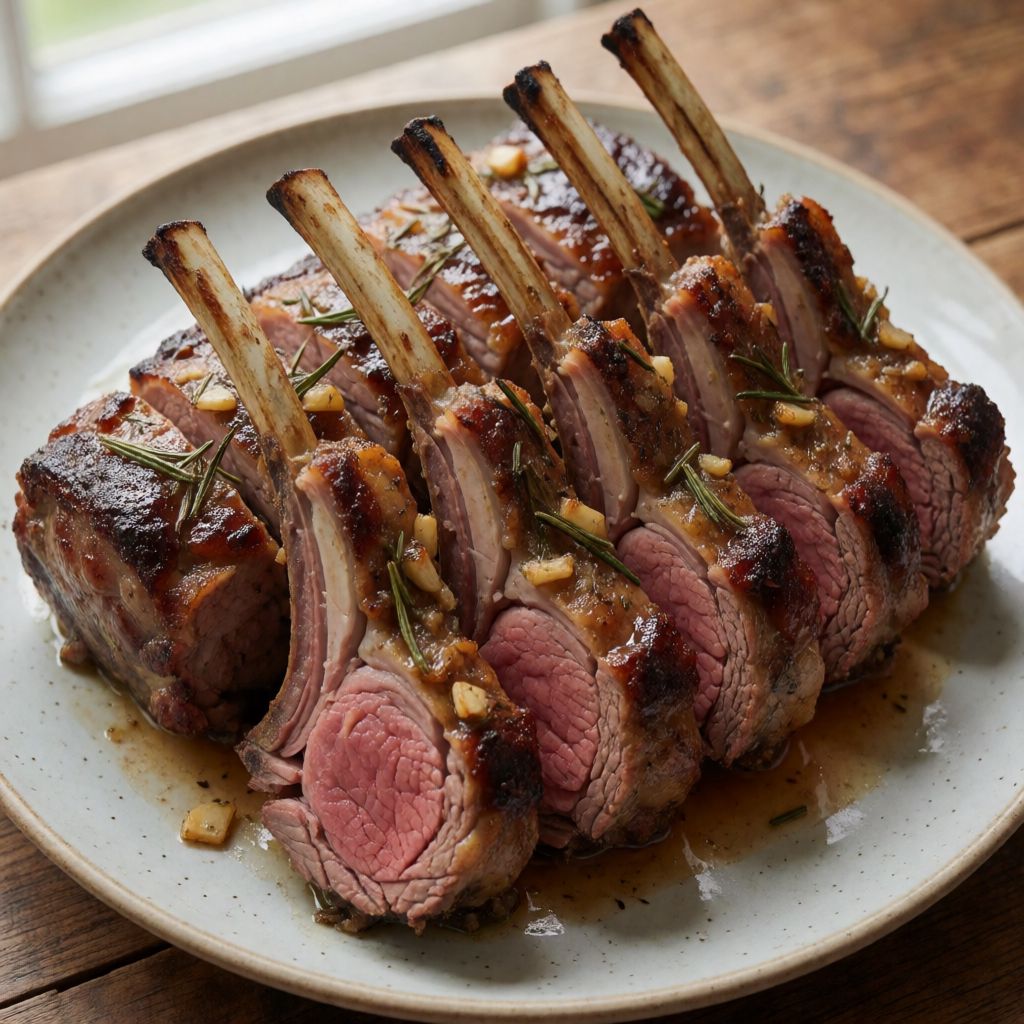
 AI photo
Rack of Lamb with Rosemary Roast Potatoes
A rack of lamb roasted with a fragrant rosemary salt rub, served with rosemary roast potatoes and carrots.
Labels are worked out automatically from the ingredients and can be wrong. Check the packaging if it matters to you.
Ingredients










Steps
Pat the rack of lamb dry with paper towel, then score the fat in a diamond pattern, cutting only into the fat, not the meat.
Put the salt, garlic and rosemary in a mortar and grind to a fragrant green rosemary salt.
Mix in the pepper and rub the mixture over the rack of lamb, pressing it well into the cuts.
Place the rack of lamb in an ovenproof dish and roast at 175°C fan, fat side up, for 20-30 minutes (ours took 24-25 minutes).
25 minLet the meat rest for 10-15 minutes before carving.
12 minFor the rosemary potatoes, put the rosemary and salt in a mortar and grind thoroughly to a fine green rosemary salt.
Grease an ovenproof dish with a little olive oil, then thoroughly toss the potato slices, carrot slices, crushed garlic and red onion rings with the olive oil, rosemary salt and freshly ground pepper.
Spread the mixture in the ovenproof dish and scatter small pieces of butter over the top.
Roast at 175°C fan for 40-45 minutes, until the potatoes are tender.
42 min
A rack of lamb is eight or nine ribs still joined along the spine, with a cap of fat on one side. That fat is the whole point of the cut — it's what you're really roasting, and the meat underneath is just along for the ride. Score it in a diamond, fat only, and you've opened a thousand little doors for the salt and garlic to walk through, and for the fat itself to render and baste the meat from above as it melts. Skip the scoring and you get a rubbery white sheet sitting on top of pink meat, doing nothing for either.
What decides whether this works is restraint at two moments: the oven, and the knife. 175°C fan is not hot enough to char — it's hot enough to render fat slowly while the meat inside stays rosy. Pull it when the fat is gone from pale yellow to deep gold, biscuit-coloured, not when a clock tells you to; 20-30 minutes is a guess based on how your oven and your rack behave, not a law. Then — and this is the part people skip because they're hungry — you let it sit. Ten, fifteen minutes under foil or an upturned bowl. Cut it straight from the oven and the juice runs onto the board instead of back into the meat; you've basically poured out what you just spent an hour building.
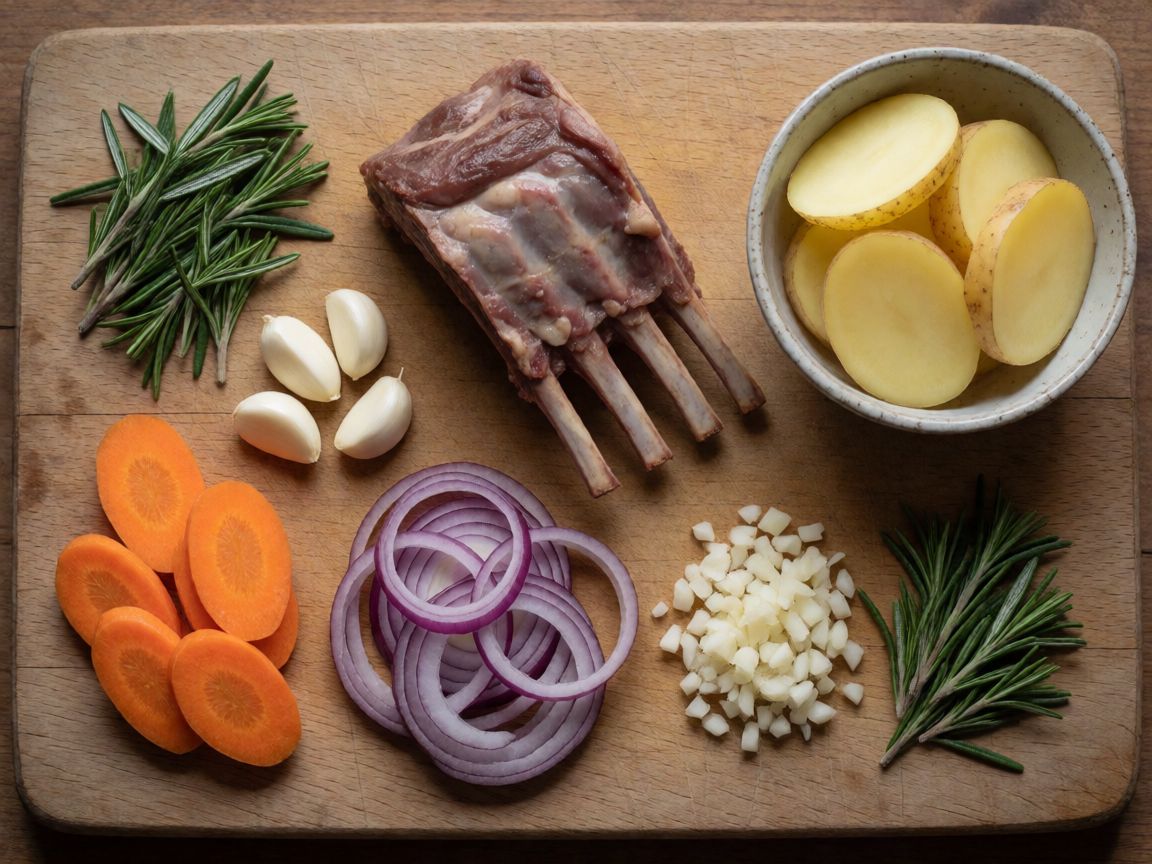
Rack of lamb itself is the ingredient that does the deciding, so buy it with your eyes before anything else. Look for fat that's white, not yellow — yellow means an older animal and a stronger, more "farmy" flavour, which some people want and some people don't, but it's worth knowing which you're getting. Ask the butcher to french it if it isn't already — that's the rib bones scraped clean of fat and membrane so they stand up bare, partly for looks, partly because bare bone chars less and burns your fingers less when you pick it up to carve between the ribs by eye.
Rosemary needles, fresh, not dried — dried rosemary is basically tiny woody splinters with a shadow of the oil the fresh leaf has, and pounded in a mortar it won't release anything, it'll just sit there. If you've only got dried, use a third of the amount and expect less. Garlic goes in raw with the salt because the coarse salt crystals act as an abrasive, grinding the garlic into paste rather than you mincing it with a knife — that's the only reason the mortar is called for here rather than a board.
The rosemary salt itself is a trick worth knowing beyond this dish: salt crystals bruise the rosemary oil out of the leaves as you grind, so you end up seasoning with flavoured salt rather than seasoning and flavouring separately. It's the same reasoning restaurants use for herb salts generally — one pass, even distribution, nothing sitting on the surface in clumps that burn.
Potatoes want to be a variety that holds its shape under an hour of heat — a waxy or all-rounder potato, not a floury mashing potato that'll collapse into the carrots. In the UK that's your Maris Piper at a push, or King Edward if you want more bite; a specifically waxy variety like Charlotte will hold shape even better if you have it, though it browns less. Carrots just need peeling and slicing to roughly the same thickness as the potato so they cook at the same rate — thick carrot next to thin potato means one's raw while the other's mush.
Butter scattered over the top at the end rather than mixed through with the olive oil earlier does a specific job: it sits on the surface and melts down through the vegetables as they finish, carrying its milk solids into the top layer where they can brown slightly and taste of butter, rather than being diluted through the whole dish from the start. If you're avoiding dairy, a bit more olive oil poured over near the end does something similar, just without the browning.
The olive oil wants no strong personality of its own for the lamb rub — you want the rosemary and garlic to be what you taste, not the oil. Any neutral oil with no smell works for greasing the dish; save the good extra virgin, if you have one, for finishing the vegetables once they're out, where its flavour actually survives the heat instead of cooking off.
One more thing on patience, because it's easy to treat it as an afterthought: the resting time isn't dead time, it's doing something. As meat cools from oven temperature, the muscle fibres relax and reabsorb the juice that heat has pushed toward the surface. Carve too soon and that juice is still at the surface, waiting to run out the second your knife opens it up. Ten minutes costs you nothing except waiting, and it's the difference between lamb that's pink and wet inside and lamb that's pink and dry.