
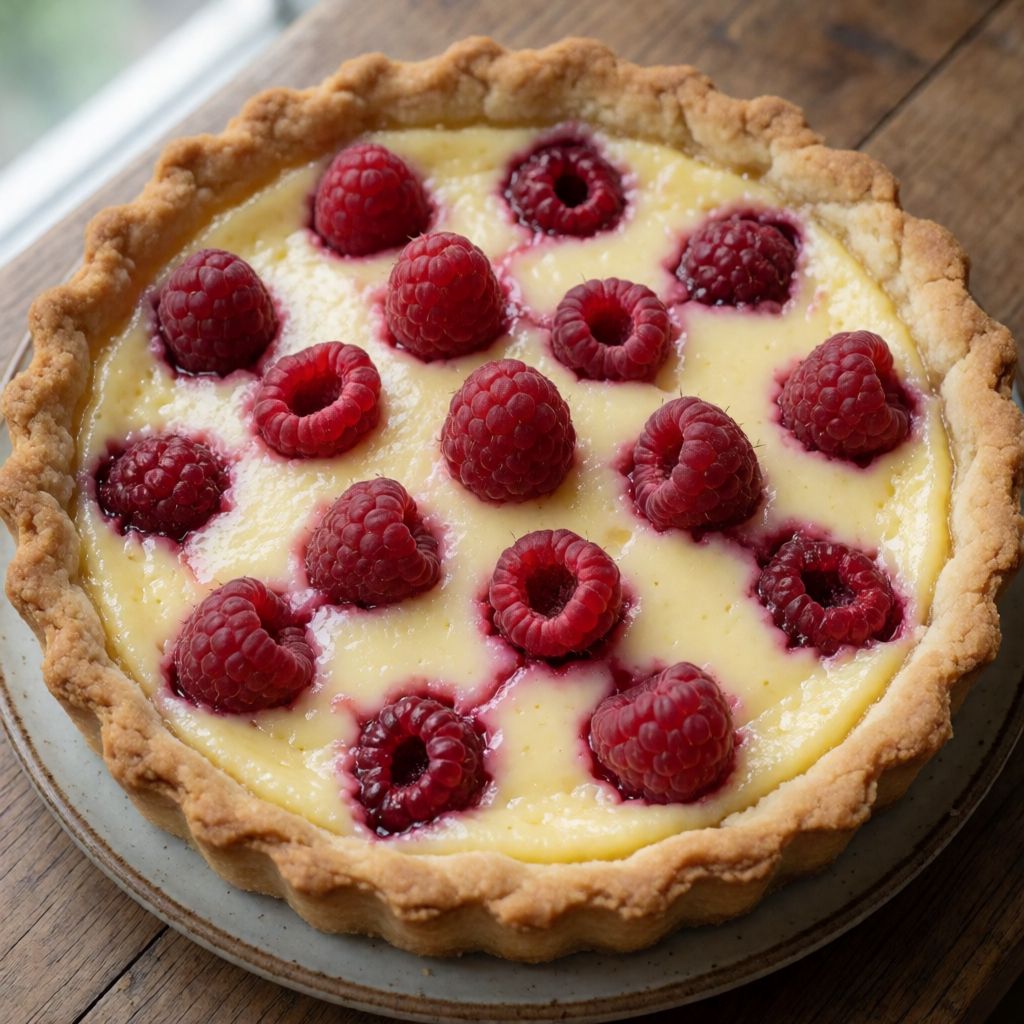
 AI photo
Raspberry Custard Crostata
A buttery shortcrust base filled with smooth vanilla custard and topped with fresh raspberries.
Labels are worked out automatically from the ingredients and can be wrong. Check the packaging if it matters to you.
Ingredients
- 500 g Raspberries
- 300 g Plain flour
- 150 g Caster sugar
- 150 g Butter cold, cubed
- 1 pcs Egg
- 0.5 l Milk
- 150 g Caster sugar
- 75 g Plain flour
- 4 pcs Egg yolks
- pinch Salt to taste
- pinch Icing sugar for dusting






Steps
On a work surface, pile the flour into a mound, make a well in the centre and add the sugar, cold butter cut into pieces, and a pinch of salt.
Add the egg yolk and the whole egg and knead by hand until you have a smooth, even dough.
Wrap the dough in cling film and chill in the fridge to rest for at least 30 minutes.
30 minBring the milk to the boil in a saucepan.
In a separate bowl, whisk the egg yolks with the sugar, gradually adding the sifted flour.
Pour the mixture into the milk and return to the heat.
Cook over low heat, stirring constantly, until the custard is thick and smooth.
Let the custard cool completely.
Preheat the oven, then butter and flour a 26-28 cm crostata tin.
Roll out the dough to a thickness of 4-5 mm and line the tin, trimming off any excess dough around the edges.
Prick the surface with a fork and bake at 180°C for about 15 minutes.
15 minLet the base cool completely.
Spoon the custard over the shortcrust base and decorate with raspberries.
Dust with icing sugar if desired.
What was changed
Removed an unrelated item, , that did not belong in this dessert.
A crostata is a tart built backwards from how you'd think: you bake the shell empty, cool it completely, then fill it with a custard that never sees the oven again. That split is the whole point. Pastry wants dry heat and no moisture nearby or it goes soft and sad; custard wants gentle, patient cooking on the hob where you control it by eye, not by a timer. Put them together too early — warm custard into a warm shell — and you get a soggy base within the hour. Cool both, fully, before they meet.
What decides whether this works isn't the raspberries on top, pretty as they are. It's two separate disciplines done well: a pastry (pasta frolla, if you want the name) that's short and sandy rather than chewy, and a custard (crema pasticcera) that's thick enough to hold its shape when you cut a slice, not a puddle that runs out from under the fruit.
The dough is kneaded briefly, by hand, cold — that's not fussiness, it's physics. Butter that stays solid and in small flecks, rather than melting into the flour, is what gives you "short" pastry: it bakes into separate sandy layers instead of one dense biscuit. Work it too long or too warm and the butter blends in fully, the gluten develops, and you get something closer to bread than pastry. The 30 minutes in the fridge afterwards isn't optional resting for show — it lets the gluten relax (so the dough doesn't shrink and pull away from the tin edges when baked) and firms the butter back up before it meets the oven.
For the base: 300 g plain flour is just flour, nothing fancy, the same bag you'd use for a Victoria sponge or Sunday roast gravy. The butter has to be cold and cubed — straight from the fridge, not softened on the counter — because its job is to stay as separate flecks through the mound-and-well method, not melt into a paste. If your kitchen is warm, work fast, or even chill the flour too; a hot summer afternoon is the enemy of short pastry more than any recipe step is. One whole egg plus one yolk (you'll use the other three yolks in the custard) bind the dough without making it wet — egg yolk carries fat, which keeps pastry tender, while the white in the whole egg gives it just enough structure to hold a shape without cracking when rolled.
Rolling to 4-5 mm matters more than it sounds: thinner and the base turns brittle and cracks when you lift the finished tart; thicker and you get a doughy, underbaked ring where the custard sits, because the centre of a 26-28 cm tart never gets the direct heat the rim does. Pricking the base with a fork before baking isn't decoration — it lets steam escape through those little tunnels instead of building up under the dough and pushing it into a dome, which would give you an uneven surface for the custard to sit in. If you don't own a proper crostata tin, a loose-bottomed flan tin from the baking aisle does the same job — the removable base is the real requirement, not the shape, because you need to get a delicate shell out without cracking it, and a solid tin leaves you prising at pastry with a palette knife and a prayer.
The custard is just milk, sugar, egg yolk and flour cooked slowly until it thickens — the same family as the stuff under a trifle, so if you've ever made that, you know the texture you're aiming for: it should coat the back of a spoon and hold a line when you drag a finger through it. The trick, and the only real trick in it, is temperature control on an ordinary hob: bring the milk to the boil first so it's hot when it meets the egg-sugar-flour mix, then cook the combined lot on low heat, stirring constantly. Some say a bain-marie is essential for custard — no, because what actually curdles egg yolks is a sudden jump to high heat, not the absence of a water bath; constant stirring on a gentle flame does the same protective job, and it's one less pan to wash in a flat that doesn't have a kazan-sized hob to spread pans across. Flour here (rather than cornflour, which some versions use) gives a slightly denser, more cuttable set — fine for a tart you want to slice cleanly rather than spoon.
If you're out of plain caster sugar for dusting, icing sugar from the baking cupboard is interchangeable at this stage — it's only there for a last dusting on top, not for sweetening anything that's already cooked. And if raspberries are out of season or the ones in the shop look sad and pale, any soft summer berry — strawberries halved, blueberries whole — sits on custard the same way; the raspberry's only non-negotiable job is tartness against all that sweet custard and short pastry, so whatever you swap in, keep something sharp.
Patience is the actual ingredient that makes or breaks this, more than any single step. The dough needs its chill, the custard needs its slow stir, and the baked shell needs to go stone cold before you fill it — rush any one of those and you're eating something that tastes fine but falls apart on the plate. This isn't a tart you build in one sitting after work; it's one you start the base for at lunchtime and finish for tea.