
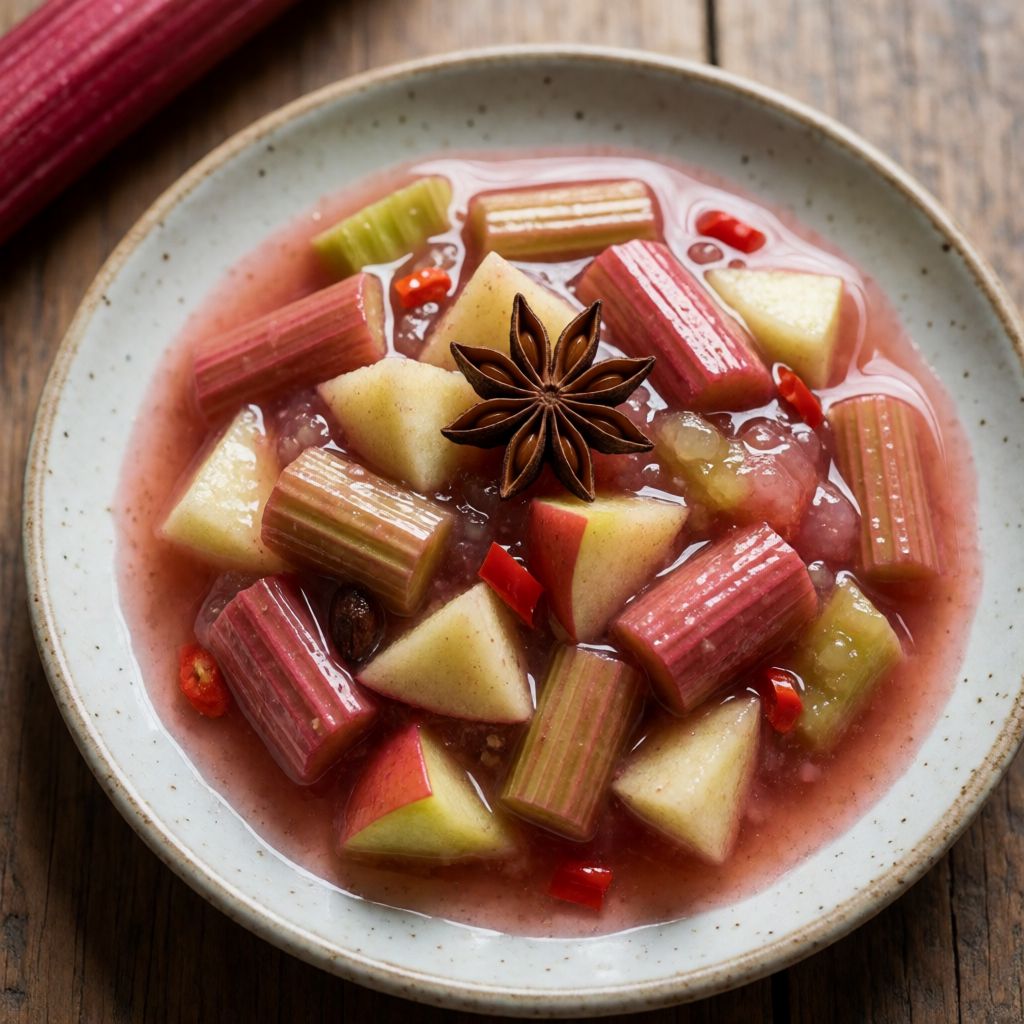
 AI photo
Rhubarb Jam
A simple homemade rhubarb jam spiced with cinnamon, vanilla, star anise and a touch of chilli.
Labels are worked out automatically from the ingredients and can be wrong. Check the packaging if it matters to you.
Ingredients
- 400 g Rhubarb cleaned and cut into roughly 1cm slices
- 1 pcs Apple coarsely grated
- 150 g Sugar
- 2 pcs Star anise
- 1 pcs Chilli finely chopped
- 1 tsp Cinnamon
- 0.5 tsp Vanilla powder or 1 whole vanilla pod





Steps
Put all the ingredients into a saucepan and simmer, covered, for 30-45 minutes.
38 minRemove the star anise and ladle the jam into sterilised jars while it is still hot.
5 min
This is a fruit jam built on a vegetable with almost no body of its own. Rhubarb is basically water and acid — pull a bare stalk through a hot pan and it collapses into sour mush, it will never set. So the whole mechanism of the dish is: give rhubarb something to lean on. That something is the grated apple, which carries the pectin rhubarb lacks. Everything else — sugar, spice, chilli — is there to manage water and flavour, not structure.
Some say rhubarb sets on its own because it behaves like a fruit in the pan. No — because pectin lives in the apple's cell walls, not the rhubarb's, and without it you've made a thick cordial, not a jam. That's the whole reason the apple is grated rather than chopped: more surface, faster breakdown, pectin released sooner instead of sitting locked inside chunks.
Forget minutes as your main clock. Rhubarb tells you itself: it goes from pink ribbons to collapsed fibre, the liquid around it turns from watery to glossy and coats a spoon in a sheet instead of running off in a thin stream. Cold-saucer test if you want certainty — a dab that wrinkles when you push a finger through it is done; if it just slides, it needs longer, whatever the clock says.
The lid matters because of what it stops, not what tradition says. Rhubarb releases plenty of its own liquid as it breaks down — a lid traps that steam and lets the fruit cook in its own moisture at a gentle simmer, rather than you having to add water, which would only dilute the one thing you're trying to concentrate.
Rhubarb itself: buy it by colour and season, not by habit. Early forced rhubarb — pink, slim, tender — needs barely any cooking and has a cleaner sourness. Field rhubarb, thicker and greener, is more fibrous and takes longer to collapse; if that's what you've got, cut it smaller than 1cm so it breaks down in the same window. Always trim the leaves off completely and discard them — they carry a much higher concentration of oxalic acid than the stalk does, which is the one genuine danger in this ingredient, not the stalk itself, which is perfectly safe in normal quantities.
The apple is doing the real engineering. You want one with backbone — a cooking apple (Bramley is the obvious UK choice) breaks down to a soft pulp fast and is naturally high in pectin and acid, both of which help the set. An eating apple will work, it just gives a milder structure and less tang, so taste at the end and nudge with a squeeze of lemon if the jam feels flat rather than sharp.
Sugar here isn't only sweetness. It pulls water out of the rhubarb's cells by osmosis, which is half of how the mixture concentrates and sets, and it's also what keeps the jam stable once jarred — low water, low spoilage. 150g against 400g rhubarb and a whole apple is a light hand; this jam stays tart on purpose, built to cut through something rich rather than stand alone as dessert. If your Sunday roast runs to pork or lamb, this is where a spoonful earns its place on the plate, the acid doing the job gravy can't.
Star anise, cinnamon, vanilla and chilli are the warm counterweight to all that sourness — they don't need defending, they need discipline. Star anise especially: pull it out the moment the jam is done. Left sitting in a warm jar, its oil keeps bleeding into the fruit for weeks and turns a pleasant background note into something medicinal. Chilli, finely chopped, is there for a slow heat under the sweetness, not fire — deseed it if you want warmth without punch. Vanilla pod, split and scraped, gives you real seeds and a rounder sweetness than the powder; the powder is the honest stand-in when a pod isn't in the cupboard, not a downgrade to apologise for.
On an ordinary hob, use the widest pan you own rather than a deep saucepan — more surface means the steam you're trapping under the lid still has somewhere to escape evaporation into once it's done its job of breaking the fruit down, and the jam won't need an age at the end to thicken. Patience is the one ingredient not on the list: push the heat to hurry it and the sugar catches on the bottom before the rhubarb's given up its structure, and you'll taste the scorch in every jar after.
Sterilising the jars and ladling while the jam is still hot isn't ceremony, it's physics: heat kills what's sitting on the glass, and a hot jam going into a hot jar, lid on straight after, pulls into a vacuum seal as everything cools. That seal is what lets this sit in a cupboard rather than a fridge — no magic, just contracting air.