
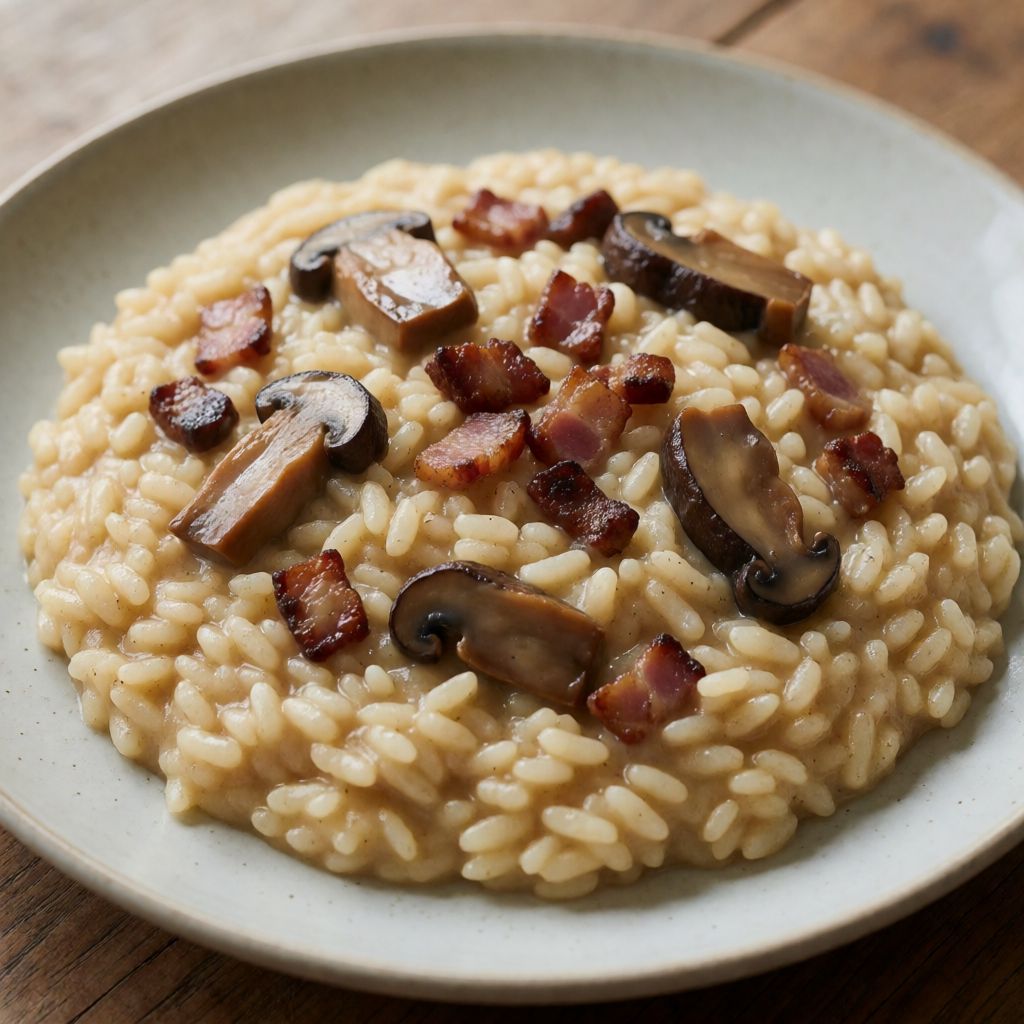
 AI photo
Porcini Mushroom and Smoked Bacon Risotto
A creamy Italian risotto with wild porcini mushrooms and smoky bacon, finished with butter and parsley.
Labels are worked out automatically from the ingredients and can be wrong. Check the packaging if it matters to you.
Ingredients
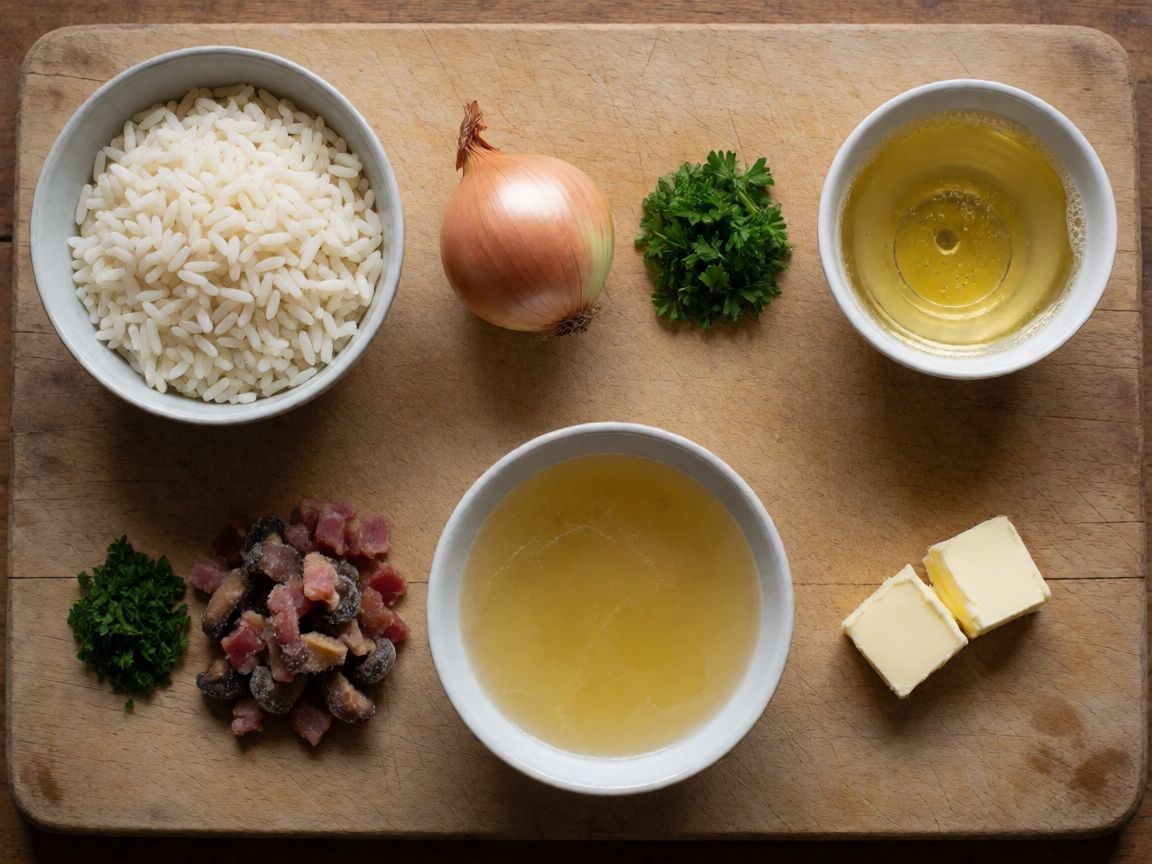
- 350 g Risotto rice (Baldo or Carnaroli)
- 1 pcs Onion
- 1 bunch Parsley chopped
- 2 tbsp Olive oil
- 150 g Smoked bacon diced
- 300 g Porcini mushrooms fresh or frozen
- 250 ml Prosecco
- 1 l Vegetable stock
- 1 pinch Salt to taste
- 1 pinch Black pepper to taste
- 20 g Butter











Steps
Fry the onion and parsley in a pan with 2 tbsp of olive oil.
5 minAdd the smoked bacon and fry until crisp, then add the porcini mushrooms.
5 minAdd the rice and toast it, then pour in the prosecco and let it almost completely evaporate.
5 minGradually add the vegetable stock in small amounts until the risotto is cooked.
15 minSeason with black pepper, add salt to taste, and stir in the butter until creamy.
2 minServe sprinkled with parsley.
Risotto is not a soup and not a pilaf — it's a technique for coaxing starch out of a short, fat rice grain until the liquid around it turns into its own sauce. This one takes that technique and feeds it ingredients from the Alpine foothills: wild porcini from the autumn woods, smoked bacon from the pig that fed the family all winter, a glass of the prosecco that was open anyway because someone's name day fell that week. Humble stuff, dressed up by method, not by cost.
What decides whether it works is not flavour — bacon and mushrooms are forgiving — it's rice management. Carnaroli or Baldo hold a firm core even as their outer layer dissolves into starch; that's the whole trick, a grain that is soft on the outside and resistant at the centre. You get that by giving the rice liquid in small, repeated doses, never a flood, so each grain has time to drink before you add more. Dump the whole litre of stock in at once and you get rice cooked through evenly — which sounds fine until you taste it and find mush with no bite, because the starch comes out all at once and chokes the grain before the centre is done.
Some say you must stir risotto without stopping, wooden spoon welded to your hand for twenty minutes. No — because what stirring does is knock starch loose from the grain's surface and keep heat distributed through the pan; it is not a ritual, it is friction with a purpose. Stir too hard and too long and you break the grains open, and then you've made rice pudding with mushrooms in it, not risotto. Stir, pause, add stock, stir again — rhythm, not endurance.
Start with the rice, because the whole method is built around it. You need a short-grain variety that is mostly amylopectin starch on the outside and holds its shape in the middle — Carnaroli and Baldo both do this; Carnaroli is the forgiving one for a first attempt, less prone to going soft if you're a beat slow with the ladle. Arborio from the supermarket shelf works as a substitute, just watch it more carefully near the end, it collapses faster. When you toast the rice in the fat before any liquid goes in, you're not browning it for flavour — you're coating each grain in oil so the outer layer takes slightly longer to absorb water. Skip this and the rice drinks stock too fast at the start, and you run dry and panicky at minute eight instead of minute fifteen.
Porcini bring the depth here — earthy, almost meaty, which is exactly why they pair with bacon instead of fighting it. Fresh or frozen both release water when they hit the pan; you need the heat high enough, and the pan wide enough, that this water boils off rather than turning the mushrooms into something stewed and grey. This is where a domestic frying pan actually beats a deep pot — more surface, faster evaporation. No fresh or frozen porcini to hand? Dried porcini, soaked in warm water for twenty minutes, will do the job and better — just strain the soaking liquid through a cloth or coffee filter and use it as part of your litre of stock, because that liquid is where most of the aroma ended up. Chestnut mushrooms alone won't substitute properly; they're mild where porcini are not, so if you use them, back them up with a spoon of porcini powder or a few rehydrated dried ones for the smell.
The bacon needs rendering, not frying. Low enough heat that the fat melts out of the lardons before the outside crisps — rush it and you get bacon that's charred outside and raw-fatted within, and you've lost the fat you wanted for the base. That rendered fat is doing real work: it's the medium the onion and parsley first went into, and now it's seasoning the rice as you toast it. Any smoked, cured pork cut into small pieces will stand in — pancetta affumicata, speck, even the smoked gammon end you've got left from a Sunday roast. Unsmoked bacon loses the point of the dish; if it's all you have, a pinch of smoked paprika gets you partway there, though it's a patch, not a fix.
The prosecco goes in to deglaze — its acidity lifts whatever's stuck to the pan from the bacon and mushrooms, and the alcohol cooks off along with the rawest edge of that acidity, leaving brightness behind rather than a wine taste. It does not need to disappear entirely; you're not trying to erase it, you're trying to tame it. Any dry white with decent acid does this job — the sparkling part of prosecco is tradition and conviviality (an opened bottle at a gathering, why waste half of it), not chemistry. A flat Pinot Grigio or a dry Picpoul from a British supermarket does exactly the same thing in the pan.
Stock has to go in hot, ladle by ladle, kept at a bare simmer in a second pot beside the risotto — cold stock dropped into a working pan stops the cooking dead for a minute while everything comes back to temperature, and that minute is when grains overcook unevenly at the edges while the centre lags. Vegetable stock from a cube is perfectly fine if you season carefully elsewhere, since cubes run salty; better still, keep the vegetable trimmings from your Sunday roast — carrot ends, onion skins, celery — in the freezer and simmer them for twenty minutes before you start. For four people, a litre is about right; you'll likely use most of it, maybe hold a splash back in case the risotto needs loosening once the butter goes in.
Butter at the end — off the heat, this is the step called mantecatura, and it's the one place in the recipe where rushing shows immediately. The starchy liquid clinging to the rice is an emulsion waiting to happen: beat cold butter through it vigorously, away from direct flame, and fat, water and starch bind into that glossy, creamy sauce risotto is known for. Do it over heat, or with butter too soft, and it splits — you get oil pooling on top instead of cream through the dish. The parsley works in two doses for the same reason good cooks use two doses of most things: the bunch fried with the onion loses its brightness but builds a grassy base note into the fat everything else cooks in; a fresh scattering at serving gives you back the smell you lost. Patience is the ingredient nobody lists — stand by the pan, ladle in hand, and don't wander off. Risotto punishes absence.