
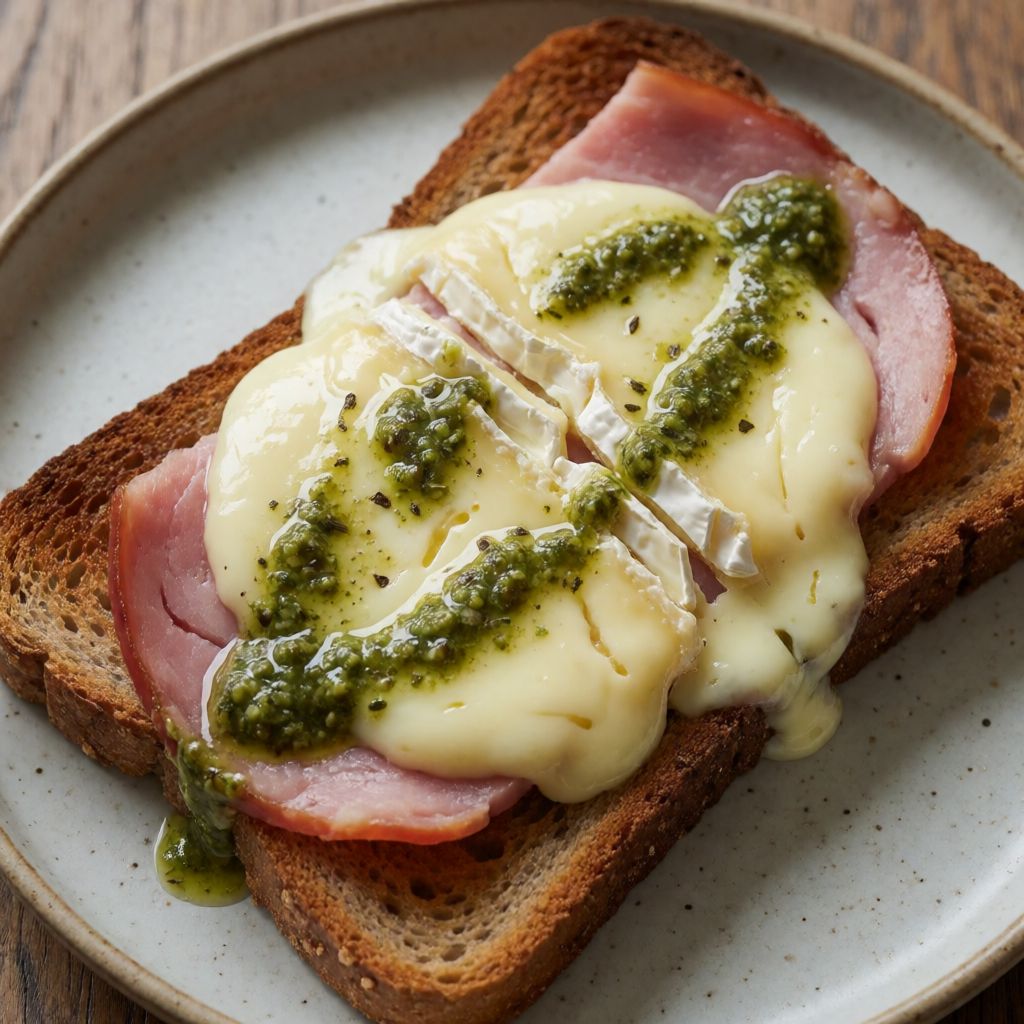
 AI photo
Rye Bread Toast with Brie and Pesto
A quick rye bread toast with melted brie, Serrano ham and pesto, ready in minutes.
Labels are worked out automatically from the ingredients and can be wrong. Check the packaging if it matters to you.
Ingredients
- 2 pcs Rye bread slices
- 2 pcs Brie slices
- 1 pcs Serrano ham slice
- 2 tbsp Pesto
- 1 tsp Butter





Steps
Spread pesto on both slices of rye bread, then place the brie and Serrano ham between them.
Press the bread slices together and spread a little butter on the outside.
Toast in a toaster, panini press or frying pan until the brie melts and the bread turns crispy.
3 minServe and eat while warm.
Forget the fancy name. This is a toastie — a pressed sandwich with cheese, meat and a sauce instead of butter and marmite, done in a frying pan or a toaster. There's no ancestry to respect here, no grandmother's method to defend. It's a good idea built on one simple mechanic: the fat on the outside browns the crust while the fat inside the cheese does the opposite job — it turns brie from a dense white brick into something you can pour.
What decides whether this works is a race. Brie needs real time and gentle heat to go from solid to cream right through the middle. Bread crust needs far less time to go from pale to gold to actually burnt. If you turn up the heat to hurry things along, you lose that race every time: the outside is already black before the inside has gone soft. So the whole method is really about slowing the crust down to let the cheese catch up — which is why the heat has to be modest and the time has to be generous, not the other way round.
Some people think a hotter pan makes a better toastie, faster and crispier. No — because speed is exactly what ruins this one. A hard sear works for a steak, where you want a crust on the outside and pink left alone inside. Here you want the opposite: everything inside turned liquid, and the outside only just turning gold. Rush it and you get burnt bread wrapped around a cold, unmelted lump of cheese — the classic toastie failure, and it's always a heat problem, never a cheese problem.
Rye bread is the one structural decision in this whole thing. It's dense and tight-crumbed, so it survives pressing without collapsing into paste, and it holds moisture inside instead of drying to crumbs the way a fluffy white sandwich loaf does under heat. Any firm, closed-crumb bread does the same job — a dense sourdough, a seeded wholemeal, even a dark German-style loaf. What you're avoiding is soft, airy bread that squashes flat and goes leathery rather than crisp.
Brie is chosen for one property: it's a soft-ripened cheese, which means the inside is already halfway to liquid before you add heat. That's why it's the right cheese for a fast domestic toastie and a hard cheddar isn't — cheddar needs much longer and higher heat to run, by which point your bread is gone. Any white-rind cheese that softens the same way works as a stand-in — camembert, a ripe taleggio. The criterion is: does it go creamy with gentle heat, or does it just sweat?
The pesto isn't decoration. It sits between dry cured ham and dry toasted bread as a moisture bridge — its oil stops the ham drying out further under heat and stops the inner bread surface from going cardboard. Any strong, oil-carried paste can take its place — a sun-dried tomato paste, even a good mustard if you want something sharper instead of herbal, though that pulls the whole flavour in a different direction, so know you're changing the dish, not just substituting an ingredient.
Serrano ham is there for salt and a bit of chew against all that soft cheese, not for substance — one slice is enough, which is why the recipe doesn't ask for more. It's cured, not raw meat that needs cooking through, so all it needs from the heat is warming, not cooking. Push it too hot for too long and it goes from silky to leathery — that's the usual fault with cured ham in a hot sandwich, and it's a heat-and-time mistake, not a meat quality one. Any dry-cured ham does the job the same way — prosciutto, Parma ham, even a smoked streaky bacon if you cook that separately first, since raw bacon fat needs proper rendering that a three-minute toastie won't give it.
Butter goes on the outside, never the inside, because its job is the crust, not the filling. Spread inside, it just sits on bread that's already getting fat from pesto and cheese and does nothing for browning. Spread outside, it's the thing that actually touches the hot metal and turns gold — any fat that browns and holds up to sustained direct heat does this: a mild oil, clarified butter if you want to push the heat a touch higher without the milk solids catching and turning bitter, which is the real cause of a toastie tasting burnt-sharp rather than just well-browned.
If you haven't got a panini press or a sandwich toaster — plenty of British kitchens have the two-plate electric kind tucked in a cupboard, and it's genuinely the easiest tool for this — a frying pan does the same job with a flat plate set on top of the sandwich as your weight. The plate's whole purpose is even contact: without pressure, the cheese melts unevenly and the bread toasts in patches rather than all at once. This is a one-person dish and a quick one, but don't let quick mean rushed — three minutes is the start of the clock, not the end of it, and the extra minute you give it, watching rather than timing, is the difference between a toastie that's merely hot and one that's actually right.