
 AI photo
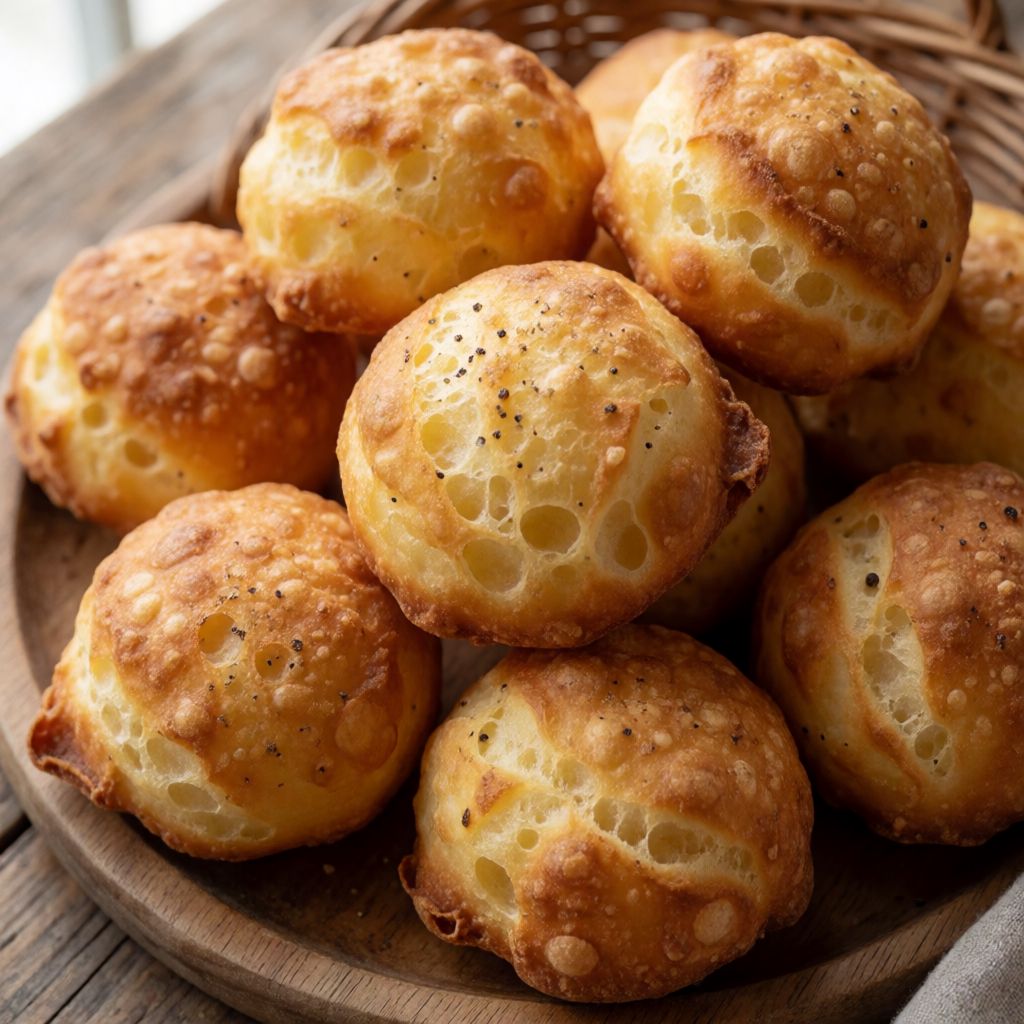
Savoury Zeppole
Golden, savoury fried dough balls – a simple snack to enjoy warm.
Labels are worked out automatically from the ingredients and can be wrong. Check the packaging if it matters to you.
Ingredients
- 250 g Plain flour
- 150 g Water
- 5 g Yeast
- 5 g Salt
- Peanut oil for frying
- Black pepper to taste





Steps
Sift the flour, add the yeast dissolved in warm water, knead the dough, then add the salt and continue kneading for a few minutes.
Cover the dough and leave it to rise until doubled in size.
120 minHeat enough peanut oil in a pan for deep-frying.
Scoop up the dough with a spoon and carefully lower small balls into the hot oil.
Fry the zeppole, turning gently, until puffed and golden.
Drain the zeppole on kitchen paper, season with salt and black pepper, and serve.
Zeppole, in this savoury form, are fried dough and nothing grander — a loose, wet batter-dough that you don't shape with your hands, you drop off a spoon into hot oil and let the oil do the shaping. That's the whole trick of the dish: the dough stays soft enough to be unmanageable on a worktop, and that's deliberate, not a failure of kneading.
What decides whether it works is two things working against each other: how wet the dough is, and how hot the oil is when the dough hits it. Too stiff a dough and you get a hard little roll, dense as a dumpling, nothing like the light, hollow-ish puff you want. Too cool an oil and the dough sits there soaking it up instead of sealing — that greasy, heavy zeppola everyone's eaten once and never trusted fried food again isn't bad luck, it's an oil that wasn't hot enough when the dough went in.
The mechanism is simple once you see it: the surface of the dough meets oil far hotter than itself and sets almost at once, a thin skin. Inside, the water in the dough turns to steam, the yeast's trapped gas expands with the heat, and the whole thing puffs against that skin from within. The outside goes on browning and crisping while the inside stays soft — that's your doneness cue, not a clock: golden, not pale, and it should feel light for its size, almost hollow when you tap it.
Flour, water, yeast, salt — four things, and each one earns its place. The flour doesn't need to be strong bread flour; plain flour gives enough gluten to hold gas bubbles once the dough's wet enough to move easily, and that's all it's asked to do here. If you only have strong flour, fine, just don't be surprised if the dough feels a touch more elastic to scoop.
The water quantity is the real decision in this recipe — 150g against 250g flour is a wet dough, close to a thick batter, and that's intentional. A firmer dough, the kind you'd knead into a ball and roll, gives you a dense bread roll fried instead of baked. The wetness is what lets the dough slump and billow in the oil instead of holding a tight shape, which is where the characteristic knobbly, cloud-like zeppola comes from.
Yeast gets dissolved in warm water first, before the salt goes anywhere near it, and that order matters. Salt tightens a gluten network early and slows yeast right down — some say salt kills yeast outright, no, it doesn't kill it, it just gets in its way before it's had a chance to wake up and start working. Dissolve the yeast, let it start, then fold in the salt once kneading's underway, and you protect the rise instead of fighting it. The water for this should feel warm to your wrist, not hot — hot water does kill yeast, and that's the one temperature myth worth taking seriously here.
The rise to double size is not a step you can shortcut by turning the oven light on and hoping. Patience is the fifth ingredient in this list whether it's written down or not — a dough rushed through its rise fries into something dense and a bit sad, because there simply isn't enough gas trapped yet to puff. Two hours is a floor, not a target; look for the dough visibly loose and domed, not timed to the minute.
For the oil: peanut oil is traditional in southern Italian frying because it has a high smoke point and almost no smell of its own at frying temperature, so it doesn't fight with the dough's own taste. The criterion, if you've no peanut oil in the cupboard, is exactly that — any refined oil that can take real heat without smoking and doesn't smell of itself. Sunflower or a plain vegetable oil does the job. You've no thermometer in most kitchens, nor do you need one: drop in a small knob of the dough, and if it sizzles at once and rises straight to the surface, the oil's ready; if it sinks and sulks, give it longer.
On an ordinary hob, use a proper pan with a decent depth of oil rather than a shallow film — the dough balls need room to float and turn, not to sit flat and burn on one side. There's no lid to speak of that helps here; splatter happens, so keep a plate and paper nearby for draining, not for covering. A word on the flat itself: frying a batch of these will fill the hallway faster than any roast does, so crack a window before you start, not after. Street vendors in Naples sold zeppole exactly because deep-fat frying in a cauldron of oil over a brazier was faster and cheaper than running a baker's oven — poor food, sold hot off the street, not a ceremony, and that's worth remembering before anyone tells you there's only one proper way to make it. 250g of flour, made this way, gives you a snackful for six — a few each, eaten hot, standing up, the way street food is meant to be eaten.