
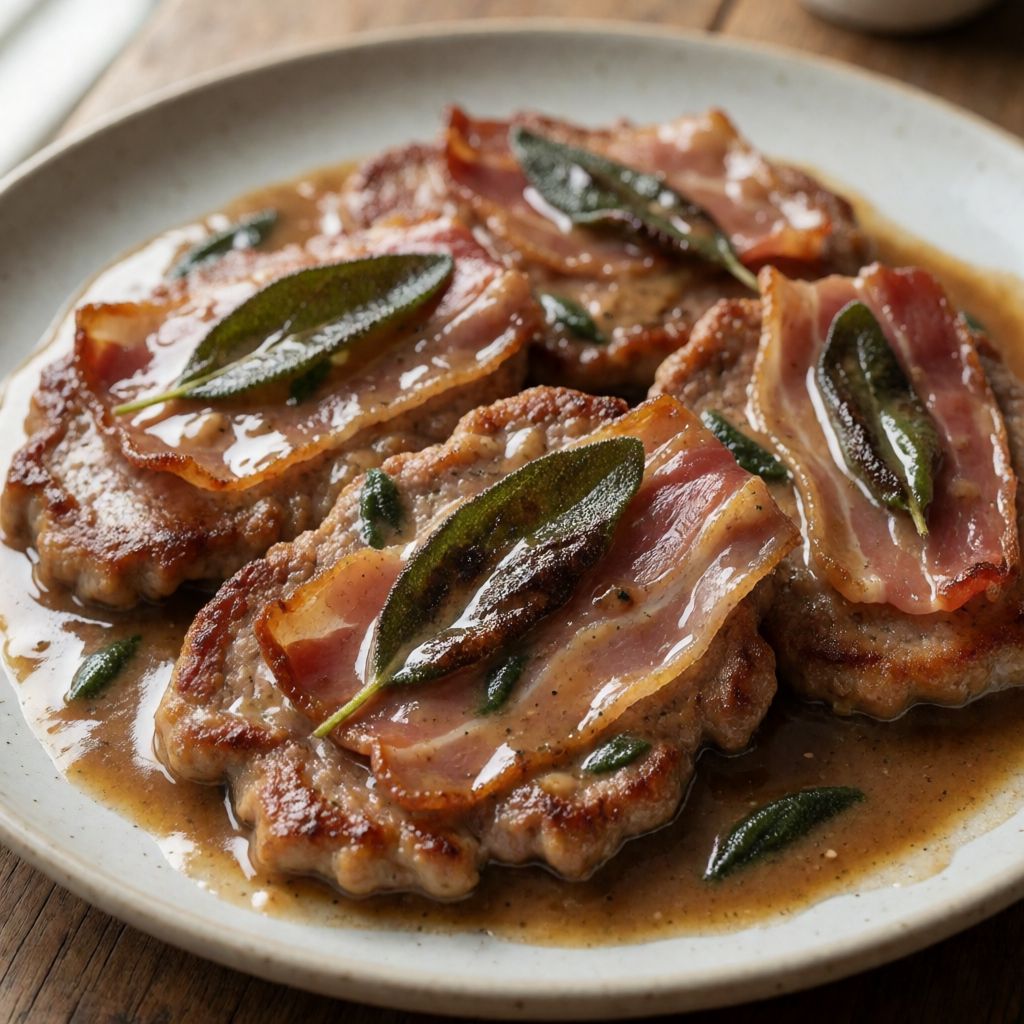
 AI photo
Saltimbocca alla Romana
A classic Roman dish of veal escalopes wrapped with prosciutto and sage, pan-fried and finished with brandy or white wine.
Labels are worked out automatically from the ingredients and can be wrong. Check the packaging if it matters to you.
Ingredients
- 6 pcs Veal Escalopes
- 6 pcs Prosciutto
- 6 pcs Sage Leaves
- Plain Flour as needed
- Salt to taste
- Black Pepper to taste
- 75 ml Brandy or white wine
- Olive Oil as needed
- 1 pcs Butter a knob of butter








Steps
Prepare the prosciutto slices, sage leaves and wooden skewers. Pound the veal with a meat mallet until thin and tender.
5 minPlace a slice of prosciutto in the centre of each veal escalope, top with a sage leaf and secure with a skewer.
5 minCoat one side only of each meat slice in flour.
2 minHeat the olive oil and butter in a frying pan.
3 minPlace the saltimbocca flour-side down in the pan and fry until the veal is cooked through.
10 minPour in the brandy or white wine, let it evaporate, cover and cook for a little longer.
5 minServe immediately.
Saltimbocca means "jump into the mouth" — not an instruction on cooking speed, but a description of eating it. It's gone in two bites because the veal is pounded paper-thin and spends almost no time in the pan. This is trattoria food, built to turn tables fast using a cut of veal too thin and cheap to roast or braise properly. If your Sunday instinct is low-and-slow until the meat falls apart, drop it here — this dish runs on the opposite logic: hot and fast, done before the kettle's boiled for tea.
What decides whether it works is thickness, not minutes. You pound the veal until it's practically see-through, because a thick escalope cooks slowly, toughens as it goes, and by the time the centre is done the outside is already grey and chewy. Thin meat flashes through in the same short window it takes the prosciutto to warm and the sage to let go of its oil into the fat. You'll know it's there when the floured side turns the gold-brown of a digestive biscuit and the veal has gone from pink to an even pale grey-white right through — a couple of minutes a side, no longer, because meat this thin has nowhere to hide an uncooked middle.
Flour goes on one side only, and that's not laziness. That side goes down first, meets the fat, and becomes the base the wine or brandy grabs hold of once it hits the pan. The other side — the prosciutto side — barely touches the heat at all, so flour there would just sit raw and pasty.
Veal: choose the thinnest, palest escalope you can find, cut from the leg. The criterion is lean meat with almost no connective tissue, because this recipe gives you no time to melt collagen the slow way — that's a Sunday-roast job, not a saltimbocca one. If good veal isn't to hand or the price puts you off, substitute on the same logic: a pale, lean meat that survives a two-minute fry without turning to rubber. Turkey breast escalope does this well, as does pork loin sliced thin and pounded; chicken breast works too if you pound it evenly, since an uneven escalope cooks unevenly — thick patches stay underdone while thin edges overcook.
Prosciutto: a raw-cured ham, already "cooked" by salt and time rather than heat. Buy it sliced thin to order where you can — the pre-packed pile that's been drying under plastic for days loses both texture and flavour. Its job in the pan is simply to warm through and give up a little fat into the veal, not to crisp like bacon. No prosciutto crudo in the shop? Serrano or any air-dried ham with real fat marbling works on the same criterion — salted and aged, not smoked. Smoke changes the whole aroma and fights the sage.
Sage: fresh whole leaves, pinned skin-side against the meat, never dried. Dried sage has lost most of the volatile oil that justifies putting it in at all — frying the fresh leaf in hot fat is exactly what releases that oil into the dish. Some treat it as a garnish you could leave off. You can't, really: it's being fried the same way you'd fry a bay leaf in oil before building a stew, as flavour, not decoration.
Flour: plain, unremarkable, its only job is to catch on the hot pan surface and give the wine something to grab and turn into a thin sauce. Any flour with no taste of its own will do that; wholemeal or anything strongly flavoured will argue with the sage instead of supporting it.
Fat: olive oil plus a knob of butter, and this pairing isn't indulgence. Butter on its own scorches before the veal is through, because its milk solids catch fire at a lower point than the heat this dish needs. The oil's whole purpose is to buy the butter time — it raises the working temperature of the pan before anything blackens, while the butter still gives you the browning and the aroma. The rule for the oil is simple: anything with no smell of its own — light olive oil, sunflower, groundnut. A heavy, grassy extra-virgin will compete with the sage rather than carry it.
Brandy or white wine — the choice shifts the dish slightly rather than transforms it. Wine brings acid, which cuts through the richness of butter and ham fat; brandy, distilled and often barrel-aged, gives a rounder, faintly caramel edge instead. Either way the mechanism is the same: alcohol lifts the browned bits stuck to the pan, and you let it bubble hard and lose its raw edge before covering, because a sharp spirit smell on the plate means that step was rushed. No lid that fits your frying pan in a UK kitchen? A plate set over the top does the same job — it traps enough steam to finish the inside gently without drying out the surface. And treat patience here as an ingredient in its own right: the actual cooking is a matter of minutes, but getting the pan properly hot before the meat goes in, and letting the alcohol genuinely cook off rather than just steam briefly, is where most people lose the dish. Six escalopes for four people isn't meant to divide evenly — plan it by appetite at the table, one each for some, two for others, rather than by arithmetic.