
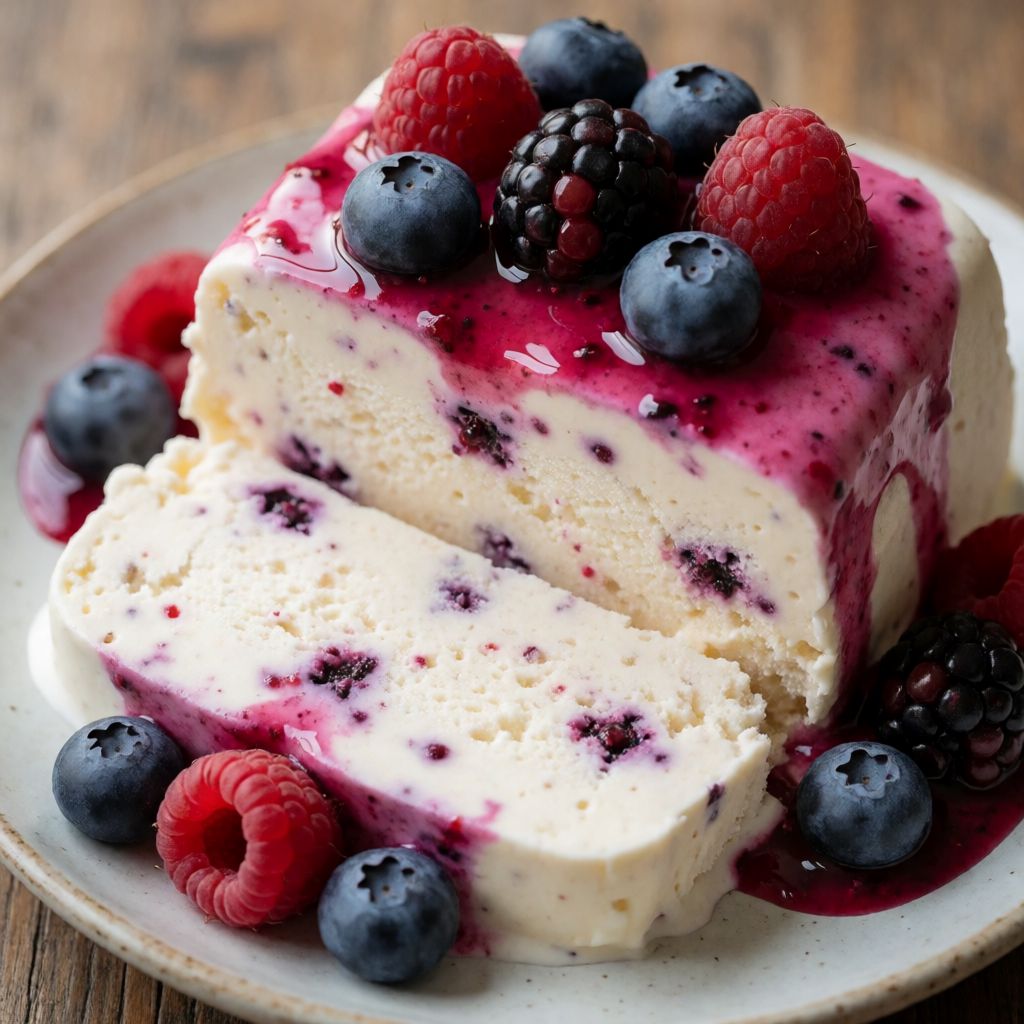
 AI photo
Forest Berry Semifreddo
A frozen semifreddo dessert made with mixed berries, a light sugar syrup and billowy whipped cream.
Labels are worked out automatically from the ingredients and can be wrong. Check the packaging if it matters to you.
Ingredients
- 500 g Mixed Berries fresh or frozen
- 400 ml Water
- 220 g Caster Sugar
- 12 g Gelatine
- 400 ml Double Cream
- 180 g Icing Sugar






Steps
Make the sugar syrup: combine the water and caster sugar in a small saucepan and melt over low heat, stirring with a whisk.
Soften the gelatine in cold water, squeeze it out well and add it to the saucepan, stirring until fully dissolved and simmering for a couple of minutes.
Pour the mixture into a bowl and leave to cool.
Cook the mixed berries.
10 minRemove from the heat, blend the berries until smooth and leave to cool; pass through a sieve if you like.
Combine the berry purée with the sugar syrup and gelatine, mixing well.
Separately whip the double cream with the icing sugar, then gently fold it into the berry mixture with a bottom-to-top motion.
Transfer the mixture into a silicone ring mould, 22–24 cm in diameter.
Freeze for at least 6 hours.
360 minUnmould the dessert and decorate with a few berries and a sprig of fresh mint.
Semifreddo means "half-cold", and that name is the whole mechanism. This isn't ice cream pretending to be fancy — it's a dessert built for people who don't own an ice cream machine. Proper ice cream is churned while it freezes, so the paddle keeps breaking up ice crystals as they form; without that constant beating, a liquid left in the freezer just turns into a flavoured brick. Semifreddo solves the same problem a different way: you beat the air in beforehand, trap it in whipped cream, and let that foam — full of tiny fat-coated bubbles — get in the way of ice crystals growing large. Freeze a foam and you get something that still yields to a spoon. Freeze a liquid and you get a doorstop.
So the whole recipe is really about building and protecting that foam. Gelatine gives the berry side some backbone, so the mixture doesn't just separate into watery fruit syrup once the air from the cream tries to rise through it. Sugar, in the syrup and in the icing sugar you whip into the cream, does double duty — sweetness, yes, but also lowering the freezing point slightly so the dessert sets soft rather than glassy-hard.
Go through the parts and the logic holds together. Mixed berries, fresh or frozen — frozen is honestly fine here, arguably better, because the freeze-thaw cycle has already broken their cell walls and they'll collapse into purée faster. The 10 minutes of cooking is a floor, not a target: you're watching for the berries to give up their shape entirely and pool into a thick, dark liquid that coats the back of a spoon. Go past that into a long simmer and you boil off the bright, slightly sour top-note that makes the whole thing taste of actual fruit instead of jam. The sieve afterwards is only there for seeds — raspberry and blackberry pips — skip it if that doesn't bother you.
The sugar syrup is deliberately plain: water and caster sugar over low heat, no higher, because you're not caramelising anything, just dissolving sugar into water until the liquid turns from cloudy to clear. That clarity is your doneness cue — no thermometer needed. The gelatine goes in after it's softened in cold water and squeezed out, which matters more than it sounds: gelatine that goes in dry and lumpy will dissolve unevenly, leaving little rubbery threads in the finished dessert instead of a smooth set. Some cooks think gelatine needs a hard boil to "activate" — no, the opposite is true. A long rolling boil breaks down its setting power; all it needs is to dissolve fully in a liquid that's warm, not furious.
Double cream earns its place by fat content — around 48%, enough structure in the fat globules to hold a stable foam under its own weight. Whipping cream (closer to 35%) will whip, but the foam is looser and more likely to weep once frozen and thawed slightly on the plate; single cream, at around 18% fat, won't whip into a foam at all, so don't reach for it here out of habit. Icing sugar rather than caster sugar in the cream isn't fussiness — icing sugar dissolves into the foam instantly with no grit, and the small amount of starch most UK brands add helps the foam hold its air a little longer, which matters once this goes into a freezer that isn't anywhere near as cold or as dry as a commercial one.
On the mould: a silicone ring is worth having precisely because it lets you unmould without heat. Metal tins need a dip in warm water to release their contents, and that warmth is exactly what starts melting the edges of a delicate foam-based dessert before you've even plated it. No silicone ring in the cupboard — line a cake tin or loaf tin with cling film instead, leaving plenty of overhang to lift the whole thing out by hand.
Six hours in the freezer is the floor, not the finish line — a domestic freezer runs warmer and gets opened more often than you'd think, so overnight is the safer bet, and tuck the mould at the back rather than near the door where temperature swings with every visit to get the milk out for tea. This is the kind of dessert that rewards being made the day before a Sunday roast — it sits quietly in the freezer doing its own thing while you deal with everything else, and arrives at the table needing nothing from you but a sprig of mint and a few whole berries on top. Patience, here, isn't a virtue you perform — it's the actual ingredient that turns a bowl of whipped fruit into something you can slice.