
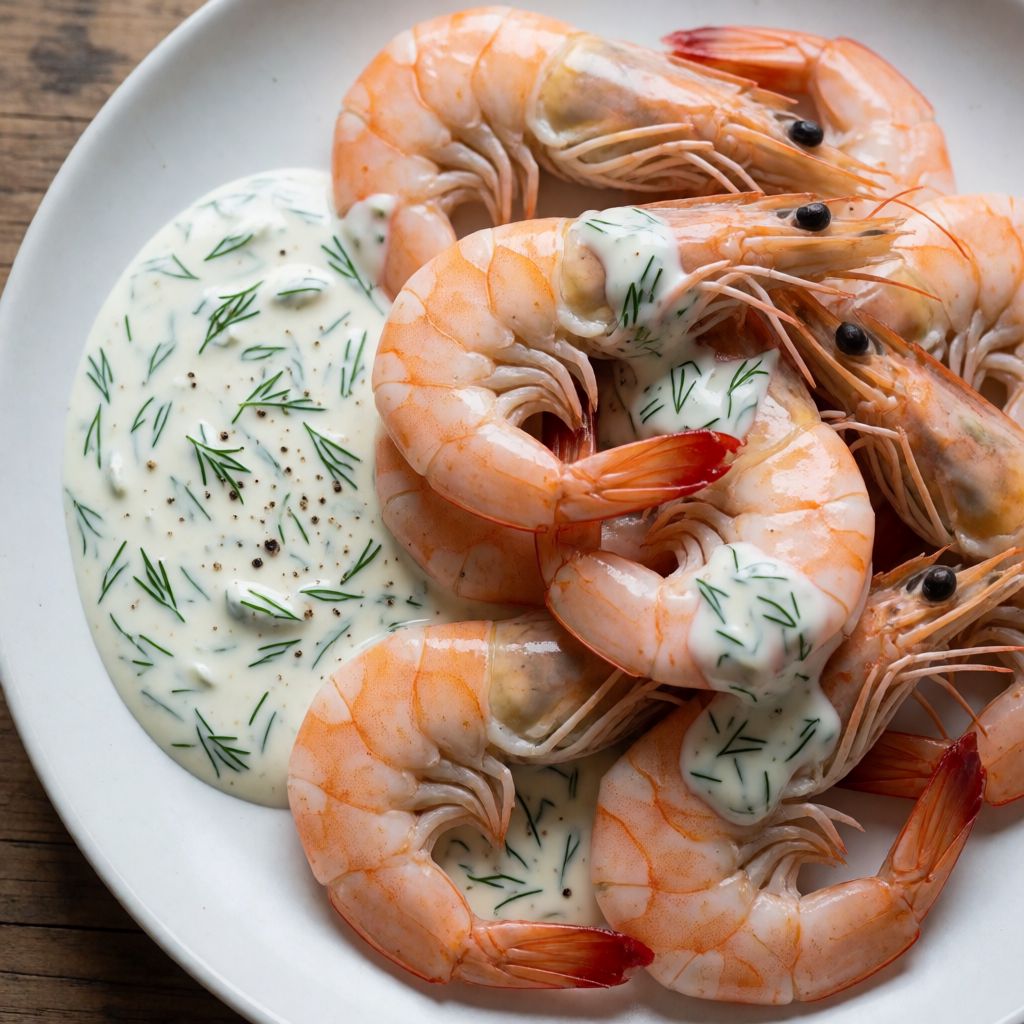
 AI photo
Shell-On Prawns with Dill Sauce
Shell-on prawns served with a creamy dill dip, lemon wedges and good bread.
Labels are worked out automatically from the ingredients and can be wrong. Check the packaging if it matters to you.
Ingredients
- 1 kg Prawns
- 100 ml Crème fraîche
- 100 ml Mayonnaise
- 200 ml Dill finely chopped
- Salt to taste
- Black pepper freshly ground, to taste
- 1 pcs Lemon cut into wedges
- 2 pcs Baguette
- 50 g Butter








Steps
Dill dip: in a bowl, mix the crème fraîche, mayonnaise, dill, salt and pepper, taste and season to your liking.
5 minLet everyone peel their own prawns: serve in a bowl, with a spare bowl for the shells and small bowls of water with lemon for rinsing fingers.
Serve with good bread and lemon cut into wedges.
There's no heat in this recipe, and that's the point, not an oversight. The prawns arrive at your door already cooked — what you're making here is a sauce and an occasion, not a dinner that needs a stove. Cook time: zero. Remember that when you look at the ingredient list and wonder why nothing tells you to fry anything.
What decides whether this works isn't technique, it's restraint. The sauce has to be rich enough to be worth dipping into but cut by enough acid and green dill that it doesn't sit on the tongue like butter left in the sun. And the prawns have to stay in their shells until the very last second before someone's mouth.
Some hosts peel the prawns ahead of time, thinking it's good manners — don't. That's where the dish falls apart. A peeled prawn starts leaking its juice the moment the shell comes off, and by the time it's sat for twenty minutes waiting for guests to arrive, it's gone from firm to slightly rubbery, and its own flavour has gone into the tea towel instead of staying where you want it. The shell isn't packaging. It's doing a job — holding moisture in and air out — right up to the point someone's fingers do the work instead of your knife.
And that's the other half of it: the peeling is the entertainment. You put a bowl of prawns in the middle of the table, a bowl for shells, a bowl of lemon water for sticky fingers, and you let people slow down. No one talks much with their hands full of shellfish. That's not a flaw in the evening — that's the whole evening.
Buy prawns that are cooked but still in their shell — not the ready-peeled tubs that sit next to them in the chiller, tempting as they look. A shell-on prawn has been protected right through cooking and chilling; a peeled one has been exposed to air and its own drying juices since the moment it left the pot. Check the shell is glossy and clinging to the flesh, not loose or crackly-dry. If you see a dark patch on the head, don't panic and don't bin it — that's usually melanosis, an enzyme reaction with age and oxygen, not rot. Smell is the real test: the sea, not ammonia.
Crème fraîche gives the sauce its body and a clean, mild sourness — it's cultured cream, soured on purpose, the same family as the sour cream you'd put on a baked potato. If you haven't got it, thick yoghurt or good sour cream does the same job; the criterion is a dairy thick enough to hold a spoon upright and sharp enough to taste like something, not just fat.
Mayonnaise is there for a different reason — it's an emulsion, oil and egg forced together, and what it adds is cling: it makes the sauce coat a prawn instead of sliding off it. Shop-bought or homemade, it doesn't matter much here, but pick one made with an oil that has no opinion of its own — a strongly flavoured cold-pressed oil will fight the dill instead of carrying it.
Dill is doing the heaviest lifting of the three. Without it you just have a rich, slightly tangy mayonnaise — pleasant, but it sits on shellfish like a blanket. The dill's sharp, almost anise-green top note is what keeps cutting through, bite after bite, so the dish doesn't get tiring halfway through the bowl. If you've genuinely no dill, parsley with a small pinch of crushed fennel seed gets you something in the same family, though it won't be the same dish — more a cousin standing in.
Lemon is working twice, not once: wedges at the table for squeezing over the prawns, cutting the richness right at the point you eat; and lemon water in the finger bowls, because shell-on prawns leave your hands smelling of the sea and lemon is the oldest, cheapest answer to that problem — older than the dish itself. The water-and-lemon finger bowl is a small piece of old European table etiquette surviving quietly in a very unceremonious dinner.
The baguette and butter aren't decoration — they're there to mop the dip once the prawns run out, and to give your mouth something plain between bites of something rich. Any butter with enough fat to spread at room temperature will do; salted is fine, since nothing else at the table is salty except the dip itself. On proportions: a kilogram of shell-on prawns for four sounds generous until you remember the shell and the empty bowl take their share — you're really feeding people around 200 grams of actual prawn meat each, which is why the bread matters as more than garnish. Treat the whole thing as a patient meal, not a fast one — if you rush people through the peeling, you've turned a lazy seaside supper into a chore, which was never the idea.