
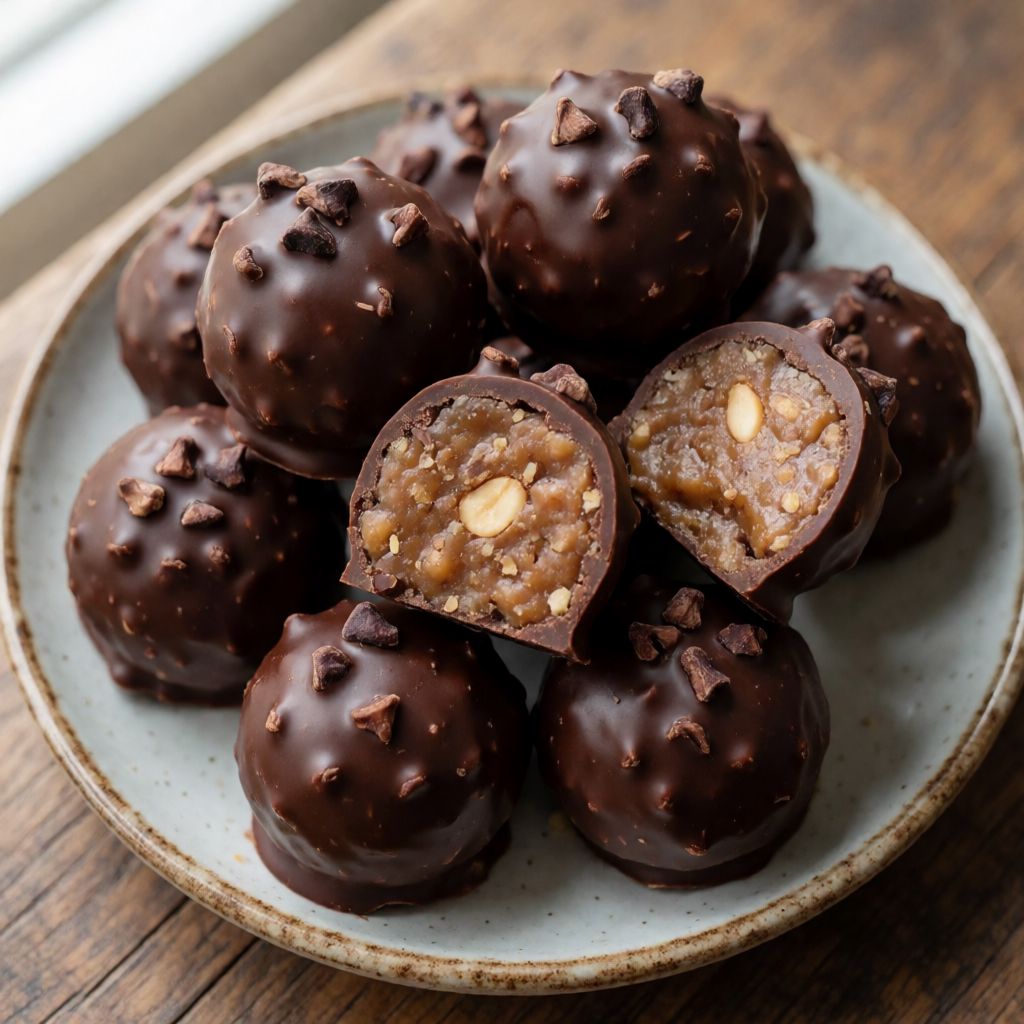
 AI photo
Snickers Balls
No-bake peanut butter and date balls dipped in dark chocolate, inspired by the flavours of a Snickers bar.
Labels are worked out automatically from the ingredients and can be wrong. Check the packaging if it matters to you.
Ingredients
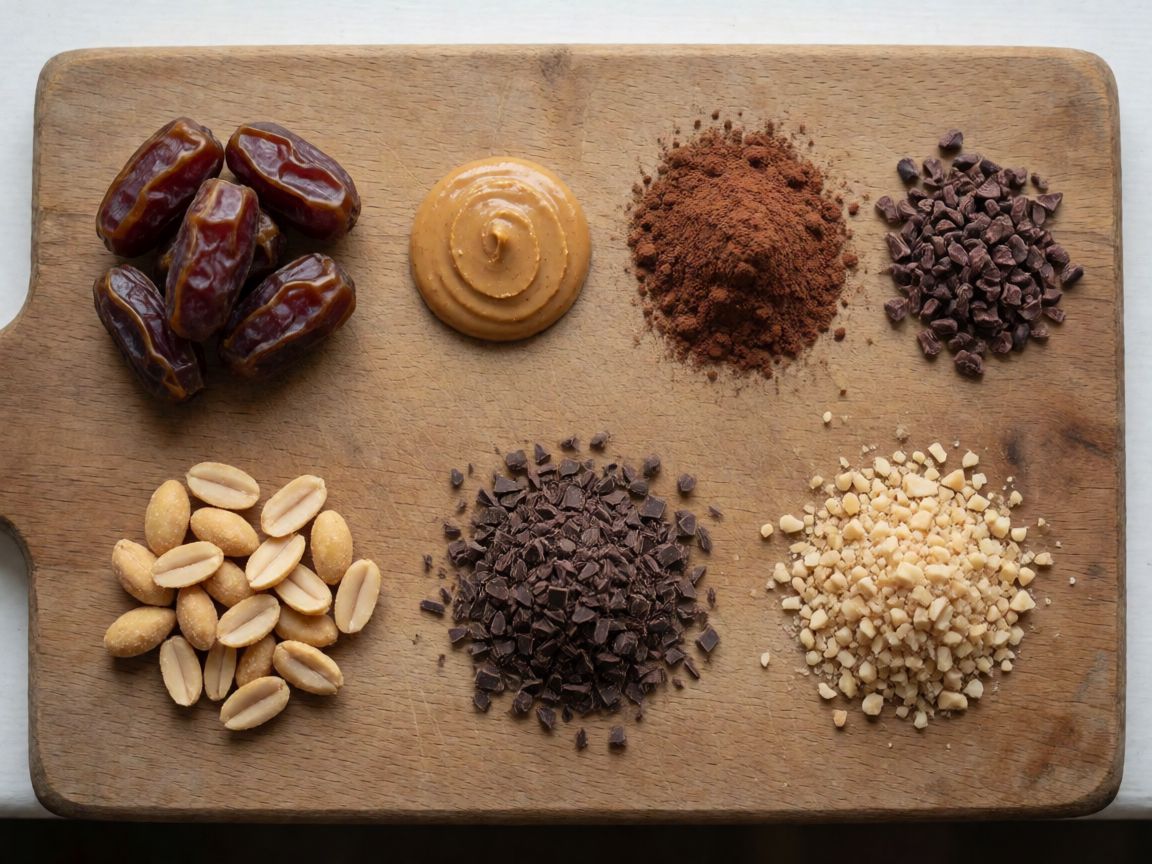
- 175 g Dates
- 50 g Peanut Butter
- 30 g Cocoa Powder
- 10 g Cacao Nibs
- 75 g Peanuts salted
- 100 g Dark Chocolate finely chopped
- 15 g Peanuts finely chopped, salted
- 10 g Cacao Nibs



Steps
Put the peanut butter, dates and cocoa powder in a food processor and blend until smooth.
Quickly pulse in the peanuts so that pieces of peanut remain visible.
Stir in the cacao nibs and roll the mixture into bite-sized balls.
Temper the chocolate by melting half of it in a bain-marie.
Remove from the heat and stir in the remaining chocolate.
Dip the balls into the chocolate.
Sprinkle with peanuts and cacao nibs, and leave to set on baking parchment.
This is a no-bake, no-cook sweet — the only heat in the whole recipe goes into melting chocolate, not into anything that becomes the filling. The dates do the job a cook usually does with sugar and butter over a flame: they're concentrated, sticky, full of their own sugar, and once you blitz them they turn into something close to a caramel paste without a pan ever getting hot. That's the real trick here, and it's why the recipe has a prep time but no cook time for the filling.
What decides whether the balls work is restraint in the processor. Blend the dates, peanut butter and cocoa until smooth — that part wants to be uniform, almost fudge-like, because that's your glue. But the moment the peanuts go in, you pulse, not blend. Keep pulsing and you lose the whole point: instead of a ball with pockets of peanut giving you something to chew on, you get a dense, monotonous paste that tastes the same from edge to centre. The defect of an overworked snickers ball isn't a flavour problem, it's a texture problem — nothing left to bite into.
The second thing that decides success is the chocolate shell, and specifically whether it sets with a clean snap or turns dull and streaky (bloom) a few hours later. That comes down to how you melt it — not whether you melt it, but how. Half melted gently, the rest stirred in raw, is a way of seeding the chocolate with intact fat crystals so it rehardens properly instead of as a greasy, soft smear. Skip that step and the shell stays tacky or turns pale and patchy — nothing wrong with the taste, just the look and the bite.
Dates are doing three jobs at once: sweetener, binder, and moisture. Medjool dates are what you want if you can get them — soft, almost wet, high in natural sugar, they blend into a paste with barely any resistance. If all you've got are the drier, wrinkled dried dates sold loose in most UK supermarkets, soak them in warm water for ten minutes first and pat them dry before blitzing — otherwise the processor will just shred them into stringy bits instead of a paste, and your balls won't hold together.
Peanut butter carries the fat. Fat is what makes the mixture pliable enough to roll without cracking, and what carries flavour across your tongue instead of leaving it sitting as sugar on the surface. Use a smooth, unsweetened one — the peanuts for crunch are added separately later, so a crunchy peanut butter here just means you lose control of texture. If peanut butter isn't to hand, any ground nut butter with no added sugar does the same job — almond, cashew, whatever's in the cupboard — though you'll lose that specific peanut note that ties the whole thing back to its name.
Cocoa powder is there for bitterness and colour, not sweetness — it's cutting the date-sugar, not adding to it. Natural cocoa gives a sharper, more acidic edge; Dutch-processed (alkalised) is rounder and milder. Either works; just know which one you're reaching for, because it shifts how sweet the finished ball tastes even though the recipe hasn't changed.
Salted peanuts and cacao nibs are the two things actually providing contrast — salt against sweet, crunch against chew, bitter against rich. The nibs inside the mixture and the ones sprinkled on top are doing slightly different jobs: inside, they're texture; on top, with the chopped peanuts, they're also visual — they tell you, before you even bite, that this isn't a smooth truffle. If you can't find cacao nibs, finely chopped dark chocolate on top gives you back the crunch, though not the particular dry bitterness real nibs carry — that's a trade, not a true swap.
For the chocolate shell, use anything genuinely dark — meaning higher in cocoa solids, lower in milk fat and sugar — because milk chocolate's extra fat and sugar fight the clean set you're after and leave a softer, tackier coating. On a UK hob without a thermometer, judge the melt by feel: warm it over the bain-marie only until it's smooth and pourable, barely warm against your lip, never hot. The water underneath must never touch the bowl and no steam should get near the chocolate — a single drop of condensation seizes it into a grainy clump that no amount of stirring fixes.
These keep a few days in the fridge rather than the biscuit tin — the dates hold moisture, and a cold flat kitchen won't dry them out the way a warm pantry would. Sixteen is a tray-sized batch, the kind of thing that turns up after a Sunday roast with tea rather than as a pudding in its own right — and it's worth saying plainly that the half hour of prep is mostly patience: rolling sticky paste into neat balls, and then waiting for the shell to actually set hard before anyone's allowed to eat one. Rushing that last part is how you end up with chocolate fingerprints instead of a shell.