
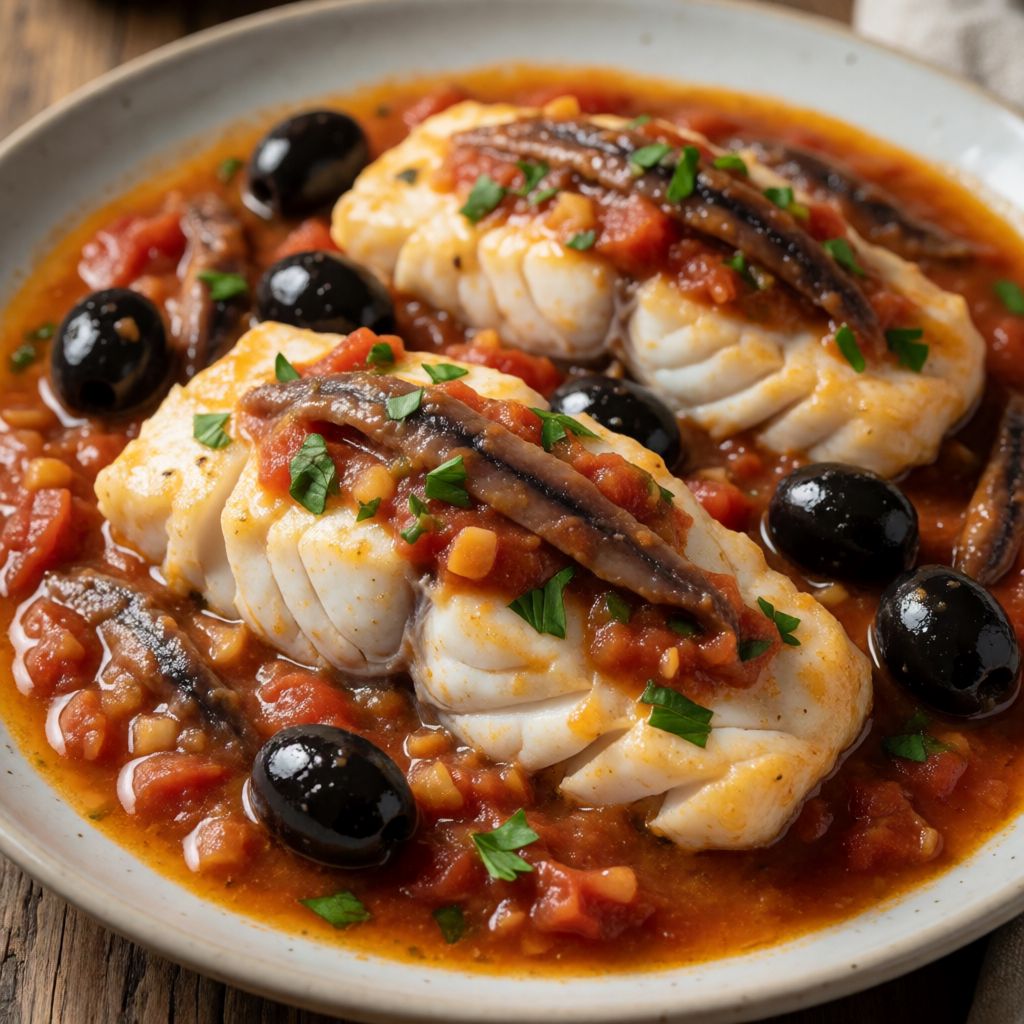
 AI photo
Flounder Fillet alla Sorrentina
A quick pan-fried flounder fillet in a Sorrento-style tomato, olive and anchovy sauce.
Labels are worked out automatically from the ingredients and can be wrong. Check the packaging if it matters to you.
Ingredients
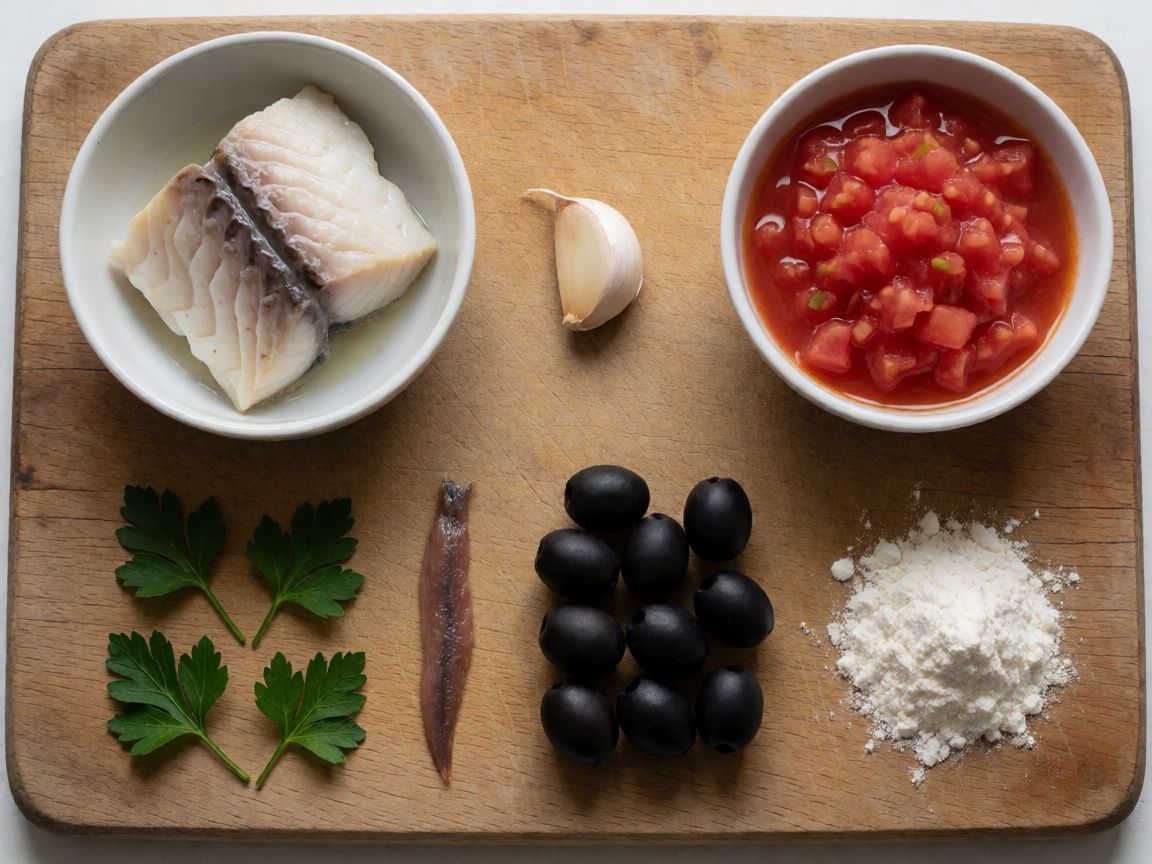
- 400 g Flounder Fillet
- 1 clove Garlic
- 300 g Canned Chopped Tomatoes
- 4 pcs Parsley sprigs
- 8 pcs Black Olives
- 1 pcs Anchovy Fillet
- 2 tbsp Olive Oil
- Plain Flour as needed
- Salt to taste








Steps
Rinse the flounder fillets under running water and pat dry with paper towel. Spread the flour on a plate and coat the fillets on all sides.
Rinse the parsley, pat dry and chop finely with a knife. Finely chop the garlic as well, and remove the stones from the black olives.
Heat the olive oil in a frying pan with the chopped garlic and parsley. Add the anchovy, broken into pieces, and fry for a couple of minutes.
Add the flounder fillets, raise the heat and fry for a few minutes on each side, turning carefully.
Add the canned chopped tomatoes and the pitted olives. Season with salt to taste and cook for a further 5 minutes without turning the fillets. The fish is done when the thickest part reaches 63°C.
5 minSpoon some of the tomato sauce from the bottom of the pan over the top of the fish.
Serve the finished dish on plates, drizzled with olive oil on top.
This is a five-minute fish dish built on a sauce that takes care of itself. Flounder, plaice, sole — any flat, thin white fish — gets a dusting of flour, a short fierce fry, and then it drowns in a tomato-olive-anchovy base that has been quietly building flavour in the pan before the fish ever touched it. It's the Campania coast's economy: a tin of anchovy, a few dried-cured olives, a tin of tomatoes — things that keep — plus whatever flat fish was going cheap that morning. Nothing here needs to be fresh except the fish and the parsley.
What decides whether it works is timing, and the timing runs backwards from what you'd expect. The fish is thin — a few millimetres of flesh — so it has almost no margin. You don't season the dish once the fish is cooking in it; by then it's too late, the fish will be done before any flavour has a chance to move into it. So the garlic, parsley and anchovy go into the oil first, alone, and that's where the seasoning actually happens — in the fat, before the fish arrives.
Some say anchovy makes a dish taste of fish. No — not cooked this way. Broken into warm oil with garlic, it dissolves into the fat within a couple of minutes and disappears as a recognisable thing; what's left is savour, not fishiness. If anything, it's doing the job that a good stock cube wishes it could do honestly.
Flounder is chosen for being thin and mild, not for being special — anything flat works the same way: plaice, sole, dab, even a thin cod loin cut like a fillet in a pinch. The criterion is thinness and a flavour that doesn't fight the sauce. Thick, meaty fish won't cook through in the time the sauce needs, and you'll end up either overcooking the sauce waiting for the fish or undercooking the fish to save the sauce.
The flour isn't there to 'seal in the juices' — that's a myth that refuses to die, mostly because it sounds true. Fish doesn't hold juice the way meat does; there's no membrane sealing anything shut. What flour actually does on a thin fillet in a short, hot fry is give the surface something dry to grip, so you get a trace of colour and crust in the minute or two you have, and it keeps the fillet from welding itself to the pan — which on a domestic hob, in a frying pan rather than a proper wide sauté, is the real danger. Any plain flour does this job; rice flour or cornflour will crisp it slightly more and that's fine too, just don't expect either to behave like a batter.
Garlic, parsley and the anchovy fillet, fried gently in the oil before anything else goes in, are the actual seasoning of the whole dish — think of it as a quick, wet soffritto rather than a garnish. Chop the garlic fine and keep the heat low enough that it softens rather than browns hard; burnt garlic turns bitter, and bitterness doesn't cook out later, it just sits in the sauce being wrong. The anchovy, broken rather than left whole, melts into the oil and vanishes as texture — if you have no anchovy, a small spoon of fish sauce or anchovy paste does roughly the same work, though you lose a little of the oil-soluble richness a whole fillet gives you.
The tinned tomatoes carry history as much as flavour. Canning tomatoes was Campania's way of stretching a short, intense summer harvest — San Marzano and its neighbours — across the whole year, and that's exactly why tinned chopped tomato belongs in a fast weekday dish like this one rather than being a compromise: it's actually the traditional, practical choice, not the lazy one. Fresh tomatoes out of season are watery and thin-flavoured and will make a worse sauce, not a better one. If you only have whole tinned tomatoes, crush them by hand in the tin — it takes thirty seconds and nobody needs a blender for this.
The olives should be the kind that taste of something — dry-cured or brine-cured black olives, Kalamata or similar — not the bland, rubbery tinned ones that taste mostly of tin. Pit them yourself with the flat of a knife if you can't find them ready-stoned; whole stones in a quick fish dish are the kind of thing that ends a pleasant dinner with a trip to the dentist.
As for doneness: the recipe gives you 63°C at the thickest part, which is a real number, not decoration — if you own a meat thermometer from checking the Sunday roast, it works just as well here, fish doesn't need a different tool. But flounder is thin enough that you'll rarely need it: watch the flesh go from translucent and grey to opaque and white, and press it gently — it should give and flake rather than resist. Five minutes in the sauce is the lower bound the recipe gives you; the fish itself, through its colour and its give, tells you when that bound has actually been met.