
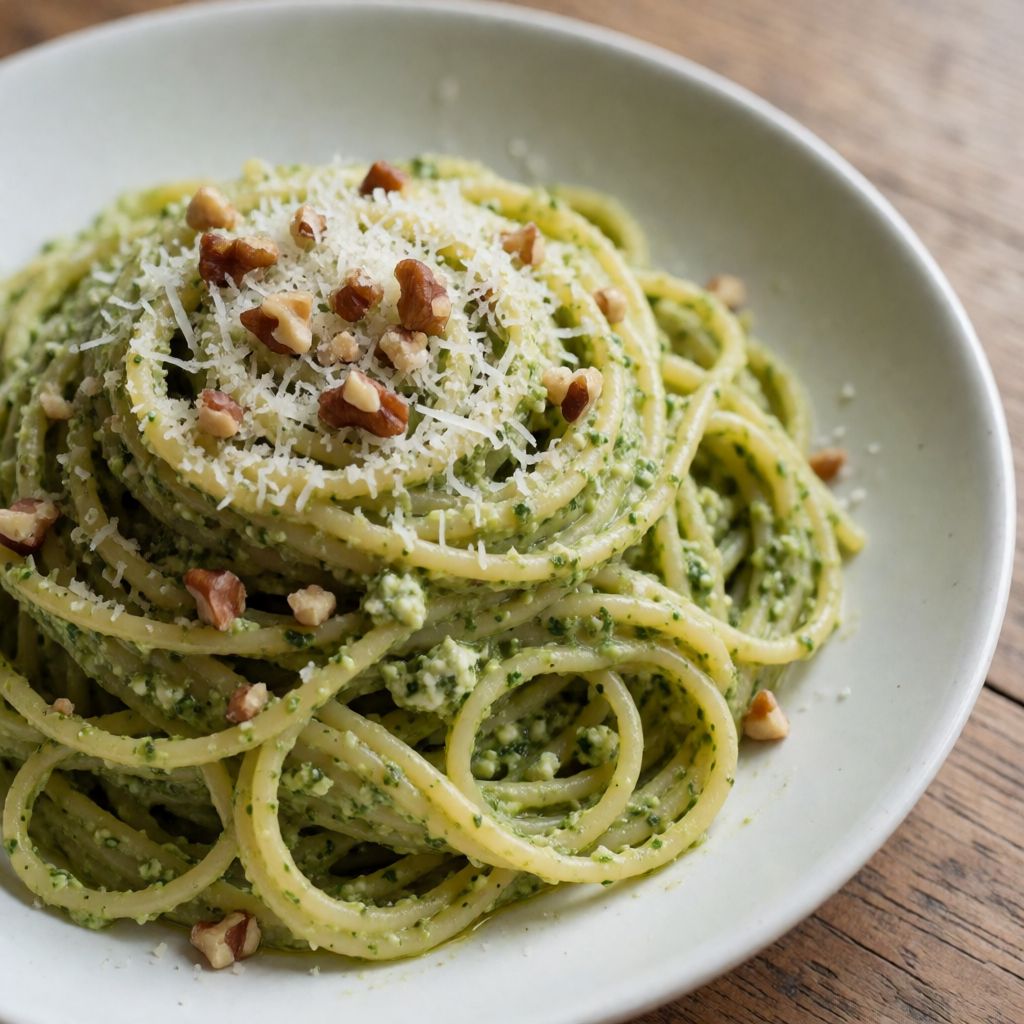
 AI photo
Spaghetti with rocket and walnut pesto
A simple spaghetti dish tossed with a fresh pesto of rocket, walnuts and two cheeses.
Labels are worked out automatically from the ingredients and can be wrong. Check the packaging if it matters to you.
Ingredients
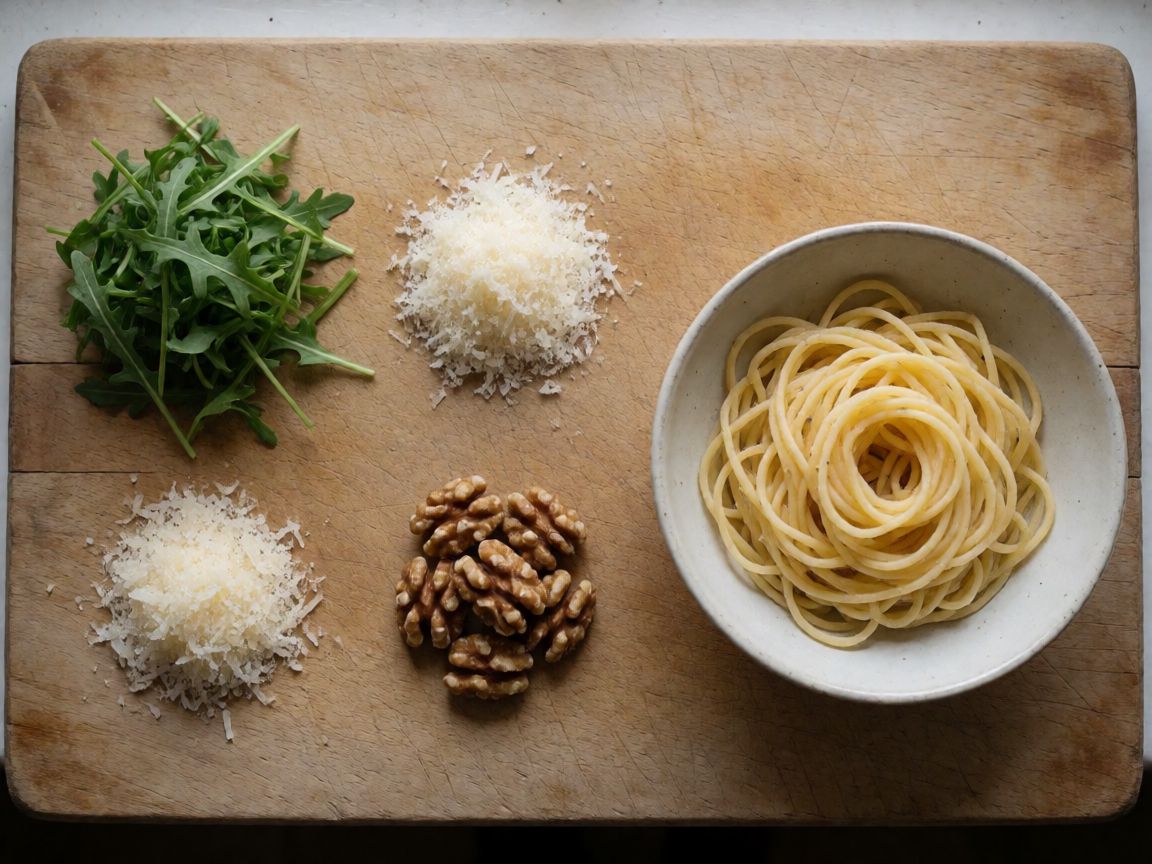







Steps
Bring a pot of water to the boil and cook the spaghetti.
10 minPut the rocket and a pinch of salt into a blender and blitz for a few minutes.
2 minAdd the walnuts, Pecorino Romano and Parmesan, then pour in the olive oil, blending until you have a creamy pesto.
3 minDrain the pasta and toss with the pesto, adding a little pasta water if needed.
1 minServe straight away.
This is a raw sauce mounted onto hot pasta — that's the whole mechanism, and once you see it, you stop worrying about "cooking" the pesto, because you don't. The only fire in this dish is under the pasta water. Everything else — rocket, nuts, two cheeses, oil — meets that heat only once, briefly, when you toss it through the drained spaghetti. The blender does the work a mortar used to do in Liguria, and it does it cold.
What decides whether it works is the ratio between fat (oil, cheese, nut oil) and water (a splash of the pasta water you saved) at the moment you toss. Too little water and the pesto sits on the spaghetti like wet sand — clumped, patchy, not a sauce. Too much and it's soup. The starchy pasta water is there to bridge the fat and the water that's already in the rocket, turning what would be a paste into something that actually clings to a strand of pasta. People say "add a splash of pasta water" like it's a ritual. It's an emulsifier, nothing more — the same starch that made the water cloudy is what glues olive oil to cheese to leaf.
Some say pesto has to mean basil and pine nuts, full stop. No — "pesto" is a method, not a shopping list. It means pounded (or, these days, blitzed). Ligurian basil-and-pine-nut is the famous one because Genoa had the money and the trade routes for pine nuts; further south and further inland, people pounded whatever grew for free and whatever fat was cheap. Rocket grows wild at the edge of fields in Puglia. Walnuts are a southern tree, not an import. This version is the economical cousin, not a betrayal of the original.
Rocket is the backbone and also the thing most likely to ruin the dish if you're impatient with it. Blitzing it with salt first, before anything fatty goes in, does two jobs: the salt pulls a little water out of the leaves so they break down smoother, and blending rocket alone, briefly, keeps the blade from heating the leaf for too long. A domestic blender runs on friction, and friction is heat — leave it running on green leaves for a few minutes straight and they'll darken and turn bitter, the same way spinach goes sour if you overcook it. That's the real cause of a pesto that tastes like lawn clippings: not too much rocket, but rocket worked too long and too warm. Short pulses, checked by eye, beat a continuous run every time. If you can't get rocket, any peppery leaf with some bite works on the same principle — watercress, young mustard leaves, even a mix of spinach and cress for the body with less heat.
Walnuts bring fat and a slightly bitter edge that balances the cheese's salt. Fifty grams for four people isn't much — this isn't a nut-heavy sauce, it's a nut-scented one. Buy them whole if you can and crack them yourself close to cooking; walnut oil turns rancid faster than most nut oils once exposed to air, which is why bagged, pre-shelled walnuts that have sat on a shelf for months sometimes taste faintly of cardboard. If that's what's in the cupboard, toast them lightly in a dry pan until you can smell them — it masks staleness and deepens the flavour, though it does shift the dish slightly away from its raw, green character. Almonds or hazelnuts will substitute on the same logic: a fatty, slightly bitter nut, not a sweet one.
The two cheeses aren't doing the same job, which is why the recipe doesn't just double up on one. Pecorino Romano is sheep's milk, aged hard, sharply salty — it's doing most of the seasoning, which is also why there's no separate salt measurement for the pesto itself beyond the pinch for the rocket. Parmesan is cow's milk, aged, with a rounder, nuttier depth and less raw salt. Together you get savoury without a flat wall of salt. If you only have one, lean towards whichever is saltier and sharper and simply taste before you add any extra salt to the pasta water — you'll need less than you think, because the cheese is carrying that weight. Any hard, aged, grating cheese with real salt in it will substitute on that same principle; a young, mild cheese won't, because it has nothing to season with.
Olive oil here is tasted raw, never heated, so this is exactly the one dish where it's worth spending on extra virgin rather than a neutral cooking oil — you're drinking its flavour, not just its fat. The general rule for substitution still holds: any oil with no smell of its own will carry a sauce without arguing with it, but that's advice for frying, not for a cold pesto, where the oil is half the flavour of the dish. Don't use something strongly flavoured in the other direction, like a toasted sesame oil — it'll fight the rocket instead of carrying it.
The pasta water you keep back before draining is not an optional flourish, it's the mechanism that turns this from "cheese paste on spaghetti" into a sauce. Scoop a cupful out before you tip the pot, because once that starchy water goes down the sink there's no getting it back, and tap water won't do the same job — it has none of the dissolved starch that lets oil and water sit together instead of separating.
And give the whole thing the patience it actually needs, which isn't much time but is attention: don't walk away from the blender, don't dump all the pasta water in at once hoping it'll fix a sauce that's already split, add it a spoonful at a time while you toss. Four people, four hundred grams of spaghetti, ten minutes of real work — the patience here is in watching, not in waiting.