
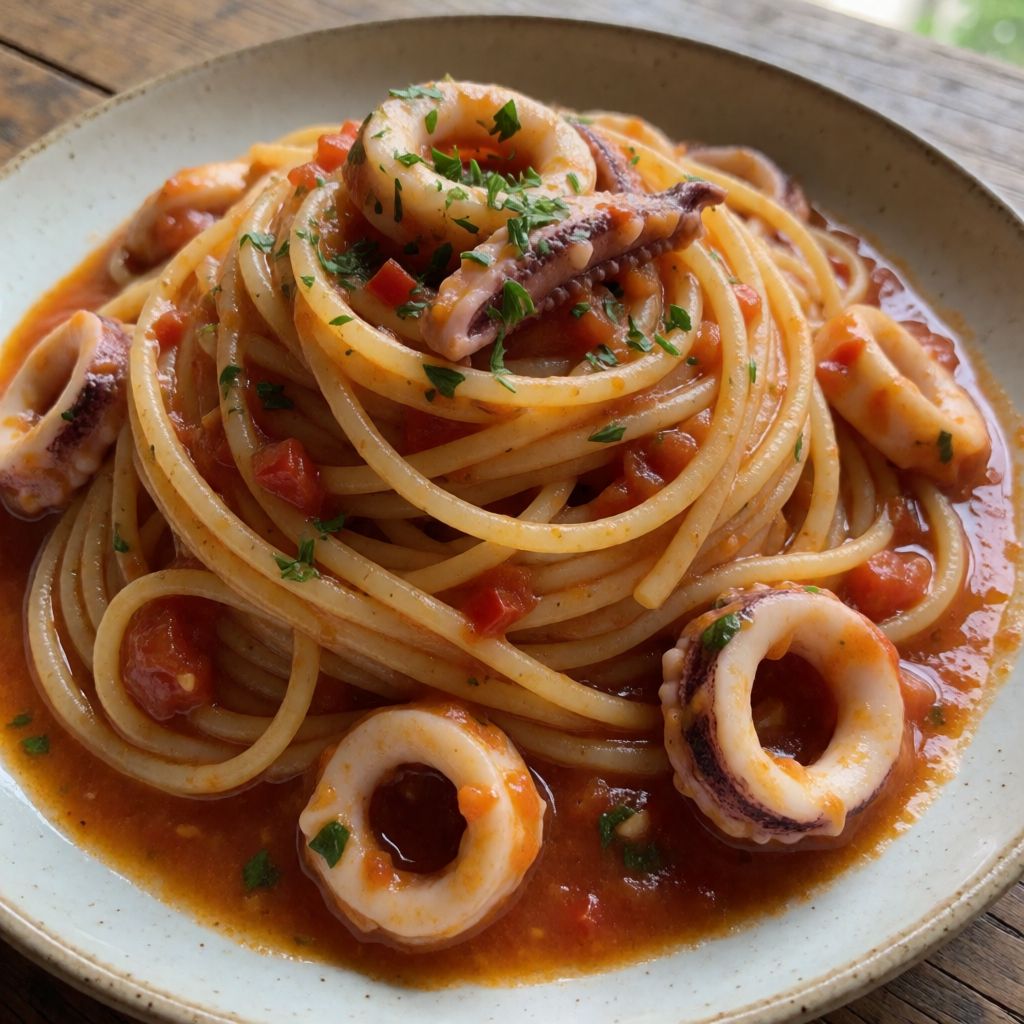
 AI photo
Spaghetti with Tomato Sauce and Squid
A quick Italian-style spaghetti with squid in a garlicky tomato and white wine sauce.
Labels are worked out automatically from the ingredients and can be wrong. Check the packaging if it matters to you.
Ingredients









Steps
Finely chop the parsley, garlic and chilli pepper, and sauté in a pan with 2 tbsp of olive oil.
Add the squid, sauté briefly, then pour in the wine.
Let the wine evaporate and cook over low heat for 20 minutes.
20 minAdd the tomato passata and cook for another 10 minutes. Doneness: 63°C at the thickest part.
10 minSeason with salt and sprinkle with extra parsley.
Toss the sauce with pasta cooked until al dente in salted water, and serve.
This is a fisherman's dish dressed up as date-night pasta: squid, tomato, wine, done in under an hour. It belongs to the family of recipes built for people who had the sea on one side and not much money on the other — squid was cheap because nobody with options wanted it, tomato stretched the pot, wine used up what was already open. Nothing here is rare. The whole question is whether the squid ends up tender or ends up like an eraser, and that is decided by heat and time, not by luck.
Squid has a trick that confuses people. Throw it into a hot pan for a minute and it tightens up — the proteins seize, the flesh shrinks and turns tough almost instantly. That's where the rule "squid cooks in sixty seconds or it ruins" comes from, and for a quick stir-fry of rings, it's true. But this isn't that dish. Here you sear it briefly, then drown it in wine and keep it at a low simmer for twenty minutes. Given that much time at gentle heat, the same tissue that seized up starts breaking down again — the connective fibres soften, the way a tough cut of beef softens in a stew. So the toughening and the tenderising are the same process at two different clocks: short heat ruins squid, long gentle heat rescues it. Rush the middle of this recipe and you get the worst of both — seized and not yet recovered.
Squid: buy it already cleaned if you can, tubes and tentacles, fresh or frozen — frozen is not a compromise here, it's arguably a help, because ice crystals rupture some of the muscle fibre and start the tenderising job before it even touches the pan. What matters more than fresh-versus-frozen is size: smaller squid cook evener in twenty minutes, very large ones may need a few more minutes of that low simmer before they bend rather than resist under a fork.
Tomato passata is tomato that's been cooked down and strained smooth — no skin, no seed, no lump. If you only have tinned chopped tomatoes, blitz them or push them through a sieve; what you're avoiding is bits of skin turning leathery in the sauce. The one thing to check on the label: no added sugar or heavy vinegar, because passata should taste of tomato and acid in balance, not of someone else's seasoning choices made for you.
White wine does two jobs at once: it deglazes whatever caught on the pan from the garlic and squid, lifting flavour off the metal, and its acid starts the same softening work on the squid that the long simmer finishes. If you don't drink wine or don't have any open, a splash of white wine vinegar cut with water does the acid part, though you lose the aromatic lift — not a tragedy, just a smaller version of the same idea.
Olive oil here isn't a neutral carrier you could swap for sunflower oil without anyone noticing — it's doing flavour work alongside the garlic and chilli, so use one you'd be happy to taste on its own. Garlic and chilli are chopped fine and cooked gently at the start specifically so they perfume the oil rather than burn and turn bitter; burnt garlic is the most common reason a simple sauce tastes wrong, and the fix is low heat and watching colour, not a timer. Parsley does double duty — some goes in early to cook into the sauce, more goes in at the end raw, because cooked parsley gives body and raw parsley gives a clean green smell that cooking kills.
In an ordinary British kitchen, use the widest pan you own instead of thinking you need a kazan — squid releases water as it cooks, and a wide pan lets that water evaporate off rather than pool and steam the squid, which is a second, quieter way to end up with rubbery results that has nothing to do with the sauce stage at all. If your pan has no lid, a plate set on top during the twenty-minute simmer does the job of holding heat in without you needing to buy anything.
And the patience bit, because it matters more than any ingredient: twenty minutes of low simmer feels like a long time to stand over a pan for what looks like a simple dish, the way a Sunday roast feels like a long time for a joint of meat. It's the same economics — cheap cut, cheap squid, both paid for in time instead of money. Pull it early because you're hungry and you'll taste the difference; that's not a flaw in the recipe, that's the recipe telling you the truth about how squid actually works.