
 AI photo
Speltotto with Peas and Lemon
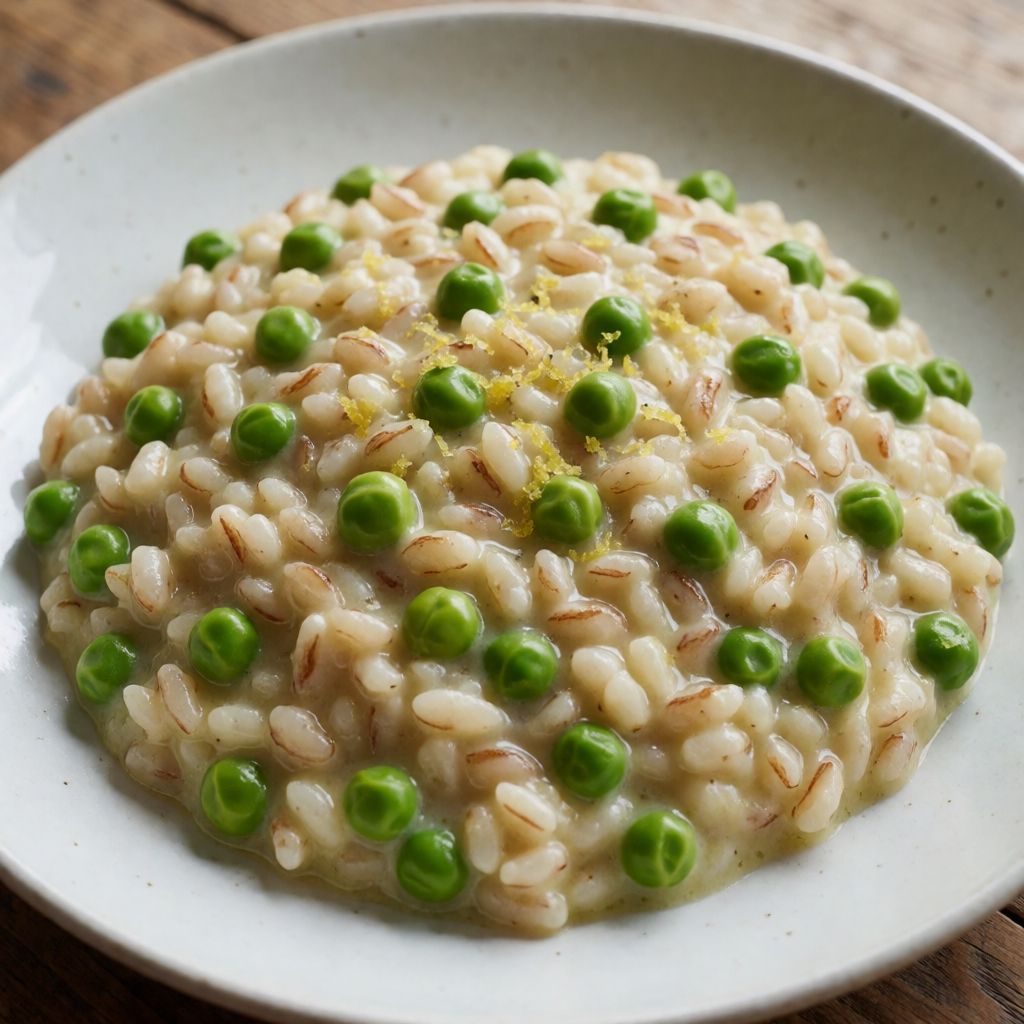
A creamy speltotto finished with peas, lemon juice and zest, and freshly grated parmesan.
Labels are worked out automatically from the ingredients and can be wrong. Check the packaging if it matters to you.
Ingredients
- 200 g Spelt berries
- 100 ml White wine
- 1.3 l Stock
- 100 g Parmesan freshly grated
- 200 g Peas shelled, fresh
- 1 pcs Lemon juice and zest
- Salt
- Black pepper freshly ground
- 30 g Parmesan freshly grated








Steps
Rinse the spelt berries and put them in a saucepan together with the white wine and half of the stock.
2 minBring to the boil, stirring, then let it simmer until the spelt berries absorb the liquid.
Add more liquid, stirring constantly, taste, and when the spelt berries are tender but still slightly al dente, remove the pan from the heat.
Stir in the parmesan and season with lemon juice and finely grated zest, salt and freshly ground black pepper. Fold in two-thirds of the fresh peas.
1 minServe with the remaining peas, parmesan shavings and finely grated lemon zest.
Call it speltotto because that's honestly what it is — risotto grammar borrowed and run on a different grain. Spelt is wheat's older, hardier cousin: husked but not polished the way arborio rice is, so it keeps its bran. That bran is the whole story of this dish. It resists water. Rice gives up its starch and goes creamy almost on its own; spelt makes you work the liquid into it slowly, which is exactly why you add the stock in stages instead of dumping it all in at once.
What decides whether this works is not a clock, it's your attention to the grain's centre. Push liquid in too fast at too rough a boil and the outside turns soft while the middle stays chalky — the bran seals it, won't let heat through evenly. Go slow, keep it at a gentle simmer where you can watch the liquid disappear into the grain rather than boil away over it, and the centre softens at the same rate as the edge. The test is a bite, nothing else: you want resistance, not crunch, not mush. Time in the method is just a floor under that — twenty minutes is where you start checking, not where you stop.
Spelt berries are the whole point and the whole difficulty. You want them with the bran on — that's what gives the bite and the slight nuttiness, and it's also what makes them behave nothing like risotto rice. If you can't find spelt, farro behaves almost identically; pearl barley will work too but cooks faster and softer, so start checking it sooner. What you're looking for in any substitute is a whole grain that holds a firm centre right up until it's done, not one that collapses the moment it's tender — that collapse is what tells you a grain's had its bran stripped, and it won't give you this texture.
Stock is doing more than filling the pan — it's the salt and savour that get drawn into the grain as the liquid disappears into it, so a thin stock makes a thin-tasting dish no matter how much parmesan you throw at the end. If Sunday's roast left you a carcass, that stock is better here than anything from a cube, and it's the sort of quiet thrift this kind of cooking was always built on — nothing about risotto method was ever really about luxury, it was about stretching a small amount of grain into a filling meal, slowly, with whatever good liquid was in the pot already. Vegetable stock is fine if you want it lighter; just taste it unsalted stock and adjust at the end, because you're reducing it and concentrating whatever's in there.
The white wine goes in at the start, with the first liquid, not at the end — its job is acid and aromatic lift while the grain is still raw and taking liquid on board, and by the time you're adding more stock the alcohol has cooked off and the sharp edge has settled into the dish rather than sitting on top of it raw. Any dry white does the job; there's no magic bottle for this, just don't use something sweet, it'll throw the balance of the lemon later.
Parmesan appears twice for two different reasons. The 100 g that goes in off the heat is the one building the creaminess — a hard, low-moisture, high-fat cheese melts into warm liquid instead of turning stringy, which is why a young, wet cheese would let you down here. Any aged hard cheese with that same dry, fatty character will substitute — grana padano, a mature pecorino if you want more bite, a hard vegetarian alternative if parmesan's traditional rennet is a problem for you. The 30 g at the end is garnish, meant to stay in shavings or coarse grate so you get a bit of salt and chew on top rather than melting back into the dish.
Lemon comes in raw, after the pan's off the heat, for the same reason the cheese does — heat mutes citrus fast, cooks the brightness out of it. Juice for acid, zest for the oils, which are a different thing entirely and worth keeping separate in your head: juice cuts the richness of the cheese, zest just perfumes it. Use a fine grater for the zest and only the coloured skin, none of the white pith, which is bitter and brings nothing useful.
On an ordinary UK hob, use the widest heavy pan you've got rather than a tall narrow saucepan — risotto method depends on liquid reducing in a thin layer you can watch, and a narrow pot just traps steam and boils rather than lets you see the grain take up what you're giving it. There's no kazan to fall back on here, no deep reservoir of gentle heat; a flat electric or induction ring runs hotter and less evenly than you'd like, so keep the simmer low and stir more often near the base, where the thin metal of most domestic pans scorches first. And treat the whole method as needing patience, not supervision — the dish doesn't want you to hurry it, it wants you to keep checking back, which is a different and much calmer kind of attention.