
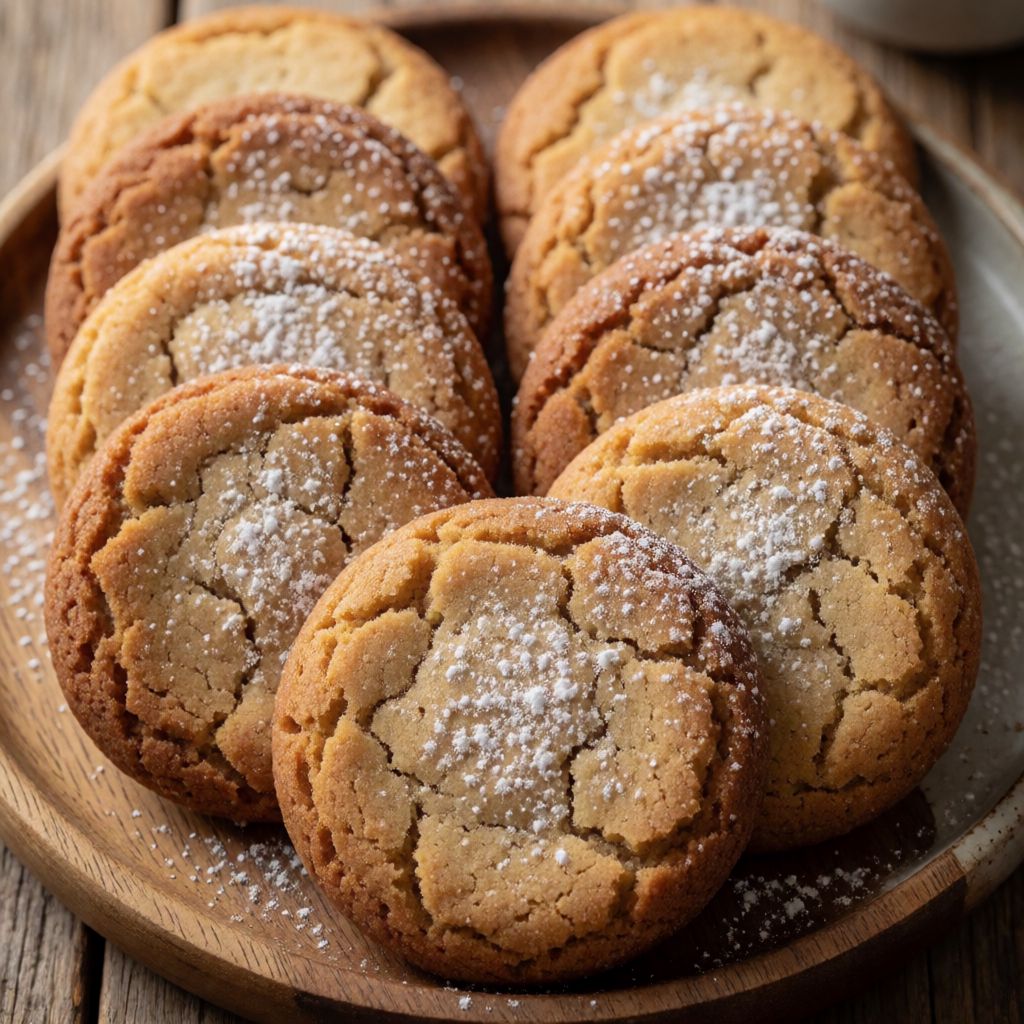
 AI photo
Spiced Chocolate and Cardamom Cookies
A fragrant spiced cookie with dark chocolate and cardamom, finished with orange zest.
Labels are worked out automatically from the ingredients and can be wrong. Check the packaging if it matters to you.
Ingredients
- 175 g Butter
- 110 g Icing Sugar
- 1 pcs Egg
- 1 pinch Baker's Ammonia (Ammonium Carbonate) dissolved in the orange juice
- 0.5 pcs Orange juice and zest
- 220 g Plain Flour
- 0.5 tsp Cardamom ground
- 50 g Dark Chocolate finely chopped








Steps
Beat the butter and icing sugar until light and soft, then mix in the egg and the baker's ammonia dissolved in the orange juice.
Mix in the flour, cardamom, chocolate and orange zest, shape into two logs and place in the freezer for 1 hour.
60 minCut the dough into thin slices (3–4 mm) and arrange on a baking tray, leaving space between them.
Bake in a preheated oven at 160°C (fan) for 8–10 minutes.
9 min
What was changed
Baker's Ammonia (Ammonium Carbonate) is used instead of the original raising agent, as it's the familiar form sold in British shops.
This is not shortbread, though it comes from the same family of rich, butter-heavy doughs — the chocolate, the orange zest and the cardamom push it closer to the spiced continental biscuits you'd find at a German or Scandinavian Christmas market, cut thin and small enough that one isn't a commitment and three become a habit. A hundred biscuits from this amount of dough tells you the size they're meant to be: a coin, not a scone. Small, so they bake through in minutes and the spice never shouts.
What decides whether this works is the dough's temperature at the moment of the knife, not the oven. Butter soft enough to slice squashes the log into an oval, and the biscuit bakes unevenly — thick in the middle, dark at the thin edge. Butter cold enough to hold a clean 3–4mm disc gives you a biscuit that spreads evenly and bakes evenly, because every slice starts the same shape and thickness. That's what the hour in the freezer buys you — not flavour, not structure, just cold, so the knife does its job cleanly rather than the butter deciding the shape for you.
Butter and icing sugar: beat these together and you're not just mixing, you're beating air in — that's the 'light and soft' the recipe asks for, and it's what makes the dough tender rather than dense once baked. Use butter that tastes of nothing but itself; there's little else carrying flavour in the base besides orange and cardamom, so a flavourless baking block does this dough no favours. The icing sugar isn't decorative either — its crystals are fine enough to dissolve straight into the butter rather than sit as grit, which is why the dough slices clean instead of tearing. Granulated sugar here leaves visible flecks and a grainier bite.
Egg binds the dough so a thin cold slice holds together rather than crumbling under the knife, and it carries just enough moisture that the baked biscuit isn't dry sand. Baker's ammonia is older than baking powder — a 19th-century leavener, cheap and stable to store, which is why it survived in European biscuit baking long after soda took over everything else in the kitchen. It needs liquid to start breaking down, which is why you dissolve it in the orange juice rather than tip it in dry; dry, it leaves pockets of unreacted powder and a bitter, metallic taste in isolated spots instead of an even lift through the whole batch. No baker's ammonia to hand — bicarbonate of soda is the honest substitute, but expect a slightly denser, less snapping biscuit. You're trading one kind of lift for another, not swapping like for like.
Orange earns its place twice over but unevenly: the zest does the real flavour work, because the fragrant oil sits in the skin, not the juice, so don't skip grating it even though you're using the juice elsewhere. The juice is there mainly to dissolve the ammonia and add a little acidity — useful, but not where the orange character comes from.
Cardamom, if you can, buy as pods and grind just before mixing — the pre-ground kind loses its top note within weeks, because the oils that carry the smell are the first thing to go once the seed is cracked open and exposed to air. Half a teaspoon looks timid next to the chocolate, but it's there to lift the orange, not to fight the chocolate for attention — go heavier and you'll taste soap, which is the one real risk with cardamom.
Chocolate should be chopped fine so it distributes through the dough rather than sitting as lumps that scorch before the biscuit's centre is done; pick one with no added vanilla or milk fat, so it keeps the bitterness that balances all that butter and sugar — milk chocolate here just tastes of more sweetness on top of sweetness. The flour is plain for a reason: the dough already has its lift from the ammonia, and a stronger flour would only make it tougher to slice and chewier to bite, when the whole point is a clean, dry snap.
160°C fan is low enough that a biscuit this thin browns at the edge before it burns in the middle, and the moving air in a fan oven means you shouldn't need to rotate the tray — worth checking once on your own oven, since a static one often runs hotter at the back. Pull them when the edges have gone from pale to just gold; the centre will still look soft, and that's correct — it firms as it cools, carried by the heat already inside the biscuit rather than the oven's. And since a hundred biscuits is more than one tray's worth in an ordinary flat with one small oven, that's exactly why the dough is shaped into a log and not a rolled sheet: wrap what you don't need, keep it frozen, and slice off six at a time over the next fortnight. That's not a shortcut. That's the whole reason for the shape.