
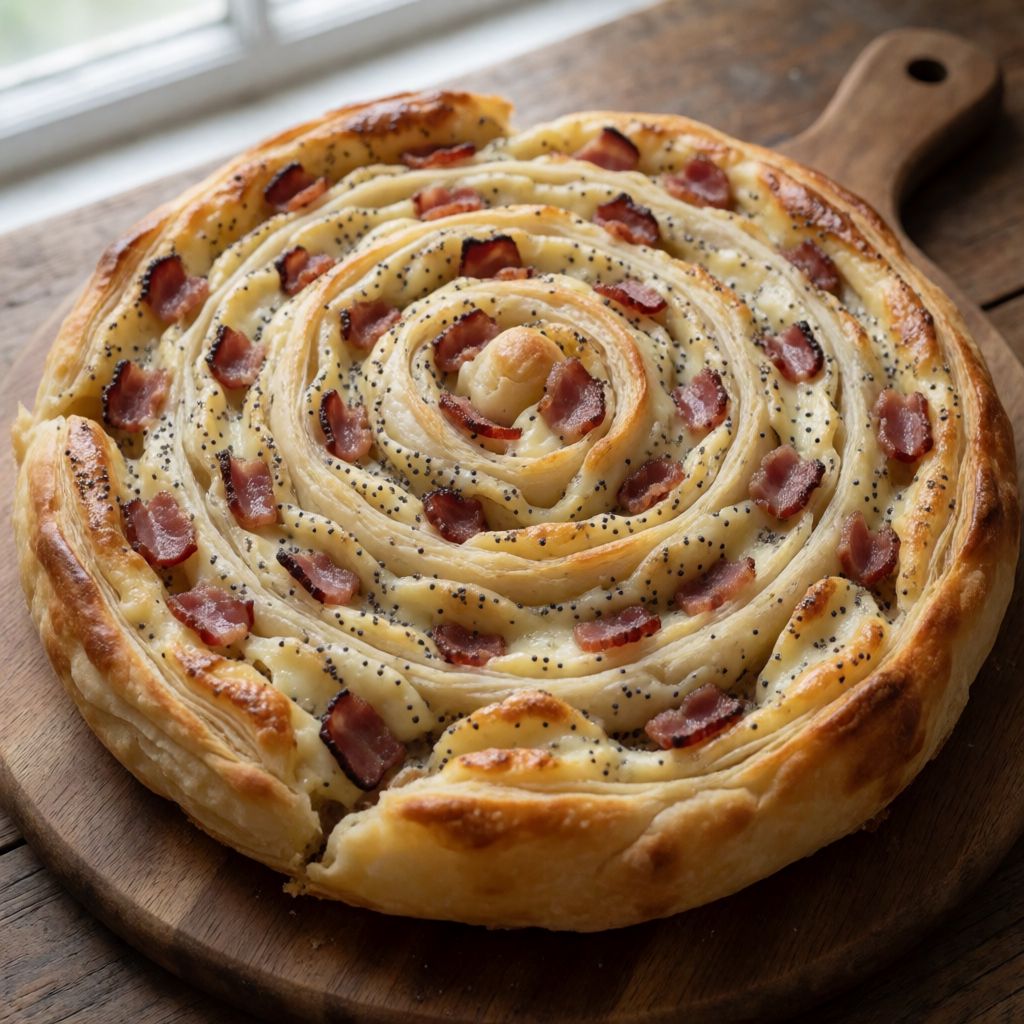
 AI photo
Spiral Pie with Bacon and Smoked Provolone
A spiral puff pastry pie filled with smoked provolone and bacon, brushed with egg yolk and sprinkled with poppy seeds.
Labels are worked out automatically from the ingredients and can be wrong. Check the packaging if it matters to you.
Ingredients
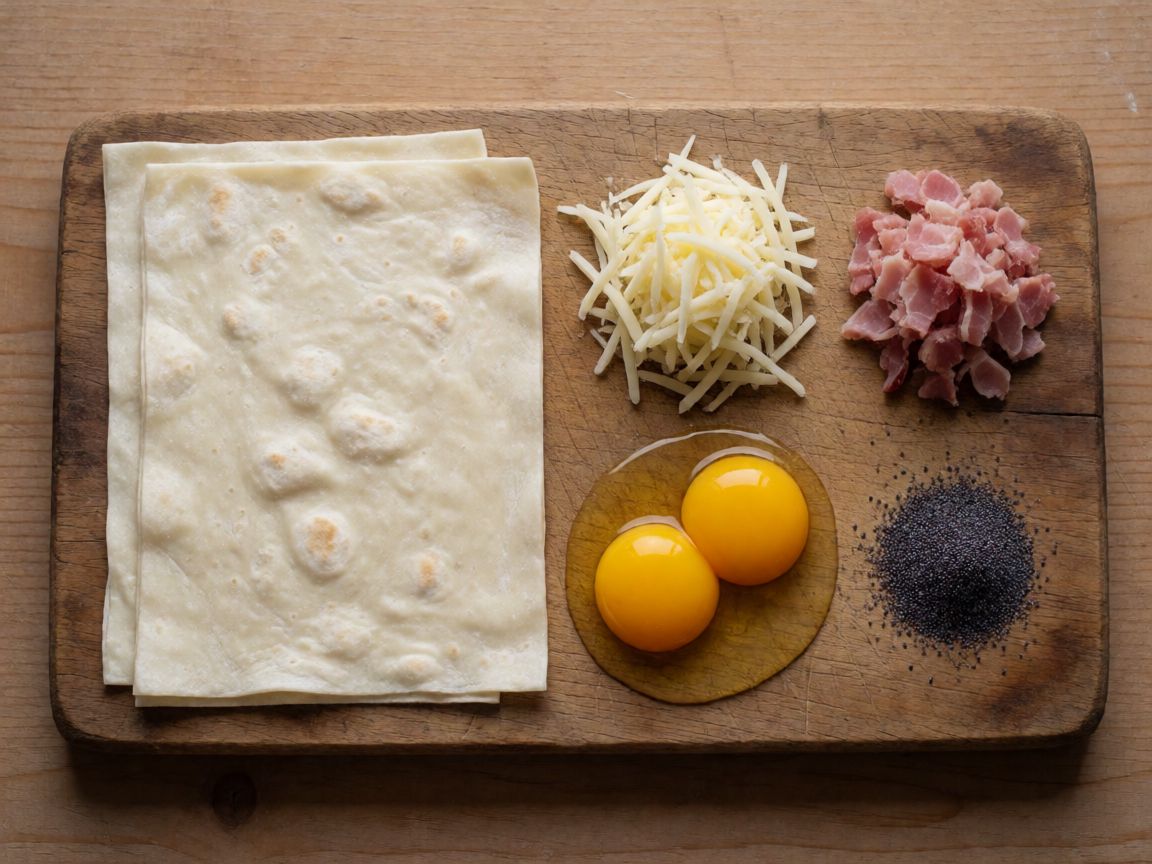
- 2 pcs Puff Pastry sheets
- Smoked Provolone to taste
- Bacon (speck) to taste
- 2 pcs Egg Yolks
- Poppy Seeds to taste


Steps
Roll out the puff pastry and divide it into three equal rectangular strips, cutting with a pizza wheel or a knife.
Lay the smoked provolone over each strip.
Arrange the bacon on top, then brush the edges of the pastry with the egg yolks.
Roll each strip into a cylinder, sealing the edges well.
Repeat the same steps with the second sheet of pastry, so you have 6 cylindrical rolls in total.
On a baking tray lined with baking paper, arrange the rolls, twisting them into a spiral around each other to form the pie.
Brush the surface with the remaining egg yolk, sprinkle with poppy seeds and bake in an oven preheated to 180°C.
35 minCheck that the thickest part of the pork has reached 70°C, then serve.
This is not a filled pie in the usual sense — it's a plait of six small cigars of pastry, each one rolled around smoked cheese and bacon, then twisted together before baking so the spiral shows the moment you cut into it. The twist isn't decoration. Soft puff pastry stuffed with wet filling won't hold its own shape in a hot oven — it slumps sideways. Twist six of them together and they lean on each other; the spiral is doing structural work, not just looking nice on the plate.
What actually decides whether it works is how tightly you roll and how well you seal the seam. Roll loose, and the melting cheese finds the gap and runs straight out onto the tray — you'll know, because you'll be scraping a sticky puddle off the paper afterwards. Roll too tight, and the steam that puff pastry depends on to lift its own layers has nowhere to go, so instead of flaky sheets you get a dense, slightly gummy coil. The egg yolk brushed along the edge before rolling isn't for colour at that stage — it's glue, holding the seam shut against an oven that wants to prise it open.
Puff pastry, bought ready-rolled, is the sensible choice for a domestic kitchen — making it from scratch is hours of folding and chilling, and almost nobody in an ordinary flat has the marble surface or the patience on a weeknight. What matters with the shop sheets is keeping them cold right up to the moment you cut and fill them: the lift in puff pastry comes from layers of butter trapped between dough, flashing to steam in the oven and pushing the sheets apart. If the butter softens while you're rolling and twisting, the layers smear into each other and you lose the flake before it's even gone in the oven. Keep the second sheet in the fridge while you work the first.
Smoked provolone earns its place here because it's firm enough not to turn into a pool of oil the second it melts, and its smoke is there to agree with the bacon's smoke rather than fight it. If you can't find it, look for the same qualities, not the same name: any semi-firm cheese that melts to softness rather than liquid, with some smoke or at least some backbone of flavour — a smoked cheddar, a scamorza, even a mild gouda at a push if smoke isn't on offer. A soft, runny cheese is the wrong choice regardless of flavour; it'll be the thing that leaks.
Speck, the cured and air-dried version named in the ingredients, is drier than most bacon sold as rashers in a British shop, which tends to be wet-cured and holds more moisture. That difference is exactly why the thermometer check at the end matters more than it might seem to — streaky bacon with more water in it needs a little more certainty that the centre of the roll has actually caught up. Use smoked streaky, rind off, laid in strips rather than draped in one lump, so it cooks evenly along the length of the roll rather than in one thick clump.
Two egg yolks, not whole eggs, because the yolk alone gives you glue and a deep, even gloss without the white, which tends to bubble and go patchy under heat. Whole egg will still work if that's what's open in the fridge — you'll just get a slightly less even shine, which nobody at the table is going to complain about.
Poppy seeds on top aren't just for looks, though they do mark the spiral nicely from above. They give the surface some grip and a bit of crunch against the softer bake underneath — easy to swap for sesame or nigella seed if that's what's in the cupboard, since the job is texture and contrast, not a specific flavour.
One honest note about the oven: home ovens lie about their own temperature more often than people expect, sometimes by ten or fifteen degrees either way, and a fan oven behaves differently from a conventional one. So treat 180°C and 35 minutes as the starting instruction, then trust what you can see — a deep gold crust, not a pale one, cheese just visible glistening at the seams — and what the thermometer tells you, over what the dial promises. Let the pie sit five minutes once it's out before you cut it; the cheese needs that pause to settle, or your first slice will simply run.