
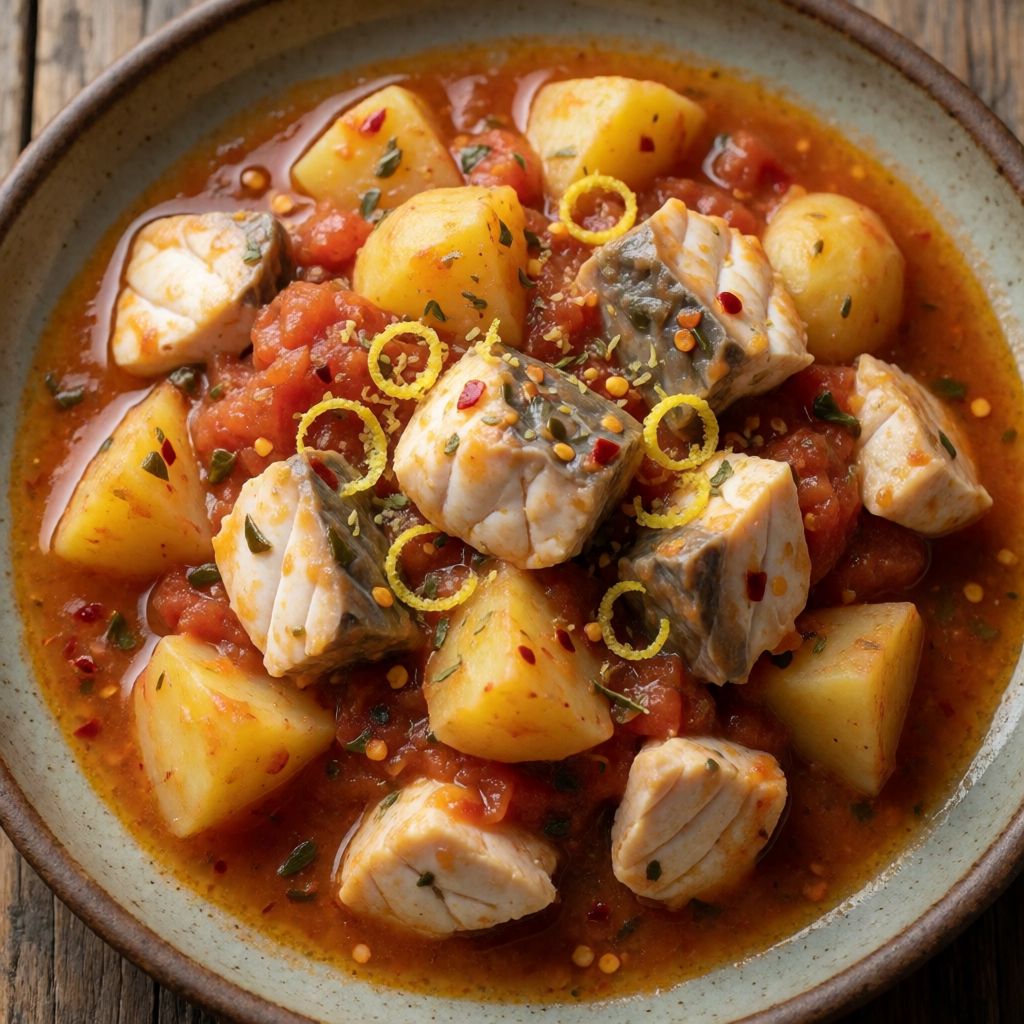
 AI photo
Piombino-Style Stockfish with Potatoes
A hearty stockfish and potato stew from Piombino, simmered with tomato, chilli and lemon zest.
Labels are worked out automatically from the ingredients and can be wrong. Check the packaging if it matters to you.
Ingredients
- 800 g Soaked Stockfish
- 10 pcs Potatoes
- 500 g Tomato Passata
- 1 pcs Chilli Pepper
- 1 pinch Oregano
- 1 pcs Lemon Zest
- 2 pcs Onions
- Salt to taste
- Olive Oil to taste
- 250 ml White Wine










Steps
Slice the onions and fry them in olive oil with the oregano and chilli until golden.
Add the stockfish and sauté gently, breaking it into small pieces.
Pour in the white wine and let it evaporate completely.
Add the tomato passata and lemon zest, and season with salt to taste.
Simmer gently until cooked, making sure the fish reaches an internal temperature of 63°C.
Add the diced potatoes 30 minutes before the dish is ready.
30 minLet the dish rest, covered, before serving.
15 min
This is a stew from Piombino, a working port on the Tuscan coast, built around dried fish that nobody local ever caught. Stockfish — baccalà's drier, unsalted cousin — came down from Norway on Venetian and Genoese ships centuries ago, because dried fish survives a voyage that fresh fish never would. The soaking is already done for you here; what's left is cooking it into something a dock worker's family could stretch with potatoes and one bottle of wine.
What decides whether this works is not the fish itself but three things around it. First, the onion: fried until it turns from pale gold to the colour of ginger, slowly, in oil — rush it and it turns bitter before the sweetness comes out, and that sweetness is the whole base of the sauce. Second, breaking the stockfish into the pan as you sauté it: the fish has gelatin in its skin and connective tissue, and breaking it releases that gelatin into the fat, which is what thickens the sauce later — not flour, not reduction alone. Third, the wine, which has to disappear completely before the tomato goes in, or you'll taste raw alcohol sitting on top of everything instead of the acidity it leaves behind.
Some say the wine has to boil hard to burn off fast. No — a hard boil flings liquid up the sides of the pan and toughens the fish fibres you've just carefully broken up; a gentle simmer evaporates it just as surely, only slower, and slower is fine, because you've got nowhere else to be.
Stockfish itself is just air-dried cod or ling, no salt involved, which is why the soak before you ever get to this recipe matters so much — days of changing water to bring it back from leather to flesh. If you can't get it, salt cod works but needs its own desalting soak, and any firm white fish that holds together under stirring — even cheap frozen cod loin — will give you a stew, just without the particular gelatin richness that real stockfish brings from its skin and bones. Don't reach for something delicate like plaice; it'll fall apart into flakes before the onion's even gone gold.
The onions are not a garnish, they're the sauce's backbone — two is a modest amount for 800g of fish, there to dissolve into sweetness, not to be tasted as onion. Sliced thin, not diced, so they melt rather than stay crunchy. The chilli and oregano go in with them because that's when their oils release into the fat; add dried oregano late and it just sits on top, tasting of dust.
The white wine's job is acidity, nothing more romantic than that — it cuts the oiliness of a fish that's been drying and reabsorbing its own fat for weeks. Any dry white does this; you're not drinking it, you're using its sharpness, so don't spend money on a bottle you'd rather have in a glass.
Tomato passata rather than whole tinned tomatoes is a practical choice — no seeds, no skins, already broken down, so it goes straight to simmering instead of you standing there crushing tomatoes for twenty minutes first. If passata isn't in the cupboard, blitz tinned whole tomatoes smooth; don't use ketchup-style sauces, the sugar in them fights the lemon zest you add later.
Lemon zest, not juice — zest gives you the aromatic oil from the peel without adding acid on top of the wine and tomato, which would make the sauce sharp instead of bright. It's there specifically to cut through the stockfish's fat, the same reason you squeeze lemon over fried fish anywhere in the Mediterranean.
Ten potatoes for two people sounds like a lot until you remember this dish is meant to be a full meal stretched from an expensive, imported fish — the potato is the cheap bulk that turns baccalà for a family into baccalà for a street. Any potato that holds its shape when simmered works — a waxy one is safer in a domestic pan than a floury one, which breaks down faster than you'd want and can turn your sauce starchy rather than silky. Use a wide pan, not a deep pot — stockfish needs room to break apart evenly rather than steam in a crowded centre, and if you don't have a lid that fits, a plate pressed over the top does the same job of holding heat in while it rests at the end.