
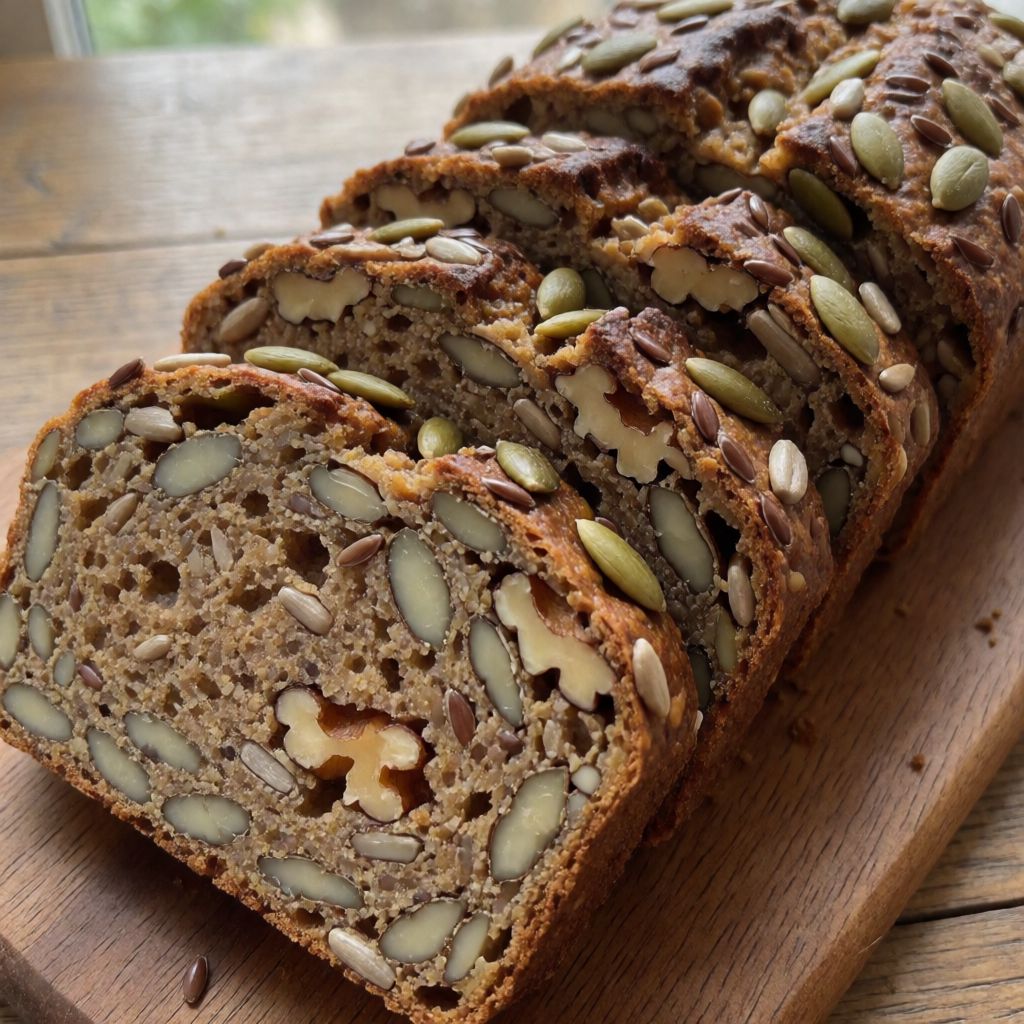
 AI photo
Stone Age Bread
A dense, gluten-free bread packed with seeds and nuts, inspired by Paleo-style baking.
Labels are worked out automatically from the ingredients and can be wrong. Check the packaging if it matters to you.
Ingredients
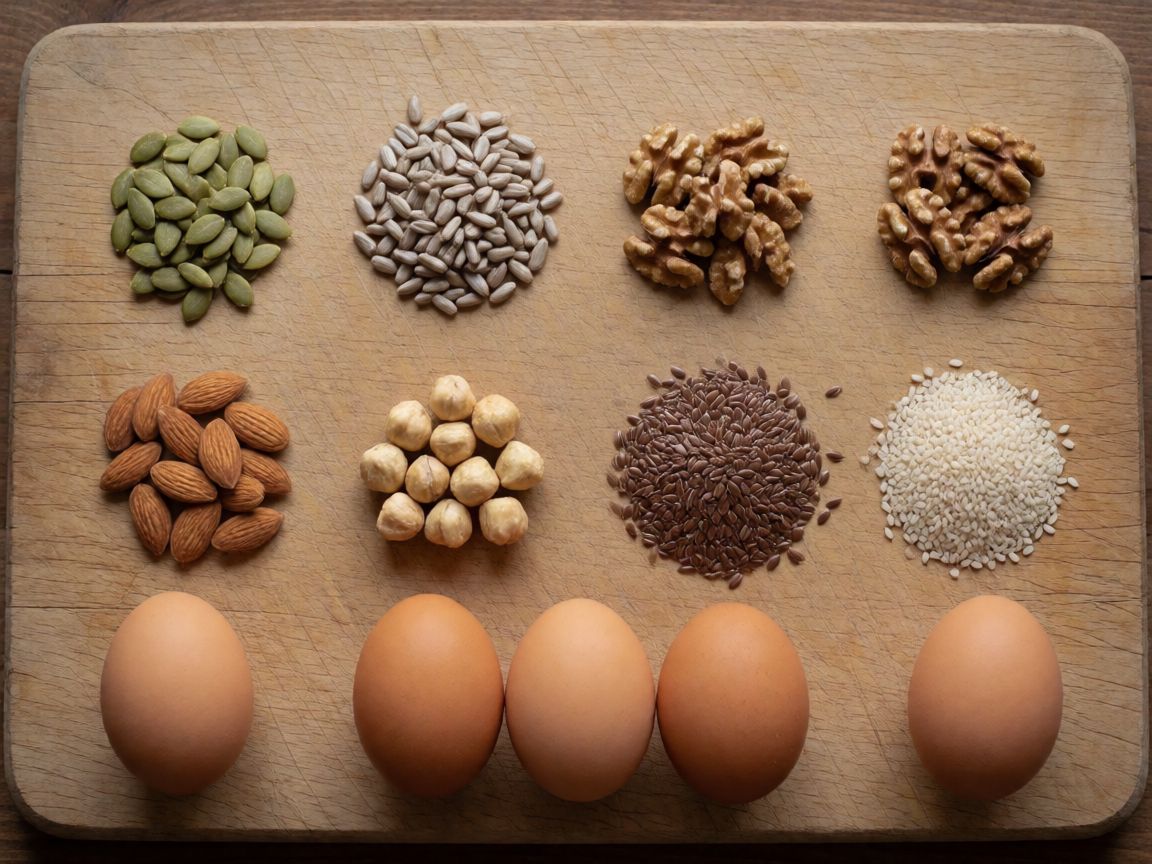
- 100 g Pumpkin seeds
- 100 g Sunflower seeds
- 75 g Walnuts
- 75 g Almonds
- 75 g Hazelnuts
- 75 g Flax seeds
- 75 g Sesame seeds
- 5 pcs Eggs
- 100 ml Olive oil
- 1.5 tsp Salt








Steps
Mix all the ingredients well in a bowl, then pour into a greased 1-litre loaf tin.
Bake the nut bread in an oven preheated to 160°C with top and bottom heat for 1 hour.
60 minLet the bread cool completely on a wire rack before slicing.
30 min
Call this what it is: not bread. There is no flour here, no gluten, no yeast — nothing that traps air and rises. What you have is nuts and seeds held together by egg, baked in the shape of a loaf. The tin gives it the silhouette of bread; the egg gives it the body of a terrine. Once you accept that, the whole recipe makes sense, and you stop waiting for a crumb that was never going to appear.
The thing that decides whether it works is the egg, nothing else. Egg white and yolk are liquid until heat makes the proteins grab each other and set solid — that happens gradually, somewhere around the point water starts steaming off a pan, well before it boils. Your job is to get that setting to happen evenly through a dense, dark, oil-rich mass without the surface — all those sunflower and sesame oils sitting right at the top — scorching first. That is the whole reason for a gentle oven and a full hour: six types of nuts and seeds pack tightly, with almost no air between them, so heat crawls through slowly, the way it does through a meatloaf, not the way it races through an airy sponge. Push the heat up to hurry it and you get a bitter, blackened crust over a middle that is still wet egg — the classic fault of anyone who treats this like ordinary bread and tries to "bake it through" by cranking the dial.
On the seeds and nuts: there are seven of them and none is decorative — together they are the entire structure, so buy them as if structure mattered, which it does. The one thing that ruins this dish silently is rancid fat — walnuts and flax especially, both high in the fastest-oxidising oils, go bitter and faintly "paint-like" within weeks of being cracked open if they sit on a warm shelf. Smell them before you tip them in. Sharp, slightly sour, not sweetly nutty — that's rancid, and no amount of baking fixes it, it only gets baked in. Buy from a shop that turns stock over, keep what's left in the fridge, and you've solved the only real quality problem this recipe has.
The eggs are doing the job flour and yeast would do in a real loaf: they are the glue. Egg protein is the only thing in this bowl that goes from liquid to solid under heat, so without enough of it the seeds simply sit in a greasy, crumbly heap when cool. There isn't a clean substitute for that in a domestic kitchen — I haven't tested a flax-egg or aquafaba version myself, so I won't tell you it works; I'd rather say honestly that this one depends on real eggs doing real coagulation, and leave it there.
Olive oil is not for flavour alone, though it does bring one. The seeds already carry their own fat, but an egg-bound mass this dense still wants a slippery agent so it doesn't eat like sawdust once cut. The criterion for swapping it is simple: any oil with no smell of its own that you don't mind tasting faintly underneath everything — a light sunflower or rapeseed oil does the job if you don't want the olive note; just don't reach for something assertive like toasted sesame oil, you already have sesame seeds doing that work.
Salt earns its place by contrast, not chemistry — against five eggs and this much fat and roasted nuttiness, a loaf without salt tastes flat and slightly sickly rather than rich. One and a half teaspoons for a kilo-odd of seeds is modest; taste the raw mix before it goes in the tin, because once baked you can't correct it.
On the tin and the oven: a one-litre loaf tin is small by British standards — think the old 1lb tin, not the 2lb tin you'd use for a Sunday-roast-sized bread loaf — and that size is doing real work, since it keeps the mass narrow enough for the heat to reach the centre in an hour at all. Grease it properly; there's no flour here to give the surface the slightest grip-resistance a real dough has, so bare metal will hold onto this loaf stubbornly. If your oven is fan-assisted, watch rather than trust the dial — fan ovens run effectively hotter and will toast that seed crust faster than the time given here assumes; judge by colour and firmness, not by the clock.
One more honest note: the card says it serves one, which is nonsense unless you mean one very committed person over a week. Realistically this cuts into eight to ten thin slices — it's dense and rich, closer to a savoury flapjack than to toast, so a slice with butter and a cup of tea goes further than you'd think. It's also not a cheap loaf to make — walnuts, almonds and hazelnuts together cost more than a bag of flour ever will — which tells you something about why this sits in the "diet bread" aisle and not in the bread aisle: it was never meant to compete with bread on price, only on what it leaves out.