
 AI photo
Rice-Stuffed Aubergines
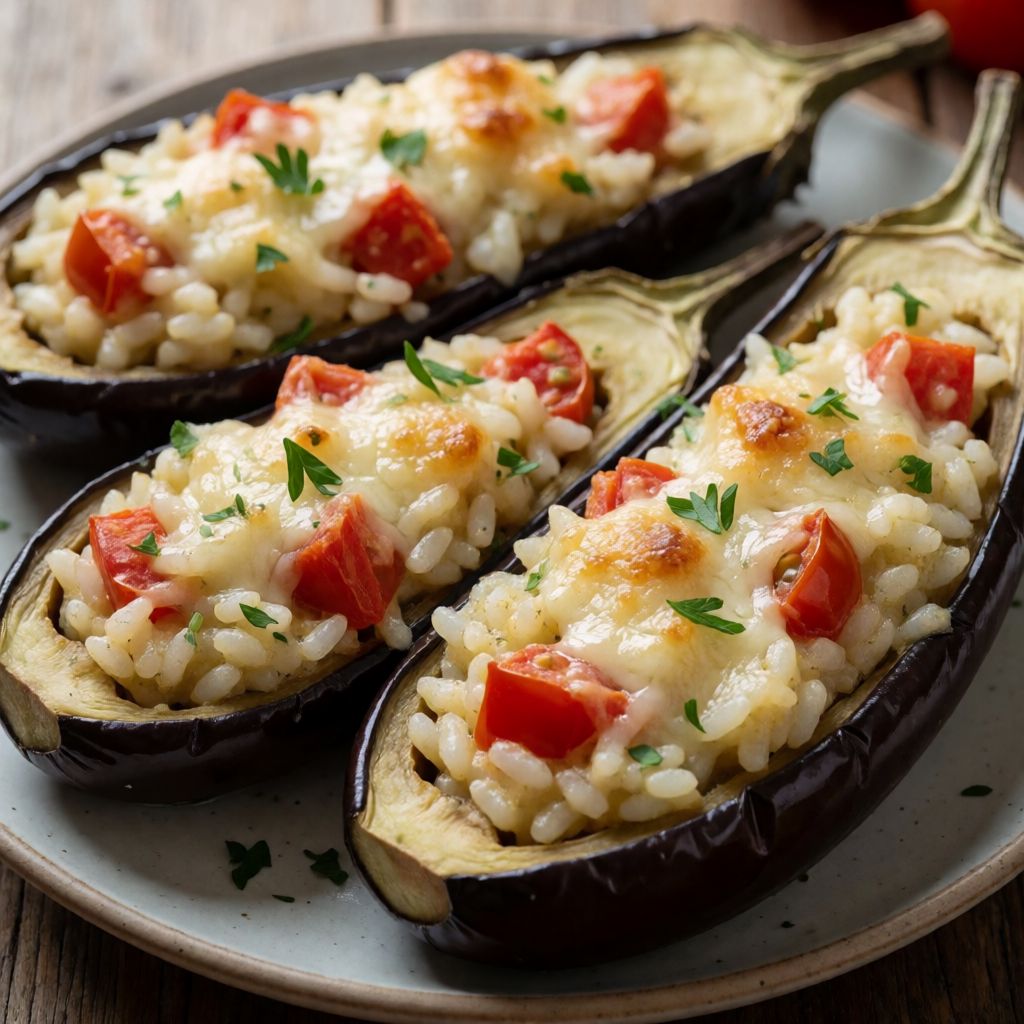
Aubergine halves hollowed out, roasted, then filled with a warm risotto-rice, tomato and mozzarella stuffing and baked again.
Labels are worked out automatically from the ingredients and can be wrong. Check the packaging if it matters to you.
Ingredients
- 2 pcs Aubergine
- 200 g Risotto rice
- 300 g Tomato
- 125 g Mozzarella
- Parmesan to taste
- Parsley to taste
- Olive oil to taste
- Salt to taste








Steps
Wash the aubergines thoroughly, cut them in half and scoop out the flesh with a knife or spoon.
Lay the hollow aubergine halves on a baking tray lined with parchment and drizzle with olive oil.
Bake in a preheated fan oven at 180°C.
30 minSeparately, boil the rice in salted water.
Dice the scooped-out aubergine flesh and transfer it to a wide pan with olive oil.
Cook over high heat, add the tomatoes cut into small cubes and continue cooking.
Drain the rice al dente, transfer to a bowl and add the warm aubergine and tomato mixture.
Add the mozzarella cut into cubes, Parmesan, parsley and salt to taste, and mix well.
If needed, add a little more olive oil if the rice seems too dry.
Fill the aubergine shells with the rice stuffing.
Sprinkle with grated Parmesan, drizzle with olive oil and bake in the oven at 180°C.
15 minTransfer the stuffed aubergines to a serving plate and serve warm.
This is a two-part dish wearing one skin: the aubergine is both ingredient and container, and you cook it twice because it does two different jobs. First bake, empty, it has to turn from a spongy vegetable full of water into something firm enough to hold a filling without collapsing into mush. Second bake, filled, it just needs to marry with the rice and melt the cheese through. Miss that distinction and you either get a soggy boat or a dry, twice-baked husk.
What decides whether it works is the water. Aubergine flesh is mostly water held in a loose sponge of cells. Heat breaks the cell walls and the water runs — that's why the scooped-out flesh goes into a hot pan on its own first, not straight into the rice. Some say aubergine needs salting and draining before cooking to "pull out bitterness" — no, that myth is left over from older, more bitter varieties bred decades ago. What salting actually does to modern aubergine is pull out water, which is exactly what high heat in a pan does anyway, faster and with flavour instead of without it.
The rice is the frame that holds everything together once the water's gone. Risotto rice releases starch as it cooks, and that starch is the glue — it's what lets a loose pile of rice, tomato, aubergine and cheese sit as a filling rather than falling apart on the plate. You take it out al dente deliberately: it finishes cooking in the second bake, inside the shell, with the tomato juice and melting mozzarella doing the rest of the softening. Cook it fully the first time and the second bake turns it to paste.
Aubergine: choose one that's heavy for its size and gives slightly under a thumb press without staying dented — that's flesh that still has structure. A shrivelled or spongy one has already lost water to storage, and it'll collapse rather than firm up in the first bake. You want the halves to become a bowl, not a biscuit — 180°C with air moving (your fan oven) is gentle enough to dry without charring, and a domestic oven at that setting is doing exactly what it's built for, no special kit needed.
Risotto rice — arborio, carnaroli, whatever's labelled "risotto" at the shop — is chosen for the starch coat on the grain, the same stuff that makes a stovetop risotto creamy without cream. Any short, round rice with visible starch will do the same job here; a long-grain basmati won't, because it's bred to stay separate, and separate is the opposite of what you want holding a stuffing together. If risotto rice isn't in the cupboard, pudding rice is closer in behaviour than any "easy-cook" long grain.
Tomato is there for acid and for juice — it's what keeps the rice from drying out in the second bake, when there's no more added liquid coming. Any ripe tomato works; what matters is that it's cut small enough to break down into the rice rather than sit as chunks, and that you don't use anything watery-but-flavourless (hothouse tomatoes in winter) without compensating — a pinch more salt, a touch more oil.
Mozzarella melts, and that's its whole function — bind by heat, not by starch. Buffalo or cow's milk mozzarella both work; what you're avoiding is the pre-shredded "pizza mozzarella" sold for browning, which is drier and was never meant to melt soft. Parmesan, by contrast, isn't there to melt — it's there for salt and savoury depth, so grate it fine and use it both inside the mix and as the crust on top, where it toasts rather than melts, because that's a different texture doing a different job.
Olive oil: any oil with no smell of its own would substitute in the pan-cooking step, because at that point it's a cooking medium, not a flavour. But where it's drizzled raw — over the baking shells, over the finished filling before the second bake — its own taste is the point, so there reach for a more flavourful extra virgin, and reach for the price that implies.
Patience here is less about long cooking and more about not rushing the handoff between stages: the rice has to actually be warm when it meets the aubergine and tomato, because that's what starts softening the raw filling into something that cooks evenly in the second bake rather than staying cool in the centre while the top browns. A wide pan rather than a kazan is fine — you want surface area for the water to evaporate off the aubergine and tomato, and a wide domestic frying pan gives you that better than a narrow saucepan would.