
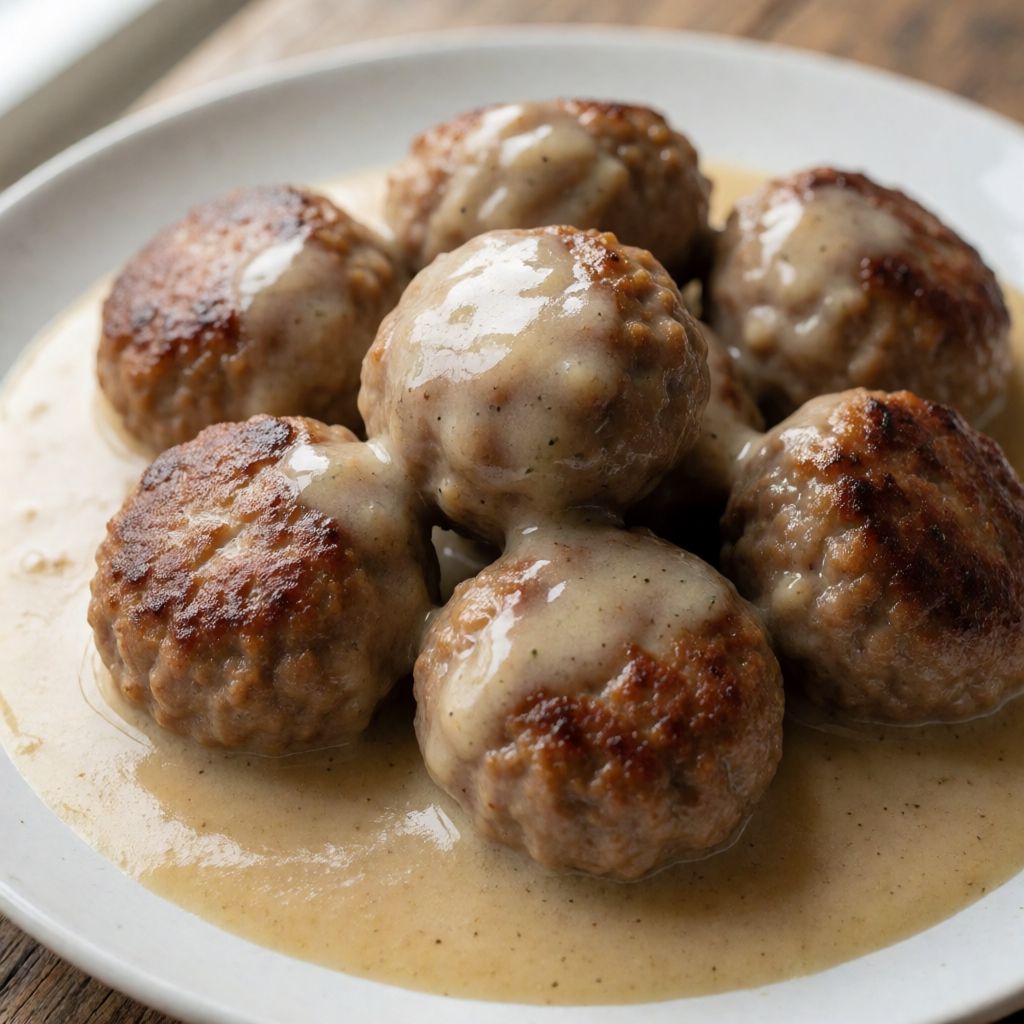
 AI photo
Swedish Meatballs (like IKEA)
A homely take on the classic Swedish meatballs, pan-fried and finished in a creamy sauce, served with lingonberry jam.
Labels are worked out automatically from the ingredients and can be wrong. Check the packaging if it matters to you.
Ingredients
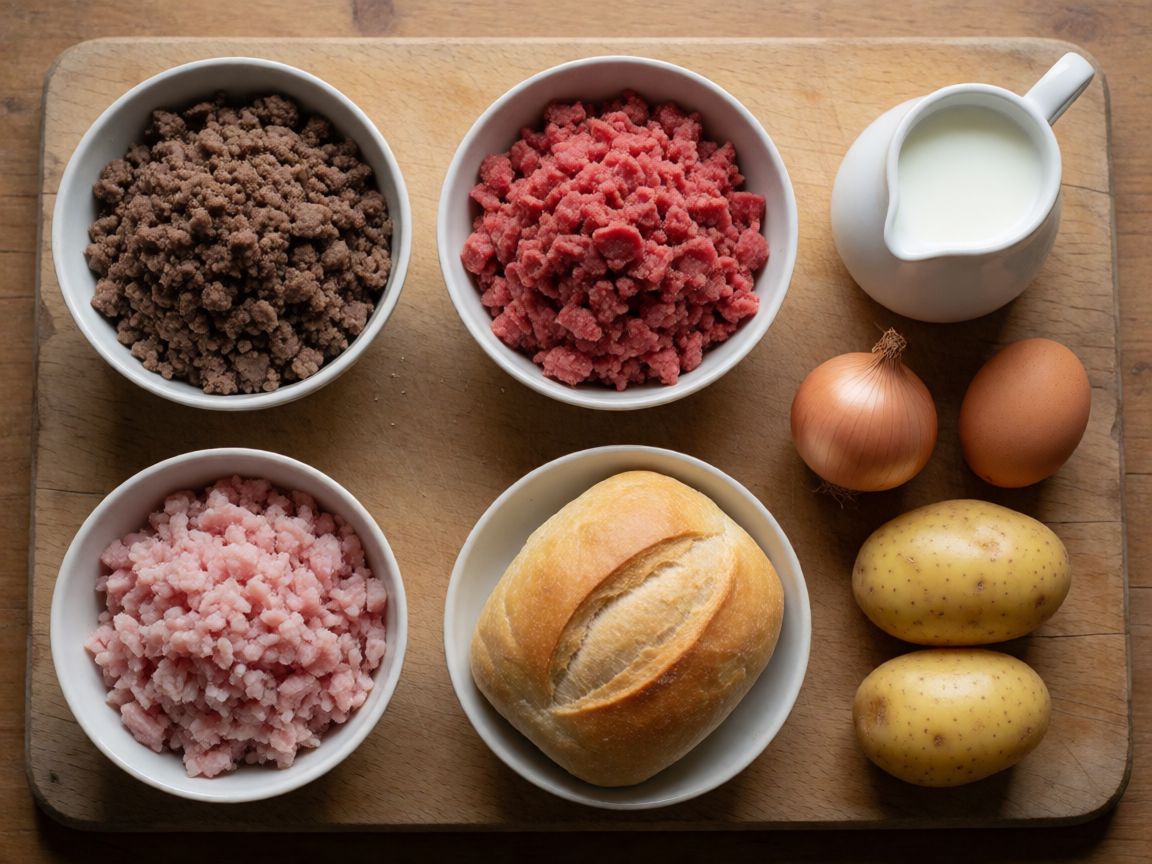
- 150 g Veal and pork mince
- 150 g Beef mince
- 200 g Pork mince
- 1 pcs Stale bread
- 250 ml Milk
- 1 pcs Onion
- 1 pcs Egg
- 2 pcs Potato
- 80 g Double cream
- 1 pinch Salt
- 200 g Butter
- Nutmeg to taste
- 125 ml Marsala wine
- Parsley to taste
- 1 tsp Allspice














Steps
Boil the potatoes, peel and cut into small pieces.
Finely chop the onion and fry it in 30 g of the butter until soft.
In a large bowl combine all three minces, add the bread soaked in milk, the egg and a pinch of salt.
Add the potato pieces and fried onion and mix everything well until even.
Season with nutmeg and allspice.
Shape into small balls about 3 cm in diameter.
Melt the remaining butter in a cast-iron pan and fry the meatballs over a low heat, turning often.
15 minPour in the Marsala and let it evaporate. Check the meatballs are done — the mince should reach 71°C.
Move the meatballs onto a plate, pour the double cream into the pan, add parsley and a pinch of nutmeg.
Thin the sauce with two tablespoons of water and return the meatballs to the pan.
Heat through gently and serve with lingonberry jam.
Three minces, not one. That's the whole trick of this dish and the reason it isn't just a meatball with a Scandinavian accent. Beef gives you the savoury backbone, pork brings fat and softness, veal-and-pork softens the bite further — together they land somewhere no single mince gets you to on its own. Skip the blend and you get something perfectly nice and perfectly ordinary. The blend is the recipe.
What actually decides whether these work isn't the spicing, it's whether the meatball stays a meatball once it hits heat. Mince alone, squeezed into a ball and fried, tightens and weeps — the proteins grip each other and push out moisture, and you get a dense little pebble. Everything else in that bowl — the bread gone soft in milk, the boiled potato, the egg — is there to get between the meat fibres and stop them from fusing into rubber. Bread-in-milk is called panade for a reason nobody needs to know, but what it does, you do need to know: it holds water inside the structure while the meat cooks, so the ball stays tender instead of becoming a chewy ball-bearing. Some say soaking bread in milk is an old trick for stretching meat when you had little of it — and that's true, poverty built this habit — but it survived because it also happens to make better meatballs, not worse ones. Economics and texture agreeing for once.
Fry low and slow, turning the balls often rather than leaving them to sit — that's not fussiness, it's because a 3cm ball needs the heat to get to the centre before the outside burns, and a domestic hob's "frying pan" setting runs hotter and less even than a proper flame under a wide cast-iron base. On a British hob, go a notch below where you'd fry sausages, and judge doneness by colour turning an even deep gold all round and the ball feeling firm, not springy, when pressed — not by a clock. Fifteen minutes is a floor, not a target. If you have a thermometer, use it: 71°C in the centre is the only honest doneness test for mixed mince, because colour inside can lie (pork mince especially can look done at a lower temperature than it actually is). If you don't have one, cut one open — sacrificing a single meatball tells you more than guessing at twelve.
The three minces: don't substitute down to just beef, or you lose the fat and tenderness that pork and veal bring — beef alone, lean, turns dry and mineral-tasting under long cooking. If veal is hard to find or expensive (it usually is, in an ordinary British supermarket), pork and beef alone in roughly equal weight gets you close enough; what you're chasing is a mix of lean and fat, not a specific animal.
Butter is the fat here for a reason beyond flavour: it browns at a lower point than most oils and that browning — those milk solids catching gold then threatening to go dark — is what gives the eventual sauce its depth. Any neutral oil would fry the meatballs fine but give you nothing to build a sauce from afterwards, because there'd be no browned butter solids left in the pan. If you're avoiding dairy fat, use an oil with no smell of its own to fry — sunflower, for instance — and accept the sauce will taste flatter; that trade-off is real, not invented squeamishness.
Marsala going into a hot pan isn't there to get you tipsy on gravy — it deglazes, which only means it dissolves the brown stuck-on residue from frying back into liquid, where it can flavour the cream. Let it bubble down hard until the raw alcohol smell is gone and the liquid's reduced to almost nothing before the cream goes in; pour cream onto a pan still swimming in wine and you get a thin, boozy sauce instead of a short, coating one. No Marsala in the cupboard — a dry sherry or even a splash of brandy does the same chemical job, though the sweetness profile shifts slightly.
Double cream thinned with two spoons of water is a fix for a real problem: double cream alone, reduced in a hot pan, tightens fast and can split or turn too thick to coat properly before you've even got the parsley in. The water buys you a few more seconds of control. Nutmeg here isn't decoration either — it's the traditional partner to cream sauces because its slight bitterness cuts the richness, the same reason you'll find it in a béchamel.
Lingonberry jam at the end isn't sentiment, it's acid and sweetness doing the job a squeeze of something sharp always does against a fatty, cream-heavy plate — cuts through, resets the palate for the next bite. If you can't get it, a sharp redcurrant jelly does the same structural work, though the flavour obviously isn't a match. Serves four as a main, generously, with the sauce — don't rush the frying stage to get it on the table faster; a meatball cooked fast on high heat browns outside and stays grey and underdone within, and no amount of sauce afterwards fixes that.