
 AI photo
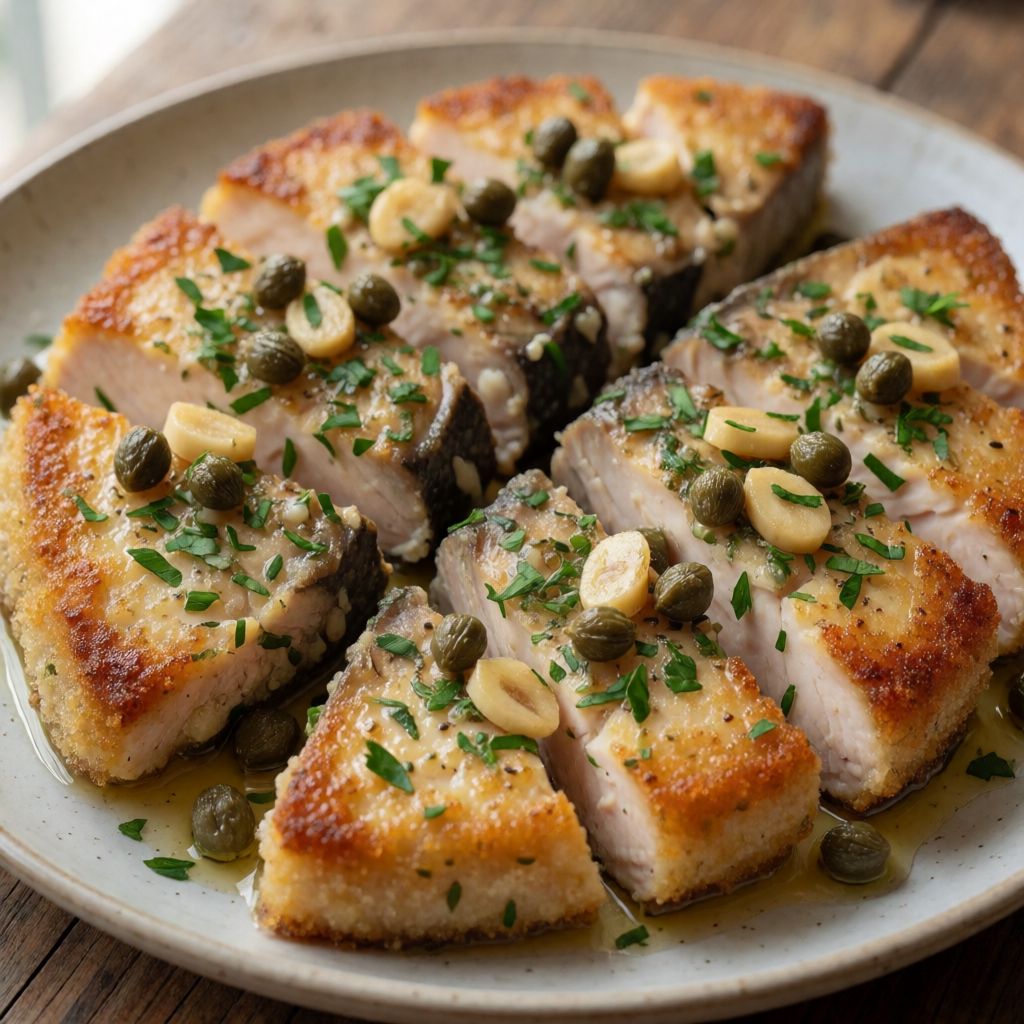
Milanese-Style Swordfish
Crispy breaded swordfish, pan-fried Milanese-style and finished with a bright garlic, parsley and caper dressing.
Labels are worked out automatically from the ingredients and can be wrong. Check the packaging if it matters to you.
Ingredients
- 600 g Swordfish
- 1 clove Garlic
- 40 g Capers
- 30 g Parsley
- 40 ml Olive oil
- 3 tbsp Plain flour
- 1 pcs Egg
- 50 g Breadcrumbs dried
- Peanut oil for frying
- Black pepper to taste
- 1 tbsp White wine vinegar









Steps
Rinse the capers, leave them to drain in a colander for 20 minutes, then soak in cold water for 10 minutes, and blend.
Rinse the parsley and blend it together with the garlic.
Heat the olive oil in a pan, add the pepper, capers, garlic, parsley and white wine vinegar.
2 minRinse the swordfish, remove any remaining skin and leave to drain in a colander for 10 minutes.
10 minSet out the flour and breadcrumbs on plates, and beat the egg in a bowl.
Cut the swordfish into pieces, coat in flour, then in egg, and then in breadcrumbs.
Heat the peanut oil in a large pan and fry the fish for about 5 minutes, turning halfway through, until it reaches 63°C inside.
5 minPlace the fish on a plate lined with paper towel to drain off the oil.
Transfer the fish to a serving plate and spoon over the garlic, parsley and caper dressing.
This is a Milanese cutlet technique borrowed by a fish that has no business being breaded — and that's exactly why it works. Swordfish is dense, almost meaty, with steaks that hold together like a chop. Treat it the way Milan treats veal: flour, egg, crumb, fry hot and fast, and you get a crust that seals in a flesh that would otherwise go dry and stringy under heat. Treat it like a flaky white fish and the crust burns before the inside sets.
What decides the dish is the crumb's job, not its crunch. Breadcrumbs aren't there for texture alone — they're there to stop direct contact between fierce oil and delicate protein, so the fish steams gently inside its own jacket while the outside fries. Skip the flour-then-egg-then-crumb order and the crumb won't grip; skip the draining step beforehand and steam trapped under a wet crust blisters it off in the pan.
The caper-parsley dressing is the part people rush, and it's the part that makes the dish Sicilian rather than Lombard — capers point south, to Pantelleria and Salina, where they're salted or brined to survive heat with no fridge in sight. Soaking them isn't fussiness; it's removing enough salt that they season the dish instead of overpowering it. Blended with garlic, parsley, oil and a splash of vinegar, they turn a fried cutlet into something with acid and green freshness cutting the fat — the actual reason this coating, usually reserved for meat, makes sense on fish at all.
Start with the swordfish itself: you want steaks, not fillets with bloodlines and skin running through — ask for loin cut, 600g enough for one generous main or two modest ones, despite what the "serves 1" suggests. The core cue that actually matters is the one given — 63°C inside. Below that, the fish is translucent and unpleasant; much above, the dense flesh turns to sawdust, because swordfish has very little fat to buffer overcooking. If you don't own a thermometer, press a skewer in: at 63°C it slides through with faint resistance, not the open resistance of raw flesh, not the complete absence of resistance of fish gone past the point.
No swordfish near you — it's not always on a UK fishmonger's slab — reach for another firm, meaty fish that holds a cutlet shape under breading: tuna steak works, even a thick cod loin if you accept slightly less bite. Avoid anything that flakes on its own; the breading technique depends on the fish staying in one piece while you turn it.
The capers are not decoration, they're the dish's backbone of salt and sharpness, and the draining-then-soaking sequence is there for a reason: straight brined or salted capers are aggressive, almost medicinal, and will flatten everything else under a wall of salt. Twenty minutes draining, ten minutes in cold water, pulls enough out that what's left is flavour, not just salt. If capers are hard to find, use chopped green olives in a pinch — not the same thing, but it supplies the same job: brine and bitterness against the fried crust.
Parsley and garlic blended together, rather than chopped separately, give you a paste that clings to the fish instead of sitting on top of it in flecks — this matters more than it sounds, because a sauce that slides off a crumbed surface has done nothing. Flat-leaf parsley, if you can choose; curly works but tastes thinner.
The three-stage coating — flour, egg, crumb — is not bureaucracy, each stage prepares the next for adhesion. Flour dries the surface so egg has something to stick to; egg is the glue; crumb is what actually fries. Skip the flour and the egg slides off wet fish, carrying half your crumb into the oil with it. Use dried breadcrumbs, not fresh — fresh crumb holds moisture and steams rather than crisps, and in a domestic pan with modest oil volume, a soggy crumb means a soggy result, because your hob can't recover lost heat fast the way a professional burner does.
On oil: peanut oil for frying is specified because it has a high smoke point and almost no flavour of its own, letting the fish and the dressing speak — any neutral oil with a high smoke point and no scent does the same job: sunflower, a light groundnut blend, rapeseed in a pinch, though rapeseed carries a touch more character. Save the olive oil for the dressing, where its flavour is wanted, not for frying, where a delicate extra virgin would simply burn and turn bitter before the fish is done — the two oils aren't interchangeable here and that's not snobbery, it's smoke points doing their job.
In your kitchen — a wide pan, not a deep-fat fryer — don't crowd the fish. Two or three pieces at a time, enough room that oil temperature doesn't crash the second you add them, because a crowded pan drops heat, and dropped heat means the crumb absorbs oil instead of sealing against it, leaving you with greasy fish rather than fried fish. That's patience as an ingredient: better to fry in batches and keep the first batch warm than to rush all the fish in at once and ruin the crust that took three separate bowls to build.