
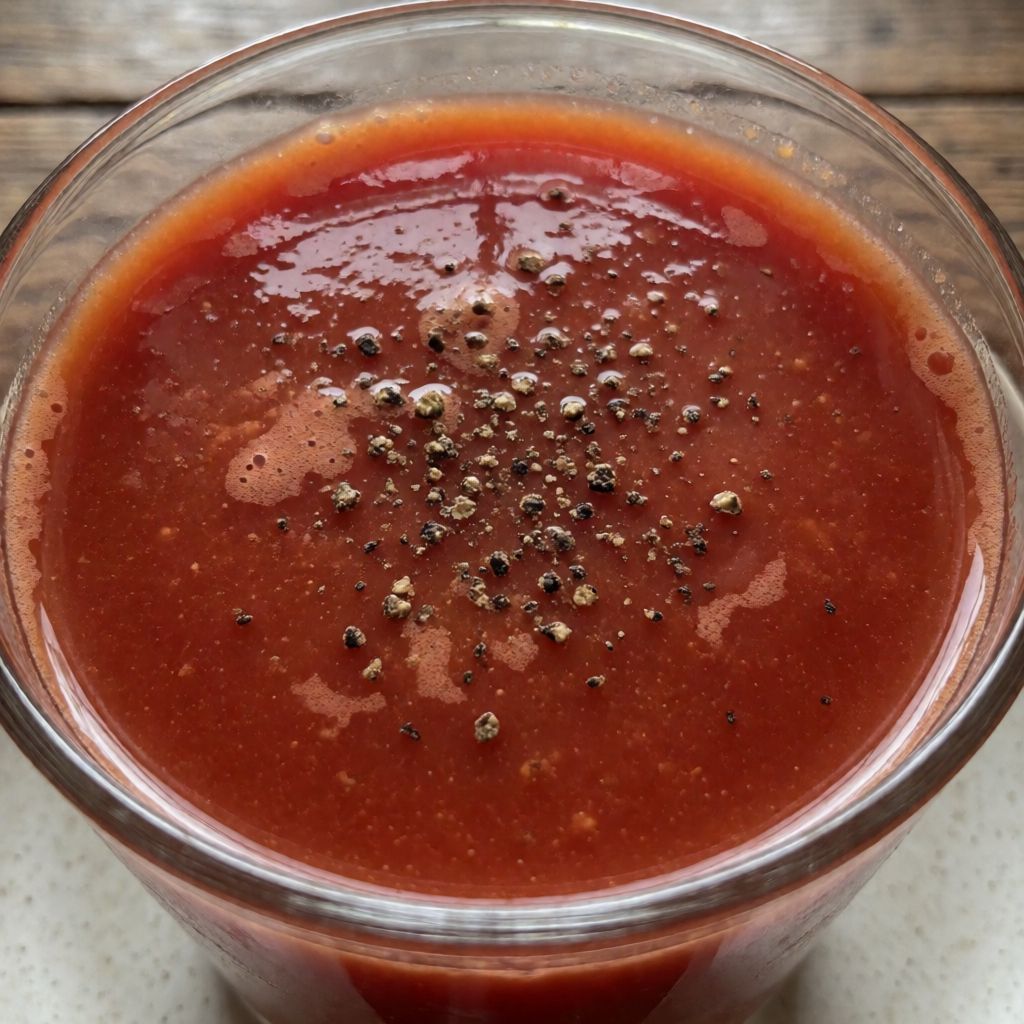
 AI photo
Tomato Juice
A simple, refreshing homemade tomato juice, chilled and seasoned to taste.
Labels are worked out automatically from the ingredients and can be wrong. Check the packaging if it matters to you.
Ingredients
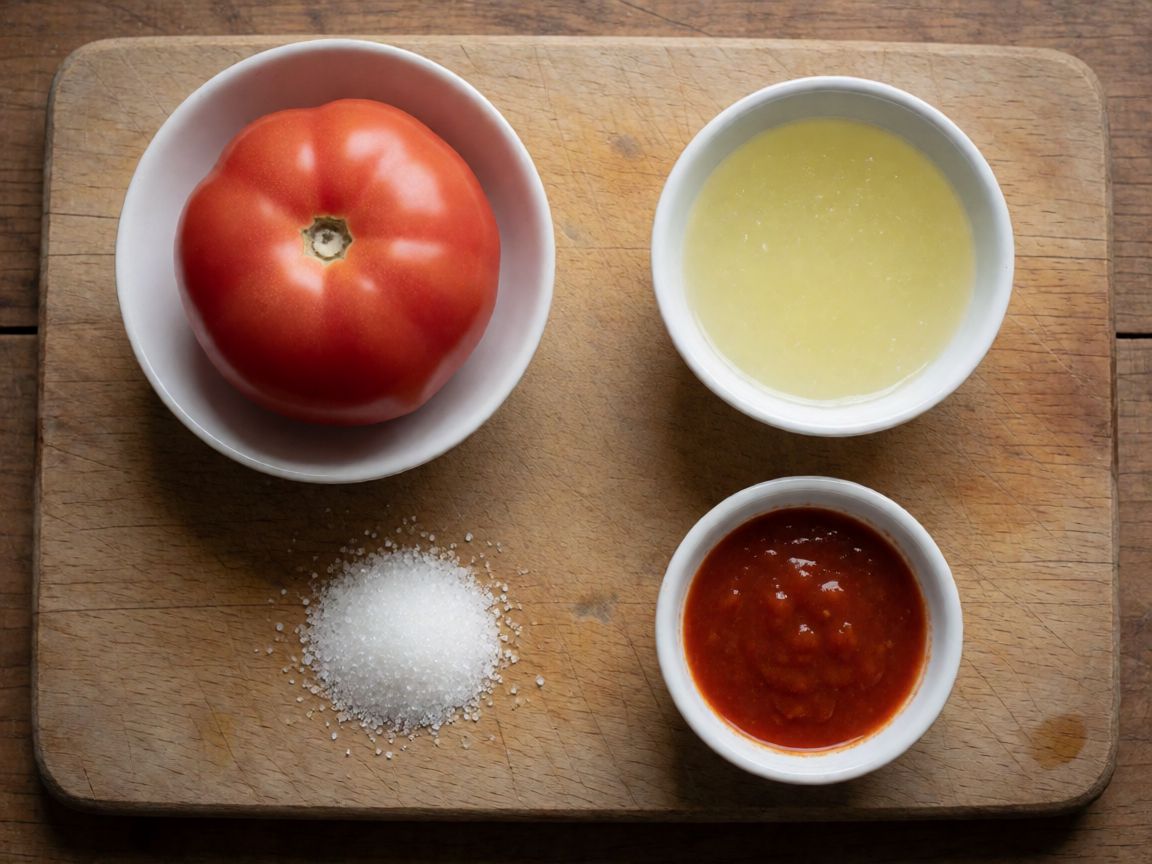
- 200 g Tomato
- 2 tsp Lemon juice fresh
- 1 tsp Sugar
- Salt to taste
- Black pepper to taste
- Tabasco to taste






Steps
Thoroughly wash the tomatoes under running water to remove any soil or other debris.
Cut the tomatoes into pieces and place them in a blender.
Blend the tomatoes for a few minutes until you get a smooth, even tomato purée.
Pass the blended mixture through a fine sieve into a container so the juice comes out clear.
Cover with cling film and refrigerate to chill.
150 minSeason the chilled juice with a pinch of salt and black pepper.
Add the lemon juice and sugar to balance the acidity.
Add Tabasco to taste.
If you like, add ice cubes before serving.
This isn't canned tomato juice and it isn't gazpacho either — it's one vegetable, pressed, nothing added that it didn't ask for. What decides whether it works is almost entirely upstream of the blender: the tomato you start with, and whether you actually strain out what you blend.
Here's the mechanism. A tomato blended whole gives you a slurry — pulp, skin flecks, seed casings, all suspended in red water. That's not a drink, that's soup you haven't bothered to cook. The sieve is what turns slurry into juice: it's the only step doing real work between 'blended tomato' and something you'd pour over ice and sip. Push it through properly — a spoon, patience, maybe a second pass — and what's left behind is fibre you don't want and flavour you're not losing, because the flavour is dissolved, not trapped in the solids.
Some say blend it longer and you won't need to sieve — no, because longer blending doesn't dissolve cell walls and skin, it just chops them smaller. Fine particles still read as grit on the tongue. There's no amount of blitzing that replaces a sieve; they're solving different problems.
The other hinge point is order: season after it's cold, not before. Taste a warm liquid and sugar, salt, acid all read louder than they will once it's chilled — cold mutes sweetness and dulls salt perception. Season it warm and you'll under-salt; chill it after and it tastes flat and you don't know why. Season at serving temperature and you're tasting the thing you're actually going to drink.
Start with the tomato, because nothing downstream fixes a bad one. You want one that gives slightly under your thumb, coloured right through, not pink-shouldered — the kind bred for a seven-day shelf life in a supermarket crate is picked underripe on purpose, because ripe tomatoes don't survive a lorry. Underripe means less natural sugar and more of that green, slightly bitter pectin flavour, and no amount of sieving removes a taste, only solids. If that's what's in your fruit bowl, don't panic — it's exactly why the sugar and lemon juice are in the recipe at all: they're not flavouring, they're correction, pushing a pale supermarket tomato back toward what a sun-ripened one tastes like on its own. If your tomato is genuinely good — a glut from someone's greenhouse, say — you may find you need less of both. Taste before you add the full amount; the measures given are for an average tomato, not your tomato.
Lemon juice does two jobs at once: it's acid, and it's a flavour in its own right, bright and citrus, which sits well against tomato's own acidity rather than fighting it. If you're out of lemon, any clean acid with no competing smell works as backup — a few drops of white wine vinegar, say — but understand you're swapping flavour as well as pH, so go lighter and taste. Sugar's job isn't to make it sweet, it's to balance that acid so it reads as 'ripe tomato' rather than 'sharp tomato.' A teaspoon is a starting point, not a rule.
Salt matters more than its small quantity suggests — without it, tomato juice tastes oddly vegetal and thin, because salt is what makes your tongue register the sugars and the umami in a tomato at all. Black pepper and Tabasco are both heat of different kinds, and both are genuinely to taste: one person's 'to taste' is a pinch, another's is enough to make their eyes water. Neither has a correct amount, only yours.
The chill isn't decoration, it's an ingredient. Tomato juice drunk warm tastes flat and slightly stewed, even though nothing's been cooked — raw tomato simply reads better cold, the same way a ripe melon does. Give it the full stretch in the fridge; rushing it with ice at the end cools the glass but dilutes the juice, which is a different thing. If you want ice, add it at serving, after chilling, as a texture choice, not a shortcut.
On equipment: you don't need a chinois. A fine kitchen sieve, or a square of clean muslin or an old (washed) tea towel set over a bowl, does the same separating job — push with a spoon, or gather the cloth and squeeze. What you're removing is a few teaspoonfuls of pulp from 200g of tomato; it won't take long, but it won't take no time either, and trying to speed it by skipping it is how you end up with the gritty, pulpy drink people mistakenly think tomato juice is supposed to be.
Worth knowing: tomato juice as a drink is largely an early-20th-century American invention, a way to use up tomatoes that didn't sell whole, pressed and bottled commercially long before anyone made it fresh at home for two people on a Sunday. This version has none of the cooking or preserving that commercial juice needs to survive on a shelf for months — it's made to be drunk today, which is also why there's no cooking step at all. That's not a shortcut, that's the whole point of doing it yourself.