
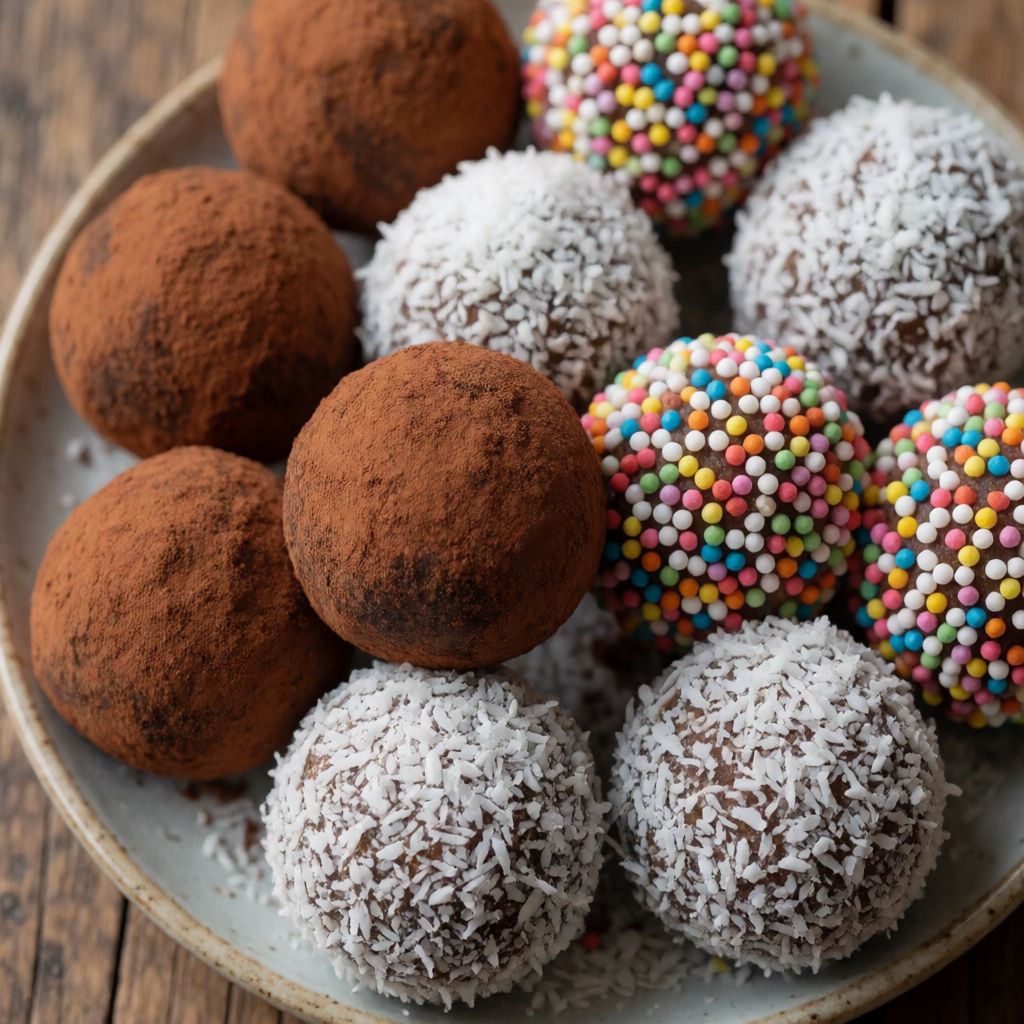
 AI photo
Pandoro Truffles
A quick, no-bake way to turn leftover pandoro into rich little chocolate-hazelnut truffles.
Labels are worked out automatically from the ingredients and can be wrong. Check the packaging if it matters to you.
Ingredients
- 300 g Pandoro
- 100 g Ricotta
- Nutella to taste
- Cocoa powder to taste, for coating
- Desiccated coconut to taste, for coating
- Sprinkles to taste, for coating




Steps
Cut the pandoro into medium-sized pieces with a knife and transfer to a food processor, blitzing it fairly fine.
Tip the finely chopped pandoro into a bowl, add the ricotta and mix well.
Shape into balls about the size of a walnut, pressing a small hollow into the centre of each with your finger.
Spoon a little Nutella into the hollow, then carefully close it up and reshape into a ball.
Roll the truffles, if you like, in cocoa powder, desiccated coconut or sprinkles.
Arrange the finished truffles in paper or silicone cases and serve.
What was changed
Desiccated coconut is used for rolling the truffles instead of coconut flour, since that is what the recipe actually means for coating.
This is not a chocolate truffle wearing a costume — it only borrows the shape and the dusting-in-cocoa gesture. What you're actually making is a cake rescue: leftover pandoro, crumbed fine, bound into a paste with ricotta, then wrapped round a spoon of Nutella like a sweet dumpling. No oven, no hob, no heat at all. The whole mechanism rests on two things — how fine you crumb the pandoro, and whether the ricotta you add matches how dry that particular pandoro is.
Pandoro on its own is crumbs and air — it has no structure once broken up. Ricotta gives it both fat and moisture, the way butter and egg give structure to a dough, except here nothing sets by cooking. It sets by absorption: the crumb soaks up the ricotta's moisture and the mix goes from sandy to mouldable, the way breadcrumbs turn into a paste for meatballs. That's your real test of doneness, and it isn't a stopwatch — it's your palm. Take a small amount and squeeze: if it cracks at the edges, it's too dry, add a little more ricotta; if it won't hold a shape and clings to your fingers like wet sand, it's too wet, work in more crumb. The 300:100 ratio in the recipe is a starting point, not a law — pandoro bought a week before Christmas and pandoro eaten on the 2nd of January are not the same cake.
Pandoro itself is worth a word, because it explains why this works better than it would with most cakes. It's Verona's answer to Milan's panettone — same enriched, laminated dough, but without the candied peel and raisins, star-shaped tin, dusted plain with icing sugar. That absence of fruit matters here: a food processor turns pandoro into even, fine crumb, where panettone would give you lumps of sticky candied peel fighting the blade. If pandoro isn't something you have — and in a UK kitchen it usually arrives once a year, boxed next to the panettone in the Italian aisle before Christmas and gone from the shelves by February — the criterion for a substitute is a dry, plain, egg-rich cake with no strong flavour of its own to clash with the Nutella: a stale Madeira cake, brioche, even a dry Victoria sponge with the jam scraped off will crumb and bind the same way.
Ricotta does two jobs, not one — moisture and fat, together, without being greasy. That's why it works better here than cream, which is moisture without structure and would turn your crumb to sludge, or mascarpone, which is fat-heavy and would make the paste slick and hard to shape. If you've no ricotta, the criterion is a soft, mild, slightly grainy fresh cheese with moderate water content — cottage cheese blitzed smooth gets close, though it brings a touch more tang, which isn't unwelcome against the sweetness of Nutella and pandoro.
Nutella is doing exactly what it should: a pocket of something that stays softer than the shell around it, so the bite has contrast — crumb outside, near-liquid inside. There's no real substitute that behaves the same way at room temperature without melting out faster or setting too hard; a thick dulce de leche would be the closest cousin if you wanted a change, but it changes the dish's whole character, so treat it as a variation, not a swap.
The coatings aren't decoration, they're function as much as looks. Cocoa cuts the sweetness with real bitterness and keeps your fingers from sticking to the truffle when you pick it up — the same reason ganache truffles are rolled in it. Coconut adds its own fat and a dry, catching texture that stops the surface being tacky. Sprinkles do neither job particularly well, they're there for children and for colour, and that's a perfectly good reason on its own — not every coating needs a mechanism, some are just for the table looking cheerful.
For a UK kitchen there's nothing here that asks more of you than a food processor, or failing that a box grater and some elbow grease — pandoro is soft enough to break down by hand if your processor's small or borrowed. Four hundred grams of dough between six people isn't much — reckon on two or three walnut-sized truffles each, which with tea after a Sunday roast is about right: rich, sweet, and small enough that nobody feels they've had pudding twice.