
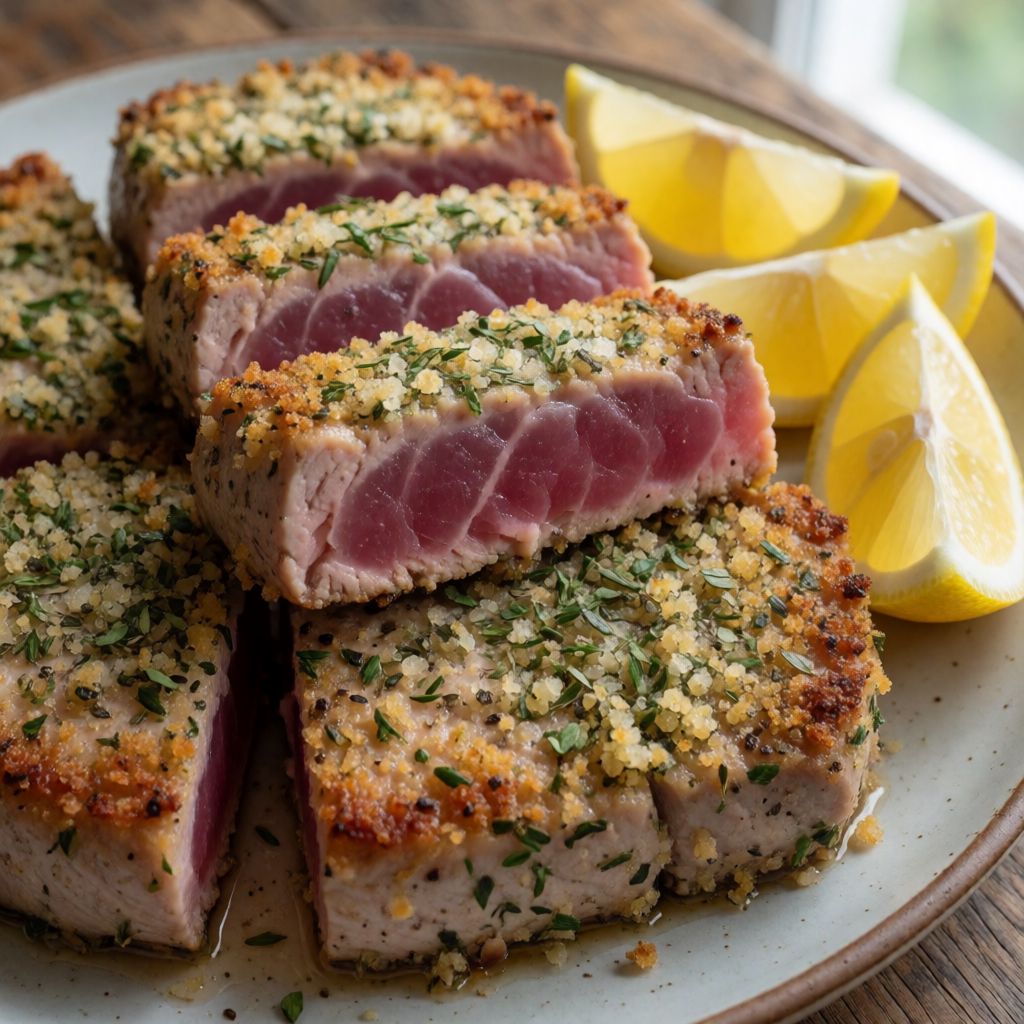
 AI photo
Tuna Steaks with Aromatic Herbs and Lemon
Herb-crusted tuna steaks finished with a bright lemon and parsley dressing.
Labels are worked out automatically from the ingredients and can be wrong. Check the packaging if it matters to you.
Ingredients
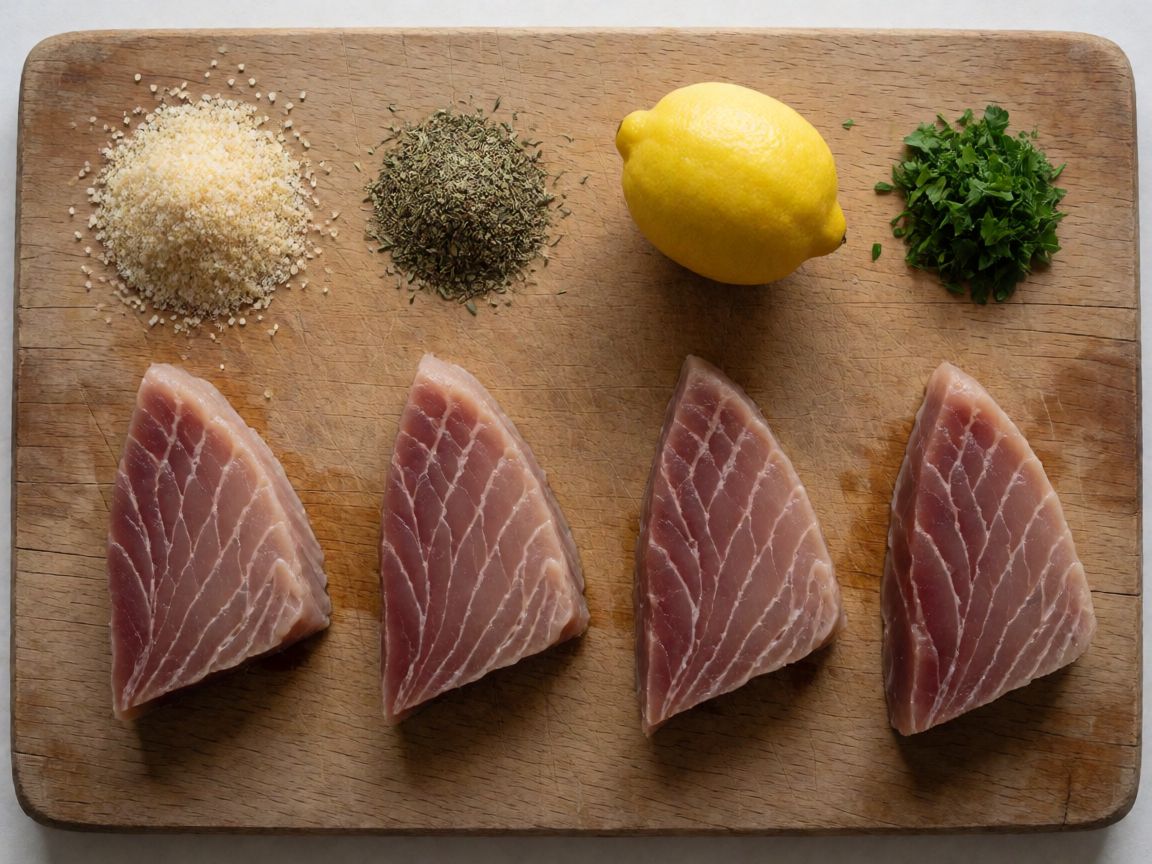
- 4 pcs Tuna steaks
- 3 tbsp Breadcrumbs dried
- 1 tbsp Mixed finely chopped herbs
- Salt to taste
- Black pepper to taste
- 1 pcs Lemon
- Olive oil to taste
- 1 tsp Parsley







Steps
Mix the breadcrumbs with the mixed finely chopped herbs, a pinch of salt and freshly ground black pepper.
3 minAdd the grated lemon zest.
1 minBrush the tuna steaks with olive oil, then coat on all sides in the flavoured breadcrumbs.
4 minHeat a griddle pan or frying pan.
2 minQuickly sear the tuna steaks on both sides until the internal temperature reaches 63°C.
4 minServe with a dressing of olive oil, lemon juice and parsley.
2 min
Four steaks, four people — one steak each, which already tells you this isn't a delicate fish dish, it's a steak dish that happens to be fish. Tuna is a big, fast, warm-blooded swimmer, and its muscle is built like beef, not like cod. That's the whole mechanism of this recipe: you treat tuna the way a butcher treats a sirloin, not the way a fishmonger treats a sole.
Some say a fish must be cooked through until it flakes apart, or it isn't safe, or it isn't proper. No — because tuna doesn't flake, it has no flakes to give. Push it to flaking and you've cooked it the way you'd ruin a fillet steak: grey, dry, sawdust in a crumb coat. The point of 63°C in the middle is that the protein has just set — enough to be food, not enough to be rope.
What decides whether this works is the crust, not the clock. You brush the steak in oil, roll it in dry crumbs mixed with zest and herbs, and sear it hot and fast. The crumb jacket is there to crisp before the heat has time to march through to the centre — that's the whole trick of searing anything thin and precious. If the pan isn't properly hot and dry when the steak goes in, the crumbs don't fry, they steam, and you get a damp beige coat instead of a crisp one. Same failure as a soggy breaded cutlet: not enough fierce, dry heat early on.
No probe thermometer needed if you don't own one. Press the centre of the steak with a finger the way you'd check a rare steak — it should give, softly, like the muscle at the base of your thumb when your hand is relaxed. Firm all the way through means you've gone past tuna into cardboard.
Tuna: buy the thickest steak the counter will cut you, a good two centimetres at least, because thin steaks give the heat no distance to travel and you'll overshoot the centre before the crust has even coloured. Pat it properly dry with paper before it goes anywhere near oil or crumb — a wet surface is the main reason a crust fails to grip and fails to crisp, since the oil you brush on has to bond with dry flesh, not fight a film of water first. If tuna isn't available or isn't worth the price that week, any other dense, meaty fish takes this treatment the same way — swordfish, a thick salmon loin — the rule is: it has to behave like a steak when you press it, not like a fillet that falls apart.
Breadcrumbs, and they must be dried, not fresh — this isn't fussiness, it's physics. Fresh crumbs carry their own moisture, and that moisture turns to steam the second it hits a hot pan, which softens exactly the thing you wanted crisp. Dried crumbs have nothing left to give off but starch, so they fry instead of steam. Three tablespoons is roughly 25 grams, enough to give four steaks a light jacket, not a breaded cutlet — this dish wants the fish to still be the fish. No dried crumbs in the cupboard? Panko works, crushed dry crackers work at a pinch, stale bread grated and left on a plate overnight works best of all, and that's really what this method is: an old, cheap way of using bread that's gone past its best, turned into a crust that both protects the fish and adds the one texture tuna doesn't have on its own.
Herbs, finely chopped, mixed — meaning soft ones: parsley, chives, a little tarragon or dill if you like it. These release their smell fast and need no cooking to do it, which suits a crust that's only in a hot pan for a couple of minutes. Leave the woody herbs — rosemary, thyme — out of this one, or use a pinch chopped very fine; they need slow heat to soften and give flavour, and here there's no slow heat on offer.
Lemon does two separate jobs and you shouldn't blur them. The zest goes into the crumb mix for its oil, which is fragrant without being sour — grate only the yellow, because the white pith underneath is bitter and will sulk in your crust. The juice is saved for the dressing, where its job is acid: tuna, like most oily fish, needs something sharp alongside it or it sits heavy. Olive oil for both the brushing and the dressing is a flavour choice, not a technical one — any oil with no strong smell of its own would crisp the crumbs just as well, but olive oil is what gives the dressing its backbone here, so don't swap it for something neutral unless you have to.
On a domestic hob you won't get the fierce, even heat of a restaurant griddle, and there's no point pretending otherwise. Compensate with patience: let the pan actually get hot and dry before the steak goes in — a pinch of breadcrumb dropped in should sizzle on contact, not sit there sweating. Don't crowd the pan, four steaks at once will cool it down and you're back to steaming instead of searing. And once they're out, let them rest a minute under an upturned plate, which does the same job a lid does on a pot — holds the heat in, lets the juices settle, without you needing any specialist kit for it. Patience here isn't a virtue, it's an ingredient — rush the sear and you get pale crumb; rush the rest and you lose what the sear earned you.