
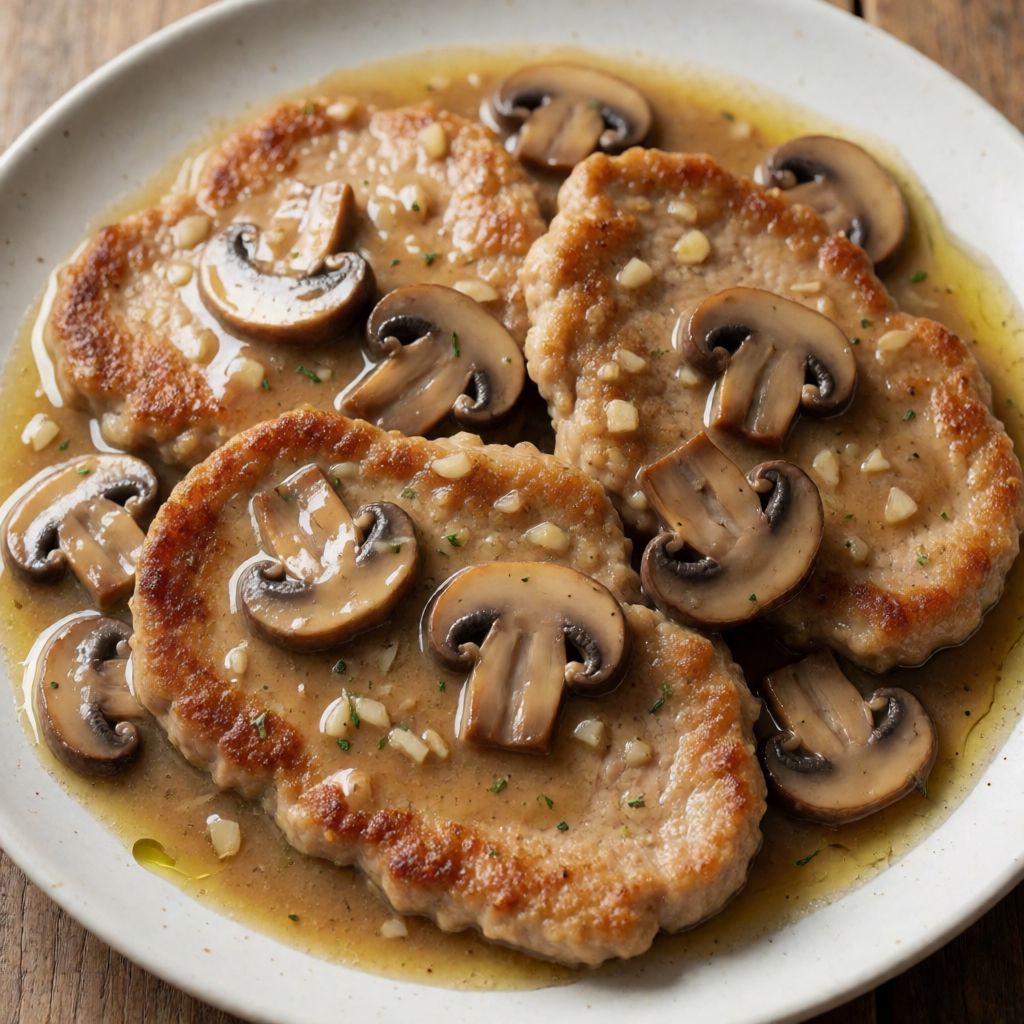
 AI photo
Veal Scaloppine with Mushrooms
Thin veal scaloppine, pan-fried until golden and served with buttery garlic mushrooms.
Labels are worked out automatically from the ingredients and can be wrong. Check the packaging if it matters to you.
Ingredients
- 8 pcs Veal thin slices, a few millimetres thick
- Plain Flour for dusting
- 50 g Butter
- 500 g Mushrooms fresh, a mushroom mix also works
- Olive Oil to taste
- 1 clove Garlic
- 1 bunch Parsley
- Salt to taste
- Black Pepper to taste







Steps
Clean the mushrooms and slice them. Add to a pan with olive oil and garlic, and fry over high heat.
Season the mushrooms with salt, add the parsley and set aside.
Pat the veal slices dry with a paper towel to remove excess moisture.
Coat the slices in flour on both sides, shaking off any excess.
Melt the butter in a pan and fry the floured veal on both sides over high heat until golden. Aim for an internal temperature of 63°C (medium).
Season with salt and pepper to taste.
Add the fried mushrooms to the veal, warm through over medium heat for a few minutes, and serve immediately.
This is not a stew, it's a sprint. Thin veal, hot pan, butter foaming — the whole cooked part of the dish is over before your tea's gone cold in the pot. It comes from trattoria economics: veal is the most expensive meat on the board, so you buy less of it and beat or cut it paper-thin, and thin meat cooks in under a minute. That's not a stylistic choice, it's arithmetic — thin slices mean you can charge for veal and still turn the table fast.
What decides whether it works is not seasoning, it's thickness and heat together. A few millimetres of veal in a properly hot pan is done through before the outside scorches. The same slice in a lukewarm pan sits there leaking moisture, going grey and tough, because it needs time instead of heat — and time is exactly what thin meat can't survive. So the pan has to be hot before the meat goes in, not warming up with the meat already sitting in it.
Drying the veal with paper towel before flouring isn't fussiness, it's the one step that stops the whole thing failing. Wet meat hitting a hot pan steams instead of browns — the water has to boil off first, and while it's doing that the pan temperature drops and the butter underneath starts to split and catch rather than foam. Flour on a dry surface does two jobs: it gives the butter something starchy to brown against, and it keeps the meat from drying out in the seconds it's over heat.
Veal for scaloppine wants to be from the leg — topside or silverside — lean, fine-grained, with no seams of connective tissue running through it, because that tissue doesn't have time to soften in sixty seconds of cooking; it just stays chewy. If your butcher doesn't do veal, a thin-cut pork escalope or turkey breast steak behaves the same way under the same rules — thin, lean, quick. What you can't really substitute is the speed: anything fattier or with more connective tissue needs long slow cooking, which is a different dish with a different name.
The flour is not seasoning, it's engineering. A light, even dusting (shake off the excess — a thick coat tastes raw and goes gummy) gives the surface starch to brown and a thin barrier that slows moisture loss while the outside colours. Plain flour does this fine; if you're avoiding gluten, a light dusting of fine rice flour or cornflour does near enough the same job, though it browns slightly differently and you'll want to watch it rather than go by a borrowed time.
Butter at 50g for four people is there for flavour, not for high-heat frying — butter's milk solids start to brown and then burn well before most oils smoke. Some cooks swap it out entirely for oil at this stage to dodge that, but then you lose the nutty flavour that makes this dish what it is. The working compromise, and the one worth using here, is butter with a splash of a neutral oil — any oil with no smell of its own, sunflower or light olive oil, not your good peppery extra virgin — which raises the point at which it starts to catch, so you get the flavour of butter without babysitting a pan that's about to blacken.
Mushrooms: a straight pack of chestnut or button from the supermarket is entirely honest here, but a mix with a few wild or dried-and-reconstituted ones in it adds a depth the pale cultivated ones don't have on their own. Clean them by wiping, not soaking — mushrooms are a sponge for water, and if you drown them before cooking you're undoing the whole point of frying them hot and dry.
The garlic clove is there to perfume the oil, not to be eaten in chunks — bruise it or slice it thick, let it colour gently in the oil before the mushrooms go in, and if it's turning dark brown rather than pale gold you've gone too far and it'll taste bitter, not toasty. Parsley goes in at the end, off any real heat, because its whole value is the green, grassy smell that a few minutes of cooking destroys — treat it the way you'd treat a teabag you've already got the colour out of: it's done its job, don't boil it further.
On the "medium" doneness — some say you can tell a steak or a scaloppine is ready by poking it and comparing to the fleshy bit of your palm. Don't trust that here: these slices are a few millimetres thick and done or overdone within ten seconds of each other, there's no slack for a guessing game. 63°C is a real number, not folklore — if you have a probe thermometer, use it; if you don't, go by sight: a faint blush of pink just visible at the very centre when you nick one slice with a knife, surrounded by meat that's gone fully opaque. And have the mushrooms, the plates and the people all ready before the veal goes in the pan — this dish has no second act, once it's cooked it wants to be eaten, not rested.