
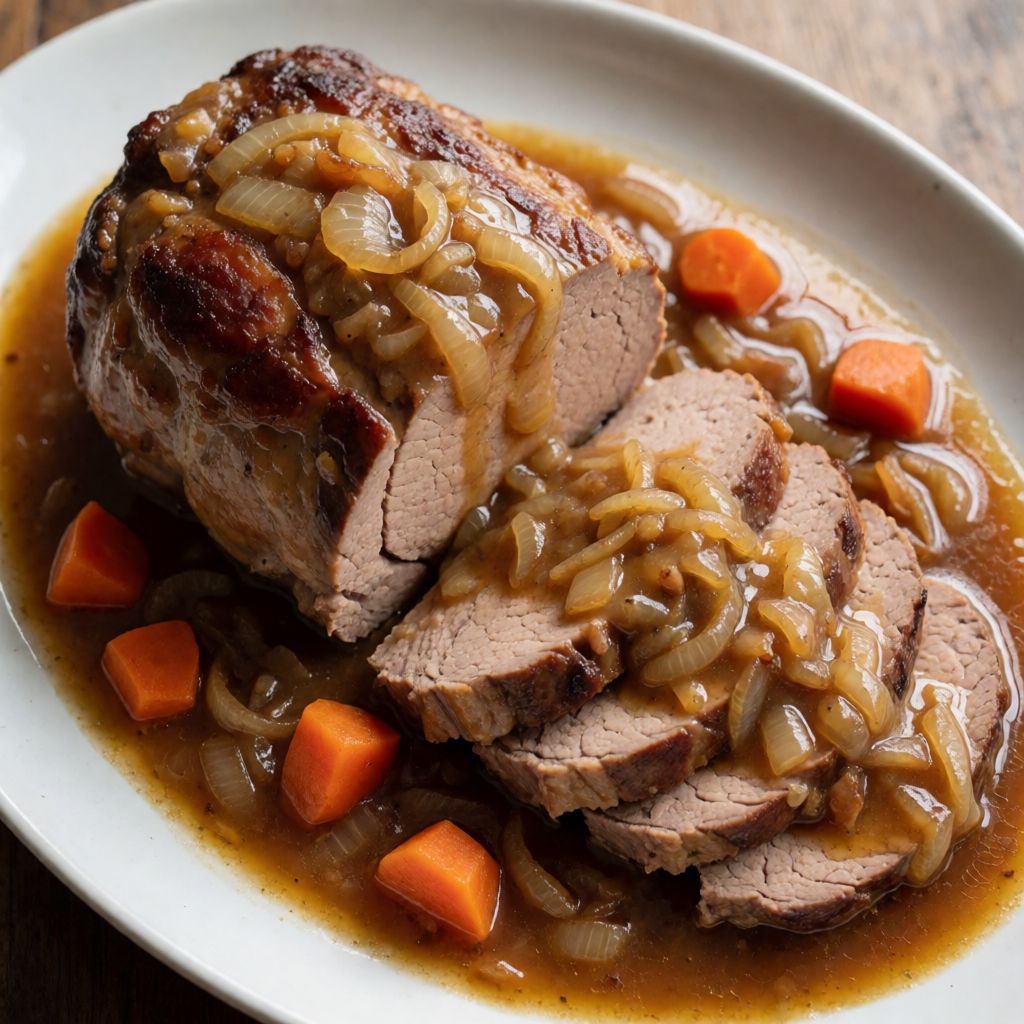
 AI photo
Veal Pot Roast
A classic veal pot roast with wine and vegetables, simmered slowly until tender.
Ingredients
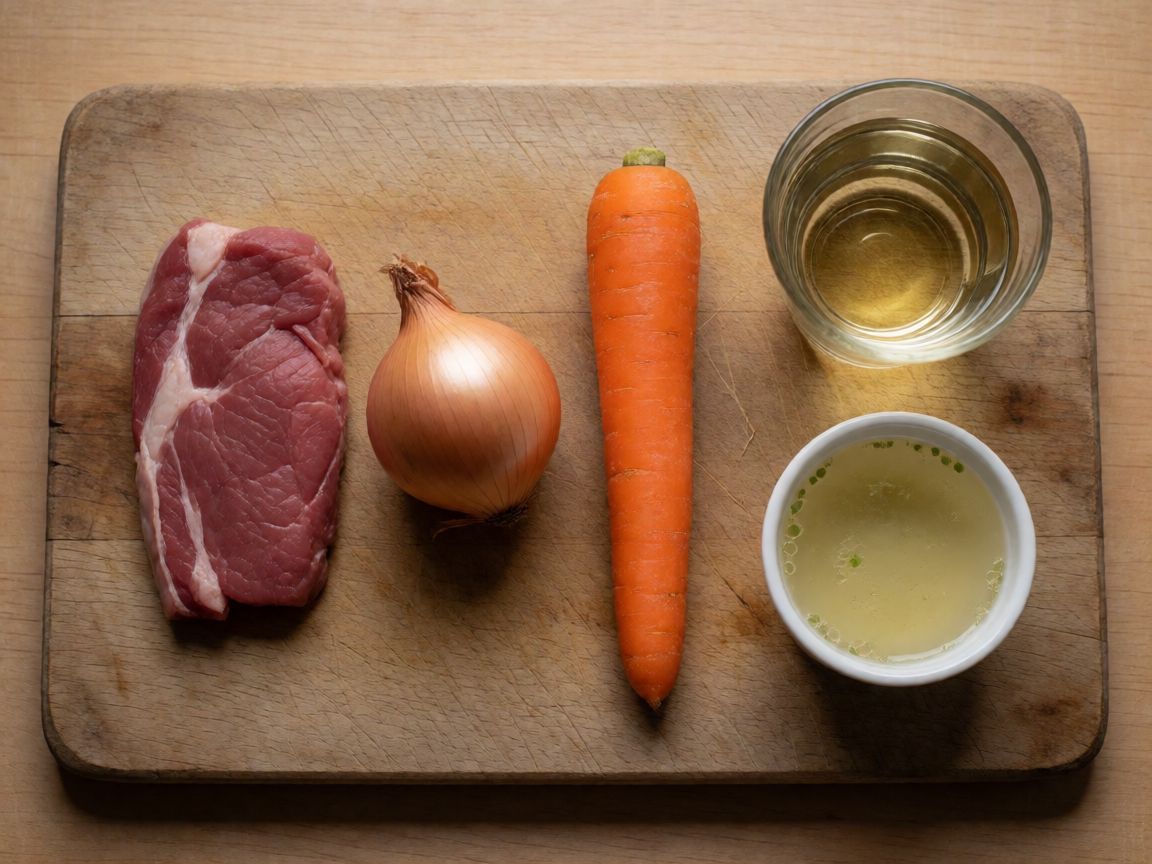
- 1 kg Veal leg or rump
- Olive oil for frying
- 1/2 pcs Onion
- 1 pcs Carrot
- 100 ml White wine
- Vegetable stock as needed
- Salt to taste







Steps
Finely dice the carrot and onion and fry them in the pot in olive oil until softened, then remove and set aside.
Brown the veal in the pot on all sides until lightly golden.
Pour in the white wine and let it evaporate completely.
Add the vegetables and the hot vegetable stock so that it covers about half of the roast.
Season with salt to taste, cover with a lid and bring to the boil.
Reduce the heat and simmer the roast gently for about 2 hours, turning occasionally.
120 minTransfer the roast to a board, remove the string and slice it.
Blend the remaining sauce from the pot with a hand blender to garnish the dish.
Serve immediately.
Despite the name, nothing here goes near an oven. "Pot roast" is a contradiction in English kitchen language on purpose — it's not the Sunday joint under dry heat, it's a leg or rump of veal braised low in liquid in a covered pot, which in Baku we'd just call what it is: a meat stewed whole. If you're picturing a joint going crisp and brown all the way through, forget that picture. The crust happens once, at the start, in minutes — after that the meat spends two hours getting wet, not dry.
The cut tells you everything. Leg and rump are the muscles that worked hardest in the animal's life — lots of connective tissue, not much fat marbled through. That tissue is collagen, and collagen is stubborn: push past about 70°C and hold it there for a long stretch, and it melts into gelatin, which is what makes the sliced meat soft and the sauce silky without a spoonful of flour. Push the same cut to a hard boil instead, hoping to save an hour, and the muscle fibres seize and squeeze dry before the collagen ever gets the chance to turn. That's the whole argument for "gentle," and it's not sentiment — it's chemistry refusing to be rushed.
Veal leg or rump, 1 kg for four people, is the right economy here, not a compromise. These are cheap cuts precisely because they're worked muscle with little fat — butchers have always priced meat by tenderness, not by flavour, and tenderness on a cheap cut is something you buy back with time instead of money. If veal isn't to hand, beef shin or topside behaves the same way under the same method; just expect beef to want a touch longer before the knife goes in without a fight. The string holding the joint together is doing one job: keeping a boneless roll from unravelling into loose meat over two hours of gentle movement in liquid. Take it off only once the roast is firm enough from cooking to hold its own shape on the board — cut it too early in the pot and you've made a stew by accident.
Onion and carrot, diced small and softened first, are the base — not decoration, not bulk. Cooked gently in oil before the meat goes anywhere near the pot, they release their sugars without browning hard, which is why they come out and wait rather than burning underneath the roast for two hours. At the end they go back in whole, cooked through twice over, soft enough that a hand blender turns them straight into body for the sauce — that's your thickener, no flour, no cream, just vegetable that's given up all its structure.
Olive oil is named here, but the actual requirement is any fat that can take the heat of a proper brown without complaining — rapeseed or sunflower oil do the job just as well and cost less, which matters if you're cooking veal weekly rather than for an occasion. Olive oil brings its own flavour at the start; if you'd rather the veal's own flavour carry the dish, use something with none.
White wine goes in after the browning specifically to be cooked off, not sipped alongside — simmered down to nothing, it leaves behind acidity and a little fruit, and that evaporation step also lifts the brown bits stuck to the bottom of the pot, which is where a good share of the dish's flavour was hiding. No wine in the house is not a crisis: a splash of dry vermouth does the same work, or water with a squeeze of lemon if you want the acid without the alcohol at all. Red wine would work too, but it pulls the sauce a shade heavier and darker than this dish is built for.
Stock should be hot going in — cold stock dropped onto a hot pot and hot meat does nothing for the dish and slows the whole braise down while everything re-equalises in temperature. Homemade is better only in the way homemade usually is; a good shop stock or even a cube dissolved properly will carry the vegetables and the meat's own juices just fine, since by the end you're blending it all together anyway and the vegetables do most of the talking.
On an ordinary hob, use the widest heavy pot you own with a lid that actually fits — not a deep narrow one, which crowds the roast and leaves too much of it standing dry above the liquid line no matter how you turn it. There's no kazan here and none needed; a decent casserole or stewpot that holds the joint snugly, lid on, low heat, is exactly the tool this recipe was always going to meet in a flat kitchen. And give it the two hours. There's no shortcut that doesn't just give you expensive, tough veal instead of cheap, soft veal — patience is the one ingredient on this list you can't buy more of at the shop.