
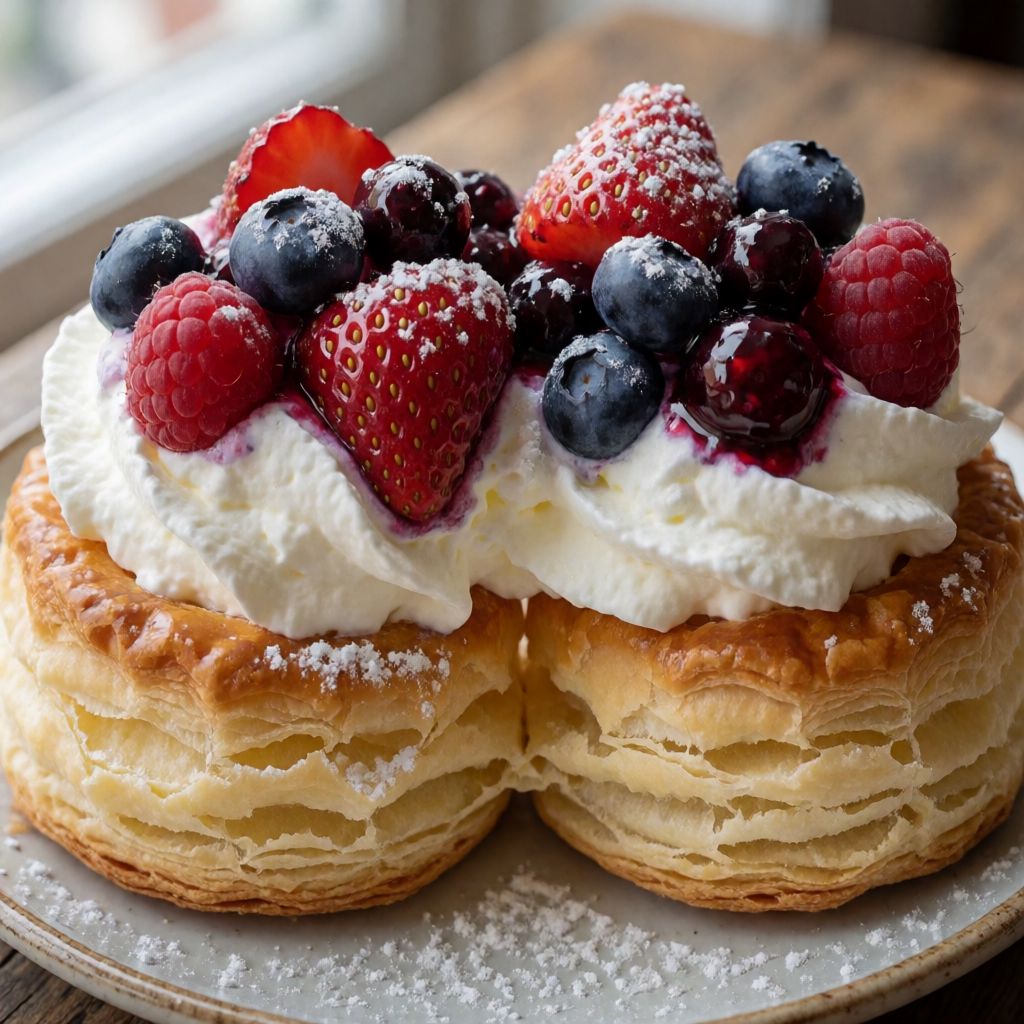
 AI photo
Sweet Vol-au-Vents
Delicate puff pastry vol-au-vents filled with whipped cream and topped with forest berries.
Labels are worked out automatically from the ingredients and can be wrong. Check the packaging if it matters to you.
Ingredients
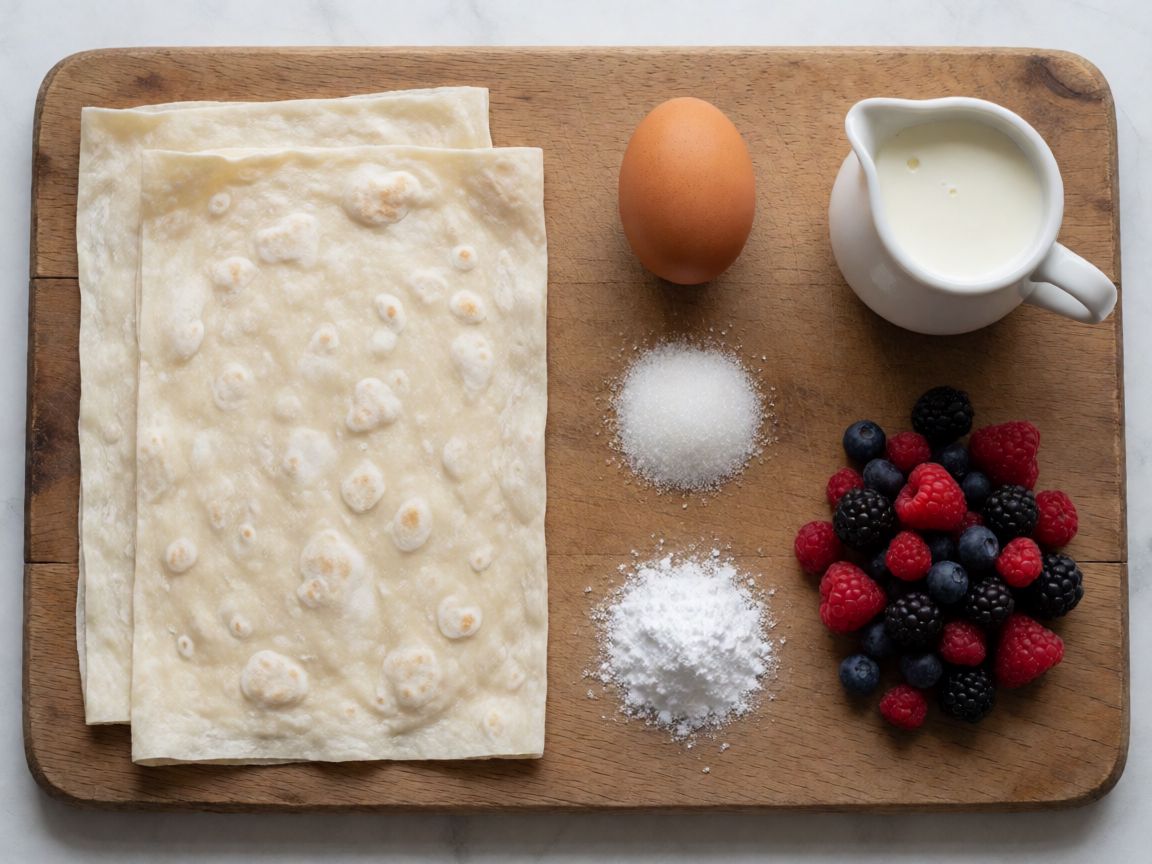
- 2 pcs Ready-rolled puff pastry sheets
- 1 pcs Egg
- Caster sugar to taste
- 200 ml Double cream for whipping
- 50 g Icing sugar
- Mixed forest berries to taste






Steps
Unroll the pastry and cut out 6 circles 5 cm in diameter using a round cutter.
Prick the circles well with a fork on both sides.
Cut the remaining pastry into 3 strips as tall as the diameter of the cutter and stack them on top of each other.
Press down with a rolling pin so the strips stick together well, then cut out another 6 circles.
Using a smaller 3.5 cm cutter, cut out the centres and place the rings on top of the bases.
Repeat with the second sheet of pastry.
Transfer the vol-au-vents, together with the baking paper, onto a baking tray.
Brush with beaten egg and sprinkle with sugar.
Bake in the oven at 180°C for about 25 minutes, until golden.
25 minWhip the cold double cream with the icing sugar while the vol-au-vents cool.
Transfer the cream to a piping bag fitted with a star nozzle and fill the pastries.
Decorate with forest berries, if you like.
Serve at once, or keep in the fridge.
A vol-au-vent is just a lid teaching itself to lift. Puff pastry rises because it's layers of dough and butter stacked like a book — in the oven the butter melts, the water in it turns to steam, and that steam has nowhere to go but up between the sheets. Stack more layers on the rim than on the base, and the rim puffs higher than the middle, leaving a little well. That's the whole trick of steps 3 to 5 — you're not decorating, you're building a wall taller than the floor so cream has somewhere to sit.
What decides whether this works is restraint with your hands and heat that doesn't argue with the pastry. Press the rolling pin hard enough that the stacked strips actually fuse — three loose layers of raw pastry will separate in the oven into three separate, sad biscuits instead of one tall ring. And prick the base well: without those fork holes, steam trapped underneath pushes the base up too, and you get a dome instead of a dish, with no room for cream.
Some say ready-rolled pastry can't give you proper height because it's "not real puff pastry." No — shop puff pastry is real butter-laminated dough, made by machines doing exactly what your hands would do with a rolling pin, just more evenly. The lift is the same chemistry. What it can't do is forgive you for handling it warm — the layers need to stay cold and distinct right up to the oven door, or they smear into each other and you lose the rise.
Two sheets of ready-rolled puff pastry are your whole architecture — base and ring both come out of the same dough, just arranged differently. Buy it cold and keep it cold; pastry that's gone soft at room temperature in a warm kitchen won't hold a crisp cut edge, and a blurred edge means the layers smear together instead of separating cleanly when they puff. If you're rolling your own, roll it thin and even — any lumps in thickness bake unevenly, thick parts staying pale and raw-tasting while thin parts burn.
The egg wash does two jobs, not one: it glues the sugar on, and it browns the surface through a reaction between its proteins and sugars under heat — which is also why you want it beaten, not just cracked and smeared, so it coats evenly rather than pooling in patches that scorch. Caster sugar sprinkled on top isn't for sweetness so much as for that faint shattering crunch on the lid — it's a textural contrast against the soft cream inside, so don't be shy with it, but don't bury the egg wash either or it won't brown properly underneath the sugar.
Double cream is the only cream that whips reliably to a stiff, pipeable peak — it has enough fat (around 48%) that the fat globules can trap air and hold their shape. Single cream or anything labelled "light" will not do this; it'll just go liquid and sulk in the bowl no matter how long you beat it. Cold cream whips faster and holds better than cream that's sat out — the fat needs to be firm to trap air, so take it straight from the fridge, and if your kitchen's warm, chill the bowl too. Icing sugar rather than caster here isn't fussiness — it dissolves instantly into the cream with no grit, where caster sugar can leave a faint sandiness because it hasn't fully melted by the time you've finished whipping.
Mixed forest berries are there for sharpness against all that sweet cream and sugared pastry — a dessert of pure sugar and fat gets tiring fast, and a raspberry or blackcurrant cuts through it. Use whatever's good and ripe; frozen berries work for flavour but bleed juice as they thaw and will make your cream weep pink, so if you use frozen, thaw and pat them dry first.
Patience matters twice here, not once. Let the baked pastry cool properly before you pipe — warm pastry melts the cream on contact and you get a soggy, collapsing mess instead of a crisp shell with cold cream sitting proud inside it. And don't fill them until close to serving if you can help it; cream sitting in pastry for hours softens the walls from the inside, the same way a sandwich left too long goes damp. If you must do it ahead, the fridge slows that down but doesn't stop it.