
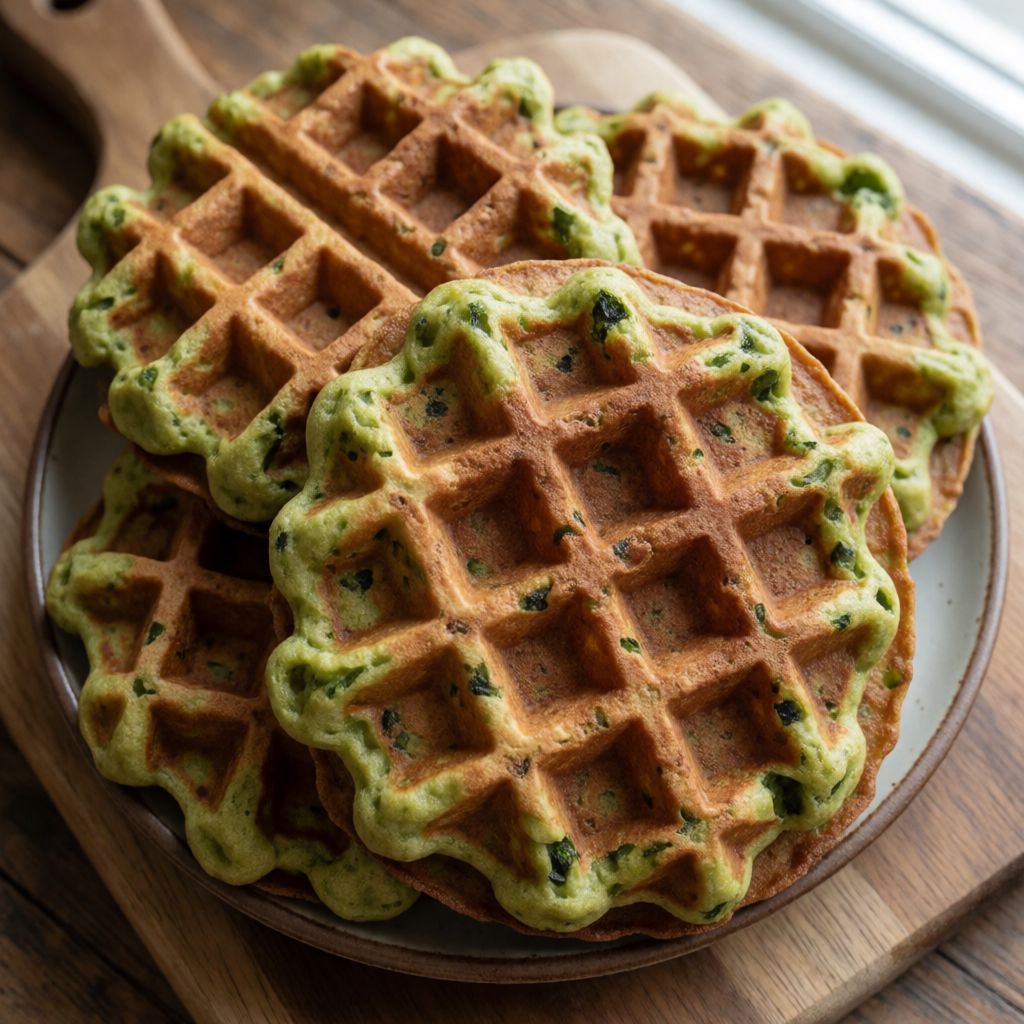
 AI photo
Kale Waffles
Savoury waffles made with kale, quick to mix and bake for breakfast or a snack.
Labels are worked out automatically from the ingredients and can be wrong. Check the packaging if it matters to you.
Ingredients
- 100 g Kale fresh or thawed
- 3 pcs Eggs
- 300 ml Milk
- 125 g Plain flour
- 50 g Wholemeal flour used instead of graham flour
- 1 tsp Baking powder
- 1 tbsp Butter for greasing the waffle iron
- Salt to taste
- Black pepper freshly ground









Steps
Put all the ingredients into a blender and blitz until you have a smooth, thin batter.
Let the batter rest in the fridge for 15–30 minutes before baking the waffles.
20 minMelt a little butter in the waffle maker and bake the waffles until golden and cooked through.
15 min
What was changed
We swapped Wholemeal flour for a flour that's easy to find in UK shops.
These aren't dessert waffles. There's no sugar in this batter, so what you're making is a savoury waffle — kale pulverised right into it until the whole thing is a thin, green batter, baked into a crisp lattice instead of fried into a pancake. Whether this works or not comes down to one decision you make at the blender, not at the iron.
The real work happens before the batter ever meets heat. Blend until it's genuinely smooth — not flecked, not stringy. A thread of kale stem left whole doesn't disappear in the iron; it either chars on the hot plate or jams in the hinge, and either way you taste a fibrous little rope instead of a vegetable. Fine puree means the kale gives you colour and a grassy edge of flavour, and gets out of the way texturally.
Some say raw kale has to be blanched first or it stays bitter. No — the bitterness in kale lives mostly in the big fibre strands and the raw cell walls; once you've shredded all of that into a liquid batter with egg, milk and flour, it's diluted and bound, and then it's cooked through anyway in the iron. Blanching here would just be an extra pan to wash for no gain — this dish is built on using what's in the fridge efficiently, not on ceremony.
The rest in the fridge is not a pause for your convenience, it's doing something: the flour needs time to actually absorb the liquid, and the baking powder needs quiet before it meets heat, or it fires off too early and you lose the lift. Skip it and you get a batter that bakes gummy in the middle no matter how golden the outside looks.
Kale: pull the leaf off the stem, or buy it ready-stripped — the stem is the one part a home blender won't fully break down, and it's what causes the stringy bits that spoil the fine texture you're after. Curly kale or cavolo nero both work; one's slightly sweeter, it won't change the mechanics. If you're using frozen kale that's thawed, squeeze it — thawing releases water that fresh kale doesn't carry, and extra water in this batter means a softer, less crisp waffle, because there's more moisture for the iron to drive off before it can brown anything.
Eggs: three for 300 ml of milk and 175 g of flour is a binding ratio, not a flavour one. The protein sets as it heats and holds the crumb together in a grid shape that would otherwise just run; blended in, they also carry a bit of air into the mix, which helps the waffle lift rather than sit flat and dense.
Milk: this is what turns a thick batter into a pourable one, and the milk sugars and proteins are part of why the outside browns rather than just drying pale. Use whole milk if you want the better crisp — the fat helps there. Any milk works as a substitute, dairy or not, as long as it isn't sweetened; you're after a neutral, slightly rich liquid, nothing more specific than that.
The two flours: plain flour gives you the gluten structure that holds the waffle's shape when it comes off the iron. Wholemeal stands in for graham flour here because graham — coarse-ground whole wheat, an American mill product — isn't something you'll find on an ordinary UK shelf. Wholemeal carries the same bran and germ, so you get the same nutty flavour and a slightly sturdier bite; it's ground a touch finer, which won't bother you in a batter this thin. Baking powder does the lifting a yeast dough would do slowly — it reacts once wet, once hot, and in a quick-baked waffle that's the only rising time you get, which is exactly why the rest before baking matters: it lets that first reaction happen calmly instead of racing the second one in the iron.
Butter for the iron: here you want butter specifically, not a neutral oil, because this is a savoury dish and that dairy fat is part of the flavour, frying the waffle's surface where it touches the plate as much as it's preventing sticking. If you're out of butter, any fat that can sit on a hot surface without smoking will do the releasing job — a flavourless oil, for instance — you'll just lose that last, small savoury note.
Salt and pepper go in raw, with everything else, because kale on its own is mild and needs seasoning built into the batter rather than sprinkled on after — by the time it's cooked, there's no fixing an underseasoned centre. Freshly ground pepper matters here for the same reason powdered, pre-ground pepper disappoints in any dish: the aromatic oils in a peppercorn fade fast once it's crushed, so pre-ground pepper is mostly just texture by the time it reaches you.
On your own hob you won't have a waffle iron with a dial telling you anything useful, so go by what you can see and smell: steam easing off, the lid lifting without resistance, the edges turning the colour of strong tea rather than pale bread. Fifteen minutes is the floor the recipe gives you, not the answer — a waffle iron running a touch cooler than another will simply take longer to get there, and that's fine. These keep well for a weekday breakfast too, which is no small thing if your kitchen's main job most weeks is turning out a Sunday roast and finding something useful to do with the kale that didn't make it onto the plate.