
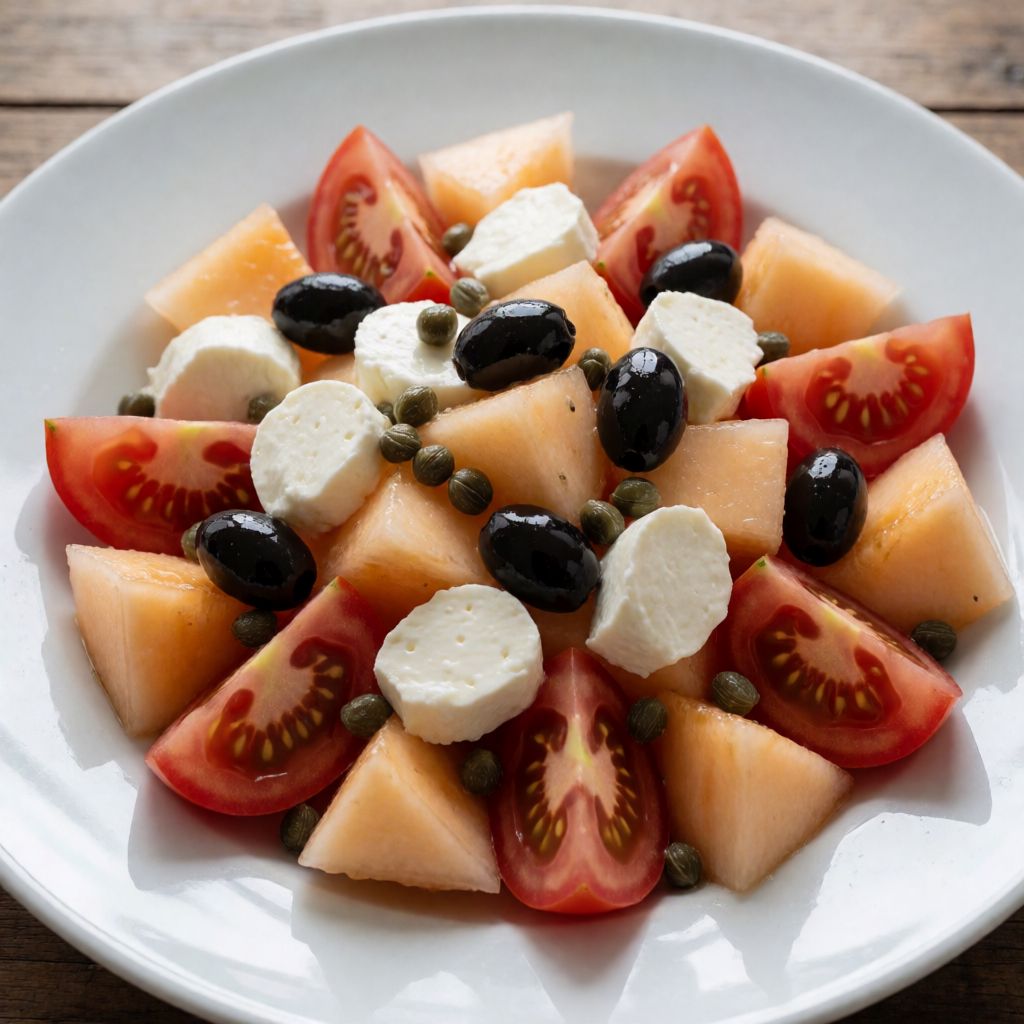
 AI photo
Melon Salad
A refreshing salad combining sweet melon, cherry tomatoes, mozzarella, olives and prosciutto.
Labels are worked out automatically from the ingredients and can be wrong. Check the packaging if it matters to you.
Ingredients
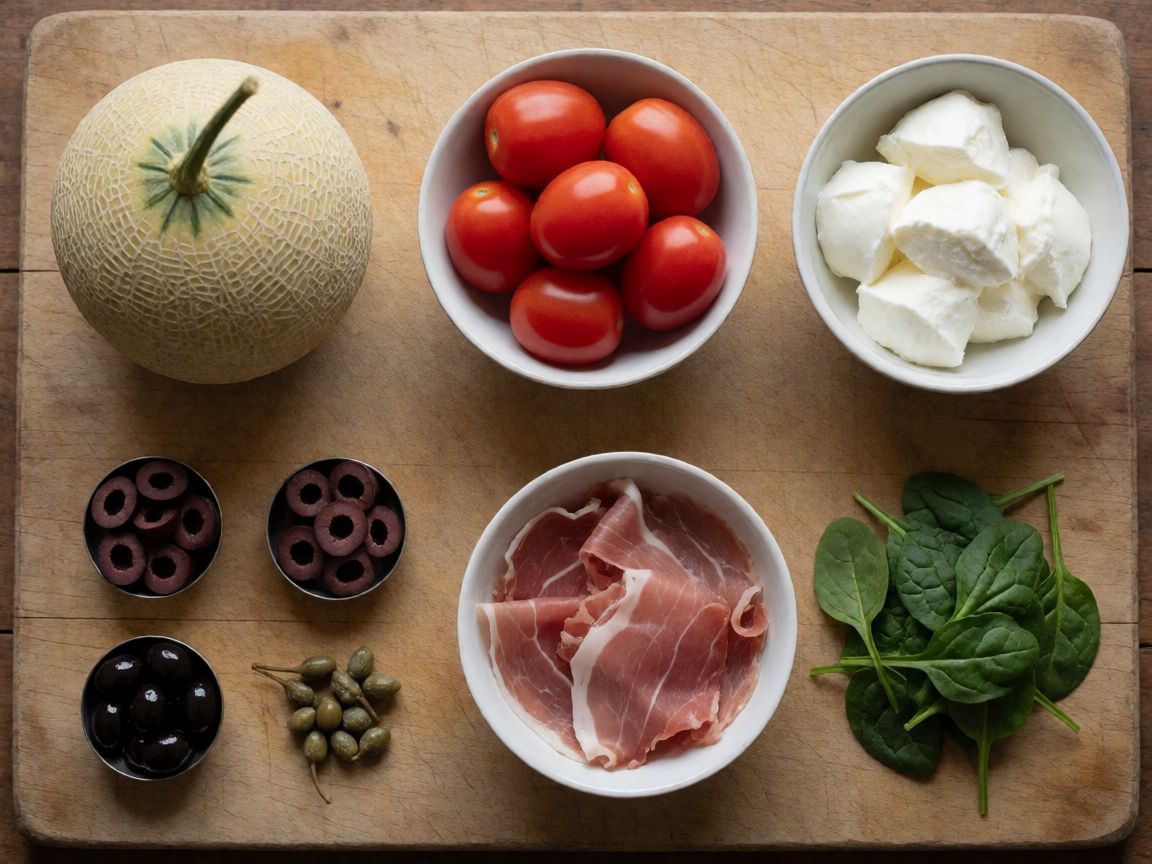
- 1 pcs Melon about 1.5 kg
- 320 g cherry tomatoes
- 300 g Mozzarella
- 2 tbsp green olives, pitted
- 2 tbsp Black olives or Taggiasca olives
- 8 pcs Capers optional
- 200 g Prosciutto
- 100 g Spinach
- 40 g Rocket
- Olive oil to taste
- Salt to taste
- Black pepper to taste








Steps
Wash the melon, cut it in half, remove the seeds and use a melon baller to scoop small balls from the flesh.
Wash the cherry tomatoes and cut them in half. If they are very small, you can leave some whole.
In a bowl, mix the melon balls, mozzarella, cherry tomatoes, olives and capers, then season with olive oil, salt and black pepper.
Shape the prosciutto slices into small roses and set them aside on a plate.
On a serving platter, lay down the spinach and rocket first, dressing with a little olive oil and salt.
Spoon the dressed melon mixture on top and finish with the prosciutto roses.
Serve the melon salad right away.
This isn't really a salad in the sense of lettuce-plus-dressing. It's a cold composition built on one trick: sweet melon flesh touching salty cured meat. That contrast is the whole dish. Everything else — the mozzarella, the olives, the capers — is there to add fat, brine and bite around that central friction. If the melon isn't properly ripe and sweet, the dish just falls apart into wet fruit and ham, with nothing holding the two ends together.
What decides whether it works is ripeness, not knife skill. You can't fix an unripe melon with salt or pepper afterwards — sugar doesn't develop once it's cut. Press the end opposite the stem gently; it should give slightly, like a ripe avocado's shoulder, and the stem end should smell of melon through the skin, not just look orange. If your melon is merely "fine", let it sit at room temperature a day or two before you cut it — cold fridge melon never tastes of anything, because cold numbs sweetness on the tongue, which is also why you shouldn't chill this dish hard before serving.
Some say you should salt the melon balls like you'd salt a tomato, to "bring out the juice." Don't — melon isn't tomato. Tomato has glutamate and acid that salt wakes up; melon's sweetness is fragile, and a hard salting just draws out water and dilutes flavour into a puddle at the bottom of your bowl. Season lightly, and season the leaves, not the fruit, if you want salt doing the work.
On the melon itself: it's the one ingredient with no real substitute, because this dish depends on genuine sweetness, not sugar added at the table. Cantaloupe or a ripe honeydew both work; watermelon is too wet and dilutes everything around it. One 1.5 kg melon gives you roughly four generous handfuls of balls once you discard rind and seeds — don't be alarmed at how much you lose, that's normal, melon is mostly water and air pockets.
The mozzarella should be the soft, water-packed kind — fior di latte or buffalo — never the drier block sold for grating on pizza. The whole point is that it yields when you bite it, releasing a little milky liquid that mixes with the olive oil and melon juice to make an accidental dressing. If you only have the dry block type, tear it smaller and expect a firmer, less creamy result — still edible, just a different texture, not a failure.
Prosciutto specifically, not "ham" in the British sense. Supermarket cooked ham is wet-cured and bland; what you want is air-dried and salty enough to argue with the melon, which is the entire mechanism of the dish. Parma or San Daniele prosciutto is sold pre-sliced in most UK supermarkets now — look for "prosciutto crudo" on the pack, not "prosciutto cotto," which is just cooked ham by another name. Serrano ham is a fair substitute if prosciutto isn't there; coppa or bresaola at a push, though bresaola is leaner and won't fold into roses as easily since it has no fat to hold its shape.
Cherry tomatoes bring acid, which the dish actually needs — melon and mozzarella are both mild and a touch fatty, so without the tomato's sharpness the whole plate tastes flat. Halving them matters less for looks than for juice: a halved tomato bleeds a little into the bowl and that juice is doing the same job the mozzarella's liquid does, loosening the dressing without you adding more oil than you need.
Olives and capers are the only aggressively salty, briny notes in the bowl besides the prosciutto, so use them with restraint — two tablespoons each of green and black olives is a guide, not a minimum. If you dislike capers, leave them out entirely as written; they're marked optional because their job (a sharp little vinegar hit) is already partly covered by the tomato's acidity.
Spinach and rocket form the bed, not a salad component you're meant to toss through everything — that's why you dress them separately, lightly, before the melon mixture goes on top. If you mixed everything together in one bowl, the raw leaves would wilt under the warm-ish melon and weep water onto your plate within minutes; kept as a base, they stay crisp a while longer and give you a bitter, peppery contrast under the sweetness. Baby spinach and wild rocket, roughly equal parts, is the standard here — if rocket isn't to hand, watercress does a similar peppery job, though it's sharper and you'll want slightly less of it.
On oil: use one with no flavour of its own strong enough to compete with the melon — a light olive oil, not an aggressive extra-virgin that tastes of itself. This is one of those dishes with zero cooking, so patience here isn't about waiting at the stove — it's about waiting for the melon to actually ripen before you start, and resisting the urge to assemble it hours ahead "to save time." Build it, dress it, eat it. Left standing, the salt pulls water from everything and you'll have a bowl of juice with sad lettuce at the bottom within the hour.